



A typical prepackaged sliced turkey breast has about 106 calories per 100 grams, or roughly 17 calories per 16-gram slice. That sounds simple, but slice count alone is unreliable, because one deli slice can be thin, thick, wet, smoked, or packed with added ingredients.
Table of Contents
- Why One Slice Is Never Just One Slice
- Calories per 100 g and per Slice Explained
- Why Two Brands Never Taste or Track the Same
- Plain Roasted vs Smoked vs Deli Sliced Turkey
- The Sodium Trade-Off Most Calorie Articles Miss
- How to Log Sliced Turkey Accurately Every Time
- Putting It All Together at the Sandwich Counter
Why One Slice Is Never Just One Slice
You're standing in front of the deli case, or maybe you're halfway through a sandwich and trying to log it fast. The label says turkey breast, the sandwich has “three slices,” and your app wants calories. The problem is that three slices isn't a real nutrition unit unless you know how much those slices weigh.
The same food name can hide very different portions
A thin slice from one brand can barely cover bread, while another brand's slice folds over itself and weighs much more. That's why the question “how many calories per slice?” leads people astray. A better question is, how many grams did I eat?
That shift matters because turkey breast sold in sandwich-friendly forms is usually a deli-style product, not plain roasted breast. The food may be sliced, smoked, prepackaged, or adjusted with water and curing ingredients, and those details change the calorie count along with the sodium load reference benchmark. For people logging lunch, the difference between “one slice” and “one slice of this brand” can be the difference between a decent estimate and a misleading one.
Practical rule: if you can weigh it, weigh it. If you can't, estimate grams first, then convert to calories.
That's the mindset that makes turkey easier to track at home, at a deli counter, or from a package. It also makes photo-based logging more accurate, because the app has something concrete to work with instead of a vague slice count.
Calories per 100 g and per Slice Explained
A slice count can mislead you, but grams give you something solid to log. For prepackaged sliced turkey breast, a useful reference point is about 106 calories per 100 grams, or roughly 1.06 calories per gram reference benchmark. Once you have the weight, the calorie estimate is simple: multiply grams by 1.06.
A simple way to think about the math
A 16-gram slice works out to about 17 calories. A 56-gram portion lands around 59 to 62 calories, depending on the exact product formulation. The same reference food also reports about 14.8 grams of protein, 3.8 grams of fat, and 2.2 grams of carbohydrate per 100 grams.
Start with the weight, then convert it to calories.
- Find the weight in grams.
- Multiply by 1.06 for a rough calorie estimate.
- Use the package label if it gives a serving size.
Best logging habit: stop counting slices first, and start asking what those slices weigh.
| Portion Weight | Approx. Calories | Protein | Fat | Carbs |
|---|---|---|---|---|
| 16 g | 17 | about 2.4 g | about 0.6 g | about 0.4 g |
| 28 g | 30 | about 4.1 g | about 1.1 g | about 0.6 g |
| 56 g | 59 to 62 | about 8.3 g | about 2.1 g | about 1.2 g |
For photo-based logging or barcode entries, grams are the anchor. A slice count is just a rough shortcut, while a weighed portion gives the app a number it can use without guessing. That same logic is used in practical logging guidance on Calorie Genie's blog, where weight-based entries are easier to trust than “a few slices.”
Why Two Brands Never Taste or Track the Same
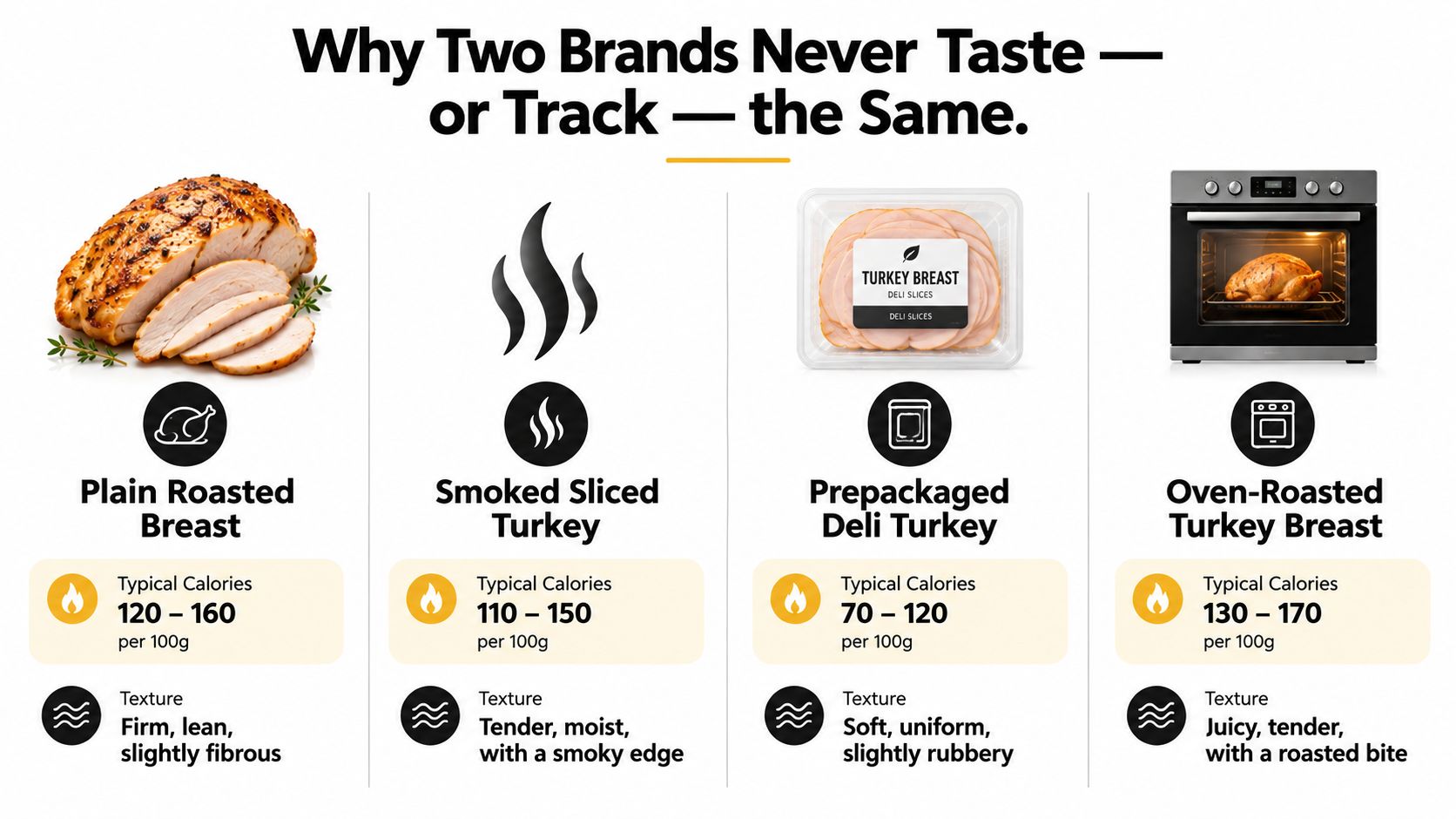
A package can say turkey breast on the front and still give you a very different food in the bowl or on the sandwich. One brand may taste mild and dry, another saltier and firmer, and the tracker may assign them different calorie values even when the slice count looks the same.
The reason is simple. Turkey breast products are shaped by moisture, curing, seasoning, and how thinly they are sliced. Those changes affect both the eating experience and the weight you should log.
What changes between products
A USDA food-service product sheet gives one useful benchmark, 43 calories per 40 grams, along with 8 grams of protein, 1 gram of fat, 1 gram of carbohydrate, and 214 mg of sodium reference benchmark. That benchmark shows why two turkey products can land in a similar calorie range while still behaving differently in a meal.
A smoked sliced turkey example can also sit in a slightly different place nutritionally, with 45 calories per 42-gram serving and 9 grams of protein. That is one reason smoked slices may taste richer even when the calorie number stays close.
The biggest differences usually come from:
- Added water: more moisture changes the edible weight, so slice count becomes a shaky guide.
- Curing or seasoning: salt, smoke, and flavoring can raise sodium fast.
- Slice thickness: thin folds and thick slabs do not weigh the same.
- Brand formulation: two labels with the same front name can still be different products.
The front label can hide the useful details
The front of the package often highlights words like “lean” or “roasted,” but the back label tells you what matters for logging. A photo may show neat slices, yet the actual weight could be far from what your eye guesses. That is why slice count is the wrong first question.
Start with grams. If the package lists a serving size, use that. If not, weigh the turkey and log the weight, because the tracker can work from a number that is tied to the food itself instead of a rough visual estimate.
Plain Roasted vs Smoked vs Deli Sliced Turkey
A shopper who asks only about calories per slice can miss the difference between turkey products. The better question is what kind of turkey is on the label, because plain roasted, smoked, and deli sliced products behave differently in both cooking and logging.
Plain roasted turkey breast is usually the cleanest reference point. USDA-linked data for roasted turkey breast meat-only sits around 136 calories and 114 mg of sodium per 100 grams reference benchmark, which gives you a baseline for comparing packaged slices. That number belongs to cooked meat, not a cured deli item.
Smoked sliced turkey often tastes richer because curing and smoke change the product before it reaches the package. A USDA food-service smoked product listed at 45 calories per 42 grams shows how a low calorie count can still come from a different style of turkey, with a different flavor and salt pattern.
Prepackaged sliced turkey breast usually sits between those two in everyday use. A benchmark of about 106 to 110 calories per 100 grams makes it practical for sandwiches and wraps reference benchmark. The name may still say turkey breast, but the form is more processed than a plain roasted portion.
Side-by-side, the label tells you more than the word turkey
- Plain roasted breast: closest to a cooked meat reference, often the simplest ingredient list.
- Smoked sliced turkey: stronger flavor, with curing that can shift the nutrition profile.
- Prepackaged deli turkey: convenient for sandwiches, and more likely to include added water and salt.
- Low-sodium or specialty versions: can change sodium more than calories.
A thin slice from one package can weigh very differently from a slice in another. That is why grams work better than slice counts, and why “turkey breast” by itself is too broad for accurate logging.
The Sodium Trade-Off Most Calorie Articles Miss
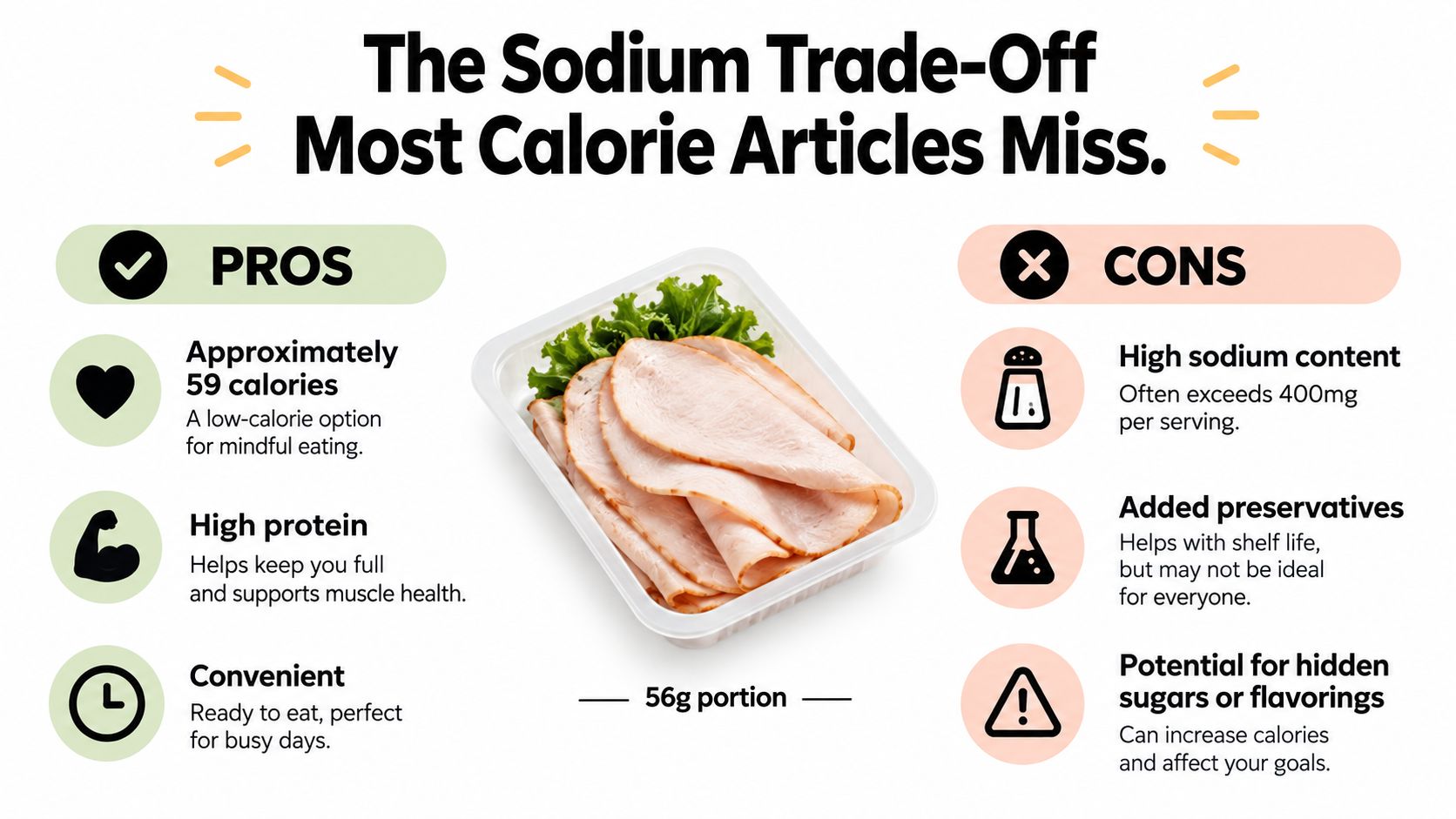
A small serving of sliced turkey can look harmless on a label, yet sodium changes the picture fast. A 56-gram portion can come in at around 59 calories, and a similar portion may carry roughly 503 mg of sodium. That jump is easy to miss if you only check calories.
The math helps make it clear. A USDA vendor label lists 43 calories and 214 mg sodium in 40 grams reference benchmark. Scaled to 56 grams, that works out to roughly 503 mg sodium. The calories stay modest while the salt rises quickly.
That matters once turkey becomes part of a full meal. Cheese, bread, sauces, pickles, and mustard can push a sandwich much higher in sodium than the turkey alone suggests. The turkey may still be the leanest item on the plate, but the sandwich can still be salt-heavy.
What to check before you call it a good choice
- Calories: useful, but only one part of the label.
- Sodium: often the number that changes how the food fits your day.
- Ingredients: added water, curing agents, and flavorings can change the product.
- Meal context: the rest of the sandwich can add more salt than the turkey.
A plain roasted version usually keeps sodium lower than deli slices, while processed versions are more convenient and often less simple nutritionally. If sodium matters to you, the front label alone will not answer the question.
How to Log Sliced Turkey Accurately Every Time
The best way to log turkey is boring, and that's a good thing. Use grams when you can, use the package label when it's clear, and treat slice counts as a backup only. That approach works whether the turkey comes from the fridge, the deli case, a restaurant plate, or a lunchbox.
Match the logging method to the situation
- Prepackaged turkey: scan the barcode, then confirm the serving grams on the label.
- Deli-counter turkey: ask for the weight, or weigh it at home if you already bought it.
- Restaurant turkey: estimate the portion visually, then choose a generic cooked or deli-style entry as a rough stand-in.
- Leftovers on a plate: compare what's left to what was served, then log the edible grams.
If you use a camera-based logger, the picture helps most when the portion is visible and the slices aren't hidden under bread or sauce. Calorie Genie AI can read a meal photo and estimate calories and macros, and it also scans barcodes and package labels, which makes it useful for packaged turkey and sandwich logging. For deli portions, though, it still helps to confirm the grams so the estimate doesn't drift.
Reliable workflow: photo first for convenience, grams first for accuracy.
A few habits make this much easier
- Set a personal slice weight: once you know your usual brand, keep that number for next time.
- Use the serving size on the package: it beats guessing from a pile of slices.
- Treat database entries as estimates: the label for your exact product is usually better.
If you've ever logged “three slices” and wondered why the number felt off, this is the fix. Weighing the food removes the guesswork and gives your tracker a real number to work with. Calorie Genie support is the place to check if you want help using photo or barcode logging for packaged foods like sliced turkey.
Putting It All Together at the Sandwich Counter
At the sandwich counter, “how many calories per slice?” is the wrong question. The useful question is how much the turkey weighs. Once you have grams, about 1.06 calories per gram is a practical shortcut for prepackaged sliced turkey breast. A slice can be a flimsy ribbon or a folded stack, so slice count alone can send your log off course.
Three everyday examples
Three thin slices at about 14 g each come to roughly 42 g, or about 45 calories. The same three slices, if they are thicker and closer to 28 g each, land near 84 g, or about 89 calories. That is the difference between a light snack and a much larger portion, even though the count looks identical.
A deli-counter turkey wrap can be even harder to judge because the slices are cut to order and often folded into a tight pile. Ask for the weight if the shop gives it, or weigh it later if you brought it home. A portion that looks modest can still be a heavier entry once the folds are opened up.
A packaged turkey snack pack is the easiest case. Read the label, scan the barcode if it is available, and confirm the serving grams before you save the entry. That keeps your log tied to the food you ate, not a loose database match.
The rule that keeps working
- Start with grams.
- Use the package label when you have it.
- Watch sodium as well as calories.
- Use slice count only when nothing better is available.
If you want a faster way to handle turkey sandwiches, deli portions, and lunch leftovers, Calorie Genie AI can estimate calories and macros from a meal photo, scan barcodes, and help you log packaged foods without digging through databases.
Weighing the food removes the guesswork and gives your tracker a real number to work with. That turns sliced turkey from a fuzzy estimate into a quick, repeatable logging task.