Free tool
Calorie calculator: how many calories should I eat a day?
Use this free calorie calculator to find out how many calories you should eat a day to maintain, lose or gain weight. Enter your age, height, weight and activity level in metric or imperial units and the maths is explained underneath, no sign-up needed.

The maths
How the calorie calculator works
First it estimates your resting energy: the calories your body uses in a day doing nothing at all. The calculator uses the Mifflin-St Jeor equation, which research has found to be the most reliable of the common formulas for healthy adults. For men it is 10 × weight (kg) + 6.25 × height (cm) − 5 × age + 5; for women the last term is −161.
Then it multiplies by an activity factor, from 1.2 for a desk job with little exercise to 1.9 for a physical job plus daily training. The result is your maintenance calories: eat about this much and your weight stays roughly where it is.
Losing weight means eating below that number. A deficit of around 500 kcal a day works out at roughly half a kilogram (about 1 lb) a week, which is inside the 0.5 to 1 kg a week the NHS describes as a safe rate. Gaining means eating above it, and a modest surplus keeps more of the gain as muscle.

What the number can and cannot tell you
It is a starting point
Two people with the same stats can differ by a few hundred calories. Use the figure for two or three weeks, watch your weigh-ins, and adjust by 100 to 200 kcal if the trend is not what you expected.
Activity is the usual over-estimate
Most people pick a level too high. If you sit for work and train three times a week, you are lightly active, not very active. When in doubt, choose the lower option.
Not for everyone
The formula is for healthy adults. Under 18, pregnant or breastfeeding, managing a medical condition, or with a history of disordered eating: talk to a GP or dietitian rather than a calculator.
Next step
Hitting the number without weighing everything
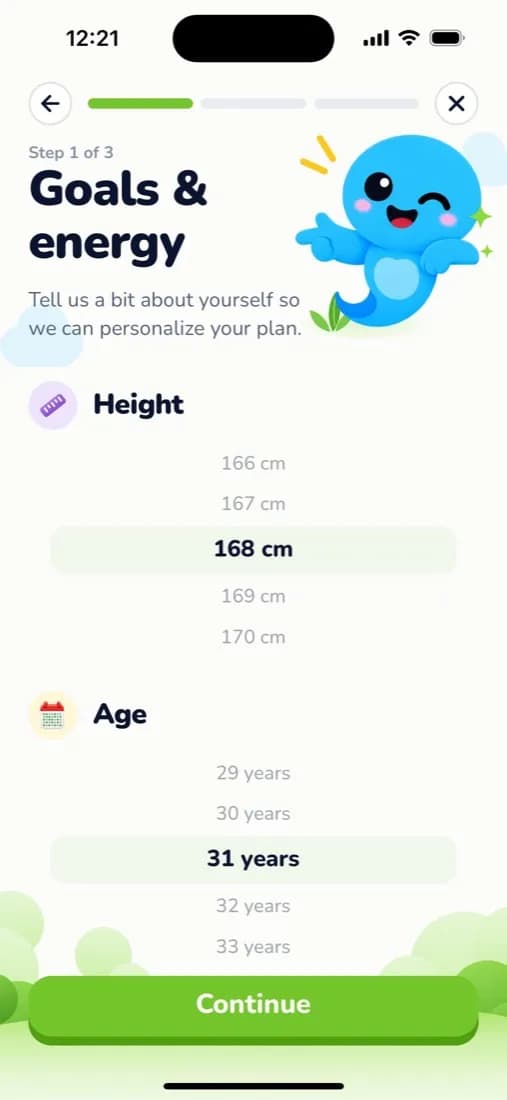
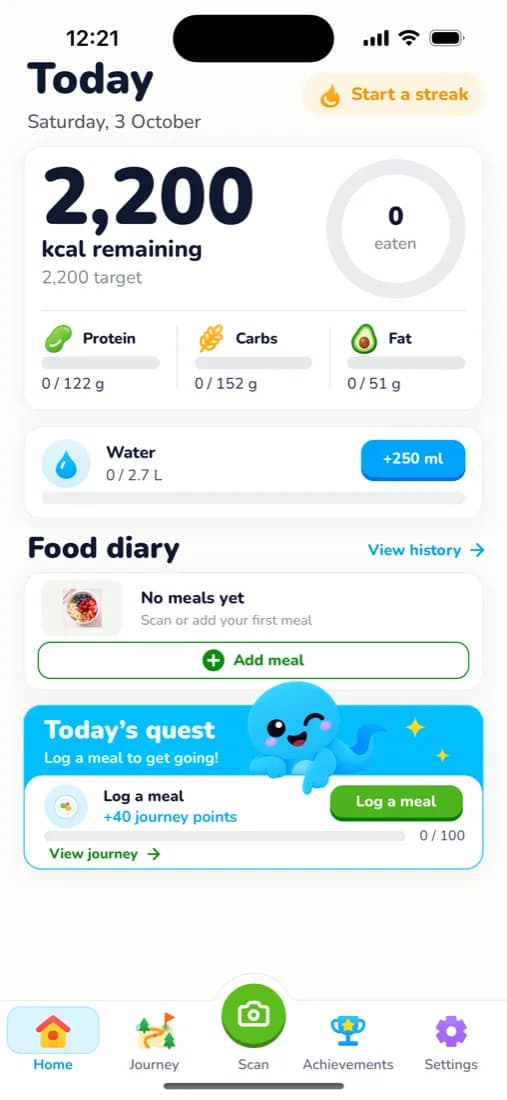
Knowing your target is the easy half. Calorie Genie sets it for you during setup from the same inputs, then counts each meal against it from a photo: the AI calorie counter estimates calories and macros from a picture of the plate, and the food diary keeps the running total alongside water and weigh-ins. Comparing apps? See how it stacks up against MyFitnessPal and five others.
Calorie questions, answered
- How many calories should I eat a day?
- It depends on your size, age, sex and how active you are. The calculator above estimates your maintenance calories with the Mifflin-St Jeor equation and an activity factor. As a rough reference the NHS uses 2,000 kcal a day for women and 2,500 kcal for men, but a small, sedentary woman may maintain on far less and a tall, active man on far more.
- How do you count calories?
- Work out your daily target, then log everything you eat and drink against it. Traditionally that means weighing food and looking each item up in a database. A photo-based app such as Calorie Genie does the lookup for you: you photograph the plate, it estimates each ingredient and portion, and you correct anything that looks off before saving. Packaged food is scanned by barcode so the numbers come from the label.
- Does calorie counting work?
- For most people, yes, because it makes the gap between what you think you eat and what you actually eat visible. The usual reasons it fails are that logging is too slow to keep up, portions are guessed, and drinks and snacks are skipped. Anything that makes logging faster and more honest, including photographing meals rather than typing them, improves the odds.
- Do liquid calories count?
- Yes. Lattes, juice, smoothies, fizzy drinks and milk in tea all count exactly like food, and they are the calories people forget most often. Log drinks the same way as meals; Calorie Genie can scan a drink or its barcode.
- Do alcohol calories count?
- Yes. Alcohol has about 7 kcal per gram, nearly as much as fat, before any mixer or sugar is added. A pint of beer or a large glass of wine is often 200 kcal or more. Count it within your daily total like anything else.
Keep exploring
- AI calorie counter →How the photo scan turns a plate into calories, protein, carbs and fat.
- Food diary app →The daily log, one-tap water, weigh-ins and 90 days of history.
- MyFitnessPal alternatives →Seven apps compared on scanning, free tiers, UK food data and price.
- Calorie and macro guides →Practical articles on calories, protein and healthy eating.
Free on iOS and Android
Turn the number into a habit
Download Calorie Genie, set your target in a minute and log your next meal with one photo.