


There's no single calorie number that fits everyone, but broad maintenance benchmarks are about 2,000 calories a day for adult women and 2,500 for adult men. Your own needs depend on your body and routine, so the useful next step is to estimate a starting point and test it against how you feel and how your weight trends.
Maybe you've typed “how many calories do I need a day?” into a search bar and found one calculator that says one thing and another that gives you a different answer. That doesn't mean you've missed a magic formula. It means calorie needs are estimates, and the most helpful number is the one that fits your life.
Table of Contents
- Why Daily Calories Are Not One Number for Everyone
- Calculating Your BMR with the Mifflin-St Jeor Equation
- Choosing the Right Activity Multiplier
- Setting a Target for Your Specific Goal
- Testing Your Number with a Two to Four Week Check-In
- Why You Should Not Eat Back Every Exercise Calorie
- Putting It All Together with Calorie Genie
Why Daily Calories Are Not One Number for Everyone
A 24-year-old nurse on her feet all shift and a 52-year-old analyst at a desk all day can weigh exactly the same and still need very different amounts of fuel. Calorie needs work more like shoe sizes than speed limits: a general range exists, and the right fit still depends on the person.
Your body spends energy even at complete rest, keeping your heart beating, lungs working, and temperature steady. Basal metabolic rate (BMR) estimates that baseline cost. Total daily energy expenditure (TDEE) adds movement and digestion on top, which makes it the more useful figure for planning actual meals, since resting needs alone undercount a real day.
The NHS calorie-counting guidance echoes those same maintenance benchmarks while noting that individual needs vary. U.S. guidance places many adults within a wider band, roughly 1,600 to 3,000 calories a day depending on age, sex, and activity, as summarized in the Dietary Guidelines for Americans.
The National Heart, Lung, and Blood Institute's estimates show how quickly needs shift once age and activity enter the picture:
| Age and sex | Sedentary | Moderately active | Active |
|---|---|---|---|
| Women, ages 19–30 | 2,000 | 2,000–2,200 | 2,400 |
| Women, ages 31–50 | 1,800 | 2,000 | 2,200 |
| Women, age 51 and older | 1,600 | 1,800 | 2,000–2,200 |
| Men, ages 19–30 | 2,400 | 2,600–2,800 | 3,000 |
| Men, ages 31–50 | 2,200 | 2,400–2,600 | 2,800–3,000 |
| Men, age 51 and older | 2,000 | 2,200–2,400 | 2,400–2,800 |
These are population averages meant to describe energy balance, not personal prescriptions. Body size, muscle mass, health, pregnancy, and daily movement can push someone's needs in either direction, which is why two people in the same row can still land on different numbers. A calculator can fold some of those details into a starting estimate, but it can't see how your body responds over time. The honest check comes from watching your own weight, hunger, and energy for a few weeks, so treat the result as a hypothesis to test rather than a verdict.
Calculating Your BMR with the Mifflin-St Jeor Equation
The Mifflin-St Jeor equation estimates resting energy using your weight, height, age, and sex. Weight contributes most directly, height adds another part of the estimate, and age subtracts from it. It's a practical calculation, but it still predicts rather than measures your energy use.

Work through the equation
Use kilograms for weight, centimeters for height, and years for age:
- For men: BMR = 10 × weight in kg + 6.25 × height in cm − 5 × age + 5
- For women: BMR = 10 × weight in kg + 6.25 × height in cm − 5 × age − 161
For example, take a 32-year-old woman who weighs 68 kg and is 165 cm tall:
- 10 × 68 = 680
- 6.25 × 165 = 1,031.25
- 5 × 32 = 160
- 680 + 1,031.25 − 160 − 161 = about 1,390 calories per day
That estimate represents resting energy, not the amount she should automatically eat each day. Daily movement and exercise still need to be considered.
For a 32-year-old man with the same height and weight, the calculation is 680 + 1,031.25 − 160 + 5, or about 1,556 calories per day. The formula's final adjustment differs, which is why the estimates differ even when the other inputs match.
A research summary of the equation reported that estimates were within 10% of measured resting energy for 70% of men and 62% of women in one young-adult study, with overestimates also occurring (Mifflin-St Jeor equation review). That makes the equation a useful starting point, not a precise reading of your metabolism.
Choosing the Right Activity Multiplier
Two people can share the exact same BMR and need wildly different amounts of food. A delivery driver walking eight hours a day burns far more than a programmer who hits the same gym twice a week. Your BMR only covers the resting part of that picture, so the next step is to multiply it by an activity factor that matches your actual week.
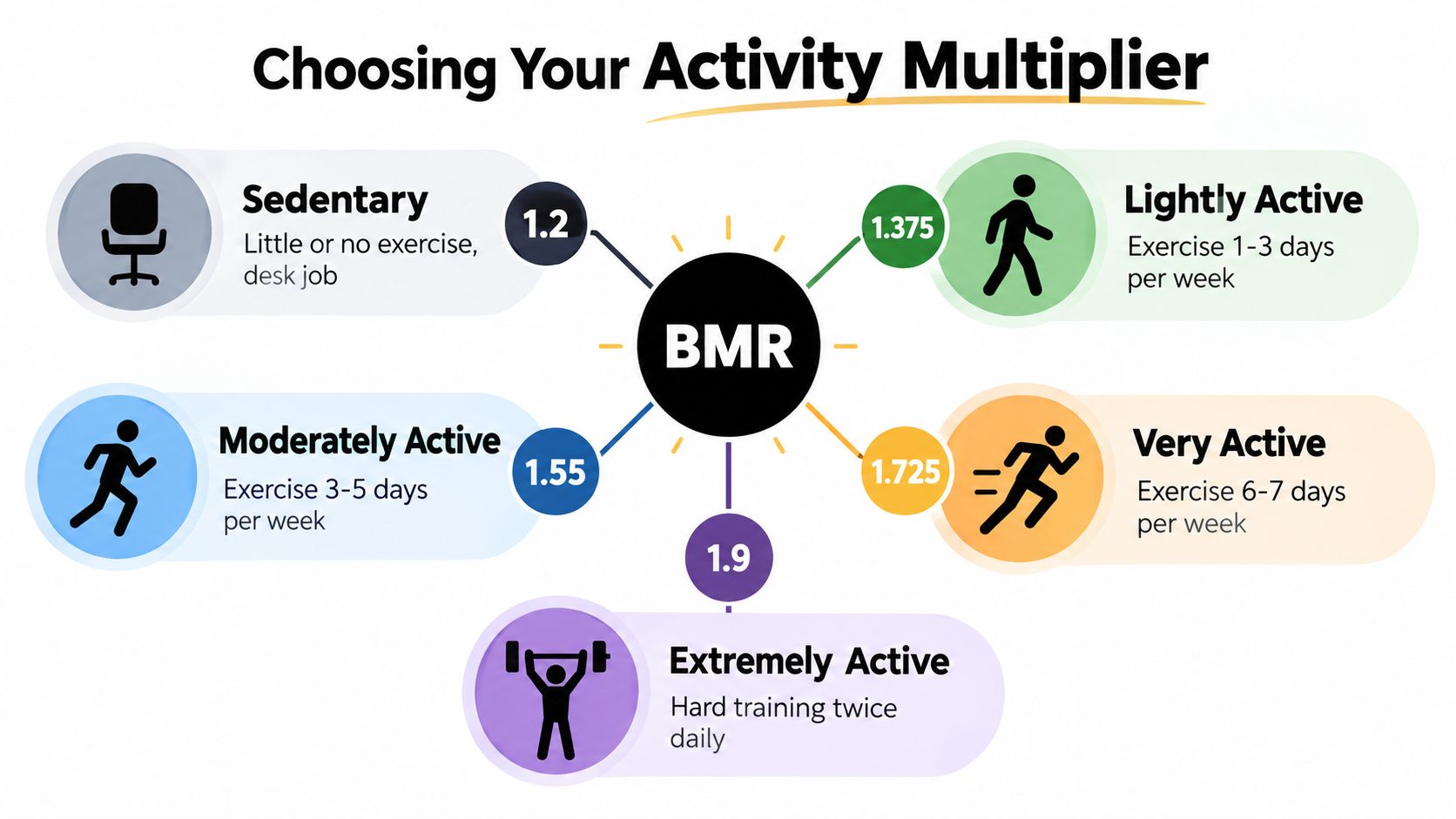
The multiplication is easy. Picking the right factor is where estimates go wrong, because it requires judging your regular routine rather than your most impressive week.
| Activity factor | A week that may fit |
|---|---|
| 1.2, sedentary | Mostly sitting, such as desk work, with little planned exercise |
| 1.375, lightly active | A generally low-movement day with some regular walking or light exercise |
| 1.55, moderately active | A routine that includes structured workouts and meaningful movement through the week |
| 1.725, very active | Frequent demanding training or a physically active routine |
Labels like "moderately active" feel concrete, but they hide a lot of variation. As noted earlier, public-health guidance describes moderate activity as walking roughly 1.5–3 miles a day at 3–4 miles per hour, on top of normal light activity, and active as walking more than 3 miles a day at that pace. Someone who runs for 45 minutes then sits for the remaining 15 waking hours may fit a lower factor than the label suggests.
The arithmetic shows why the choice matters. A person with a BMR of 1,500 calories gets an estimated TDEE of 1,800 using the sedentary factor, 2,325 using the moderately active factor, or about 2,588 using the very active factor. Same resting number, three different answers, all driven by one judgment call.
Treat the factor you pick as a first draft, not a verdict. If you are torn between two rows, start with the lower one and let a few weeks of real-world results confirm or correct it. The short video below walks through how the multipliers change a BMR estimate in practice.
Setting a Target for Your Specific Goal
TDEE estimates the intake that may maintain your weight under your current routine. Your goal determines whether you hold near that estimate or adjust it. Keep the change measured: a target that leaves you drained or makes training harder may be difficult to sustain.
| Goal | Calorie adjustment | Sample daily target | Protein focus |
|---|---|---|---|
| Fat loss | A modest reduction from estimated maintenance | Start below estimated TDEE, then assess the trend | Include a protein source regularly |
| Maintenance | Stay near estimated TDEE | Begin at estimated TDEE | Choose an amount that supports your routine |
| Muscle gain | A modest increase from estimated maintenance | Start above estimated TDEE, then assess the trend | Pair adequate intake with structured strength training |
The table deliberately doesn't assign a universal number to each goal. If your estimated maintenance is different from someone else's, the target that follows will differ too. Start with a manageable adjustment rather than making a dramatic cut or adding food because you've started a new plan.
Protein is one part of the picture, alongside total energy, training, and food choices. Active people may use about 1.6–2.2 grams of protein per kilogram of body weight as a planning range, but needs and appropriate targets vary. A registered dietitian can help personalize that range, especially if you have a medical condition or a history of disordered eating.
Practical rule: If a calorie target leaves you persistently hungry, low on energy, or struggling through workouts, don't treat that as a test of willpower. Revisit the estimate and consider professional advice.
Your goal doesn't require you to hit an exact number every day. It's more useful to start with a reasonable target, keep your routine consistent, and judge whether the plan is working by the trend and how you feel.
Testing Your Number with a Two to Four Week Check-In
Say your calculator puts maintenance at 2,300 calories. That figure is a hypothesis, and the only way to know whether it fits your body is to watch what happens while you eat at that level. A calculator estimate works like a weather forecast: useful for planning your week, but you still look at the sky. A single weigh-in can't answer the question either, so the test runs over two to four weeks.
Use a simple feedback loop
- Start with your estimate. Use your estimated maintenance as a baseline, then choose a goal-based target.
- Track consistently. Record meals and drinks as carefully as you reasonably can, including cooking oils, sauces, and snacks. A food diary app can make entries easier to review, though every logging method has some uncertainty.
- Weigh under similar conditions. If weighing suits you, use the same scale and a consistent time and routine. Compare averages or the broader direction, not one reading.
- Check how you're doing. Note hunger, energy, sleep, and training performance alongside weight. Those cues help show whether a target is workable, not just whether the scale is moving.
- Adjust gradually. If the trend doesn't match your goal, consider a small change of about 100–200 calories a day, then give the revised plan time to show a pattern.
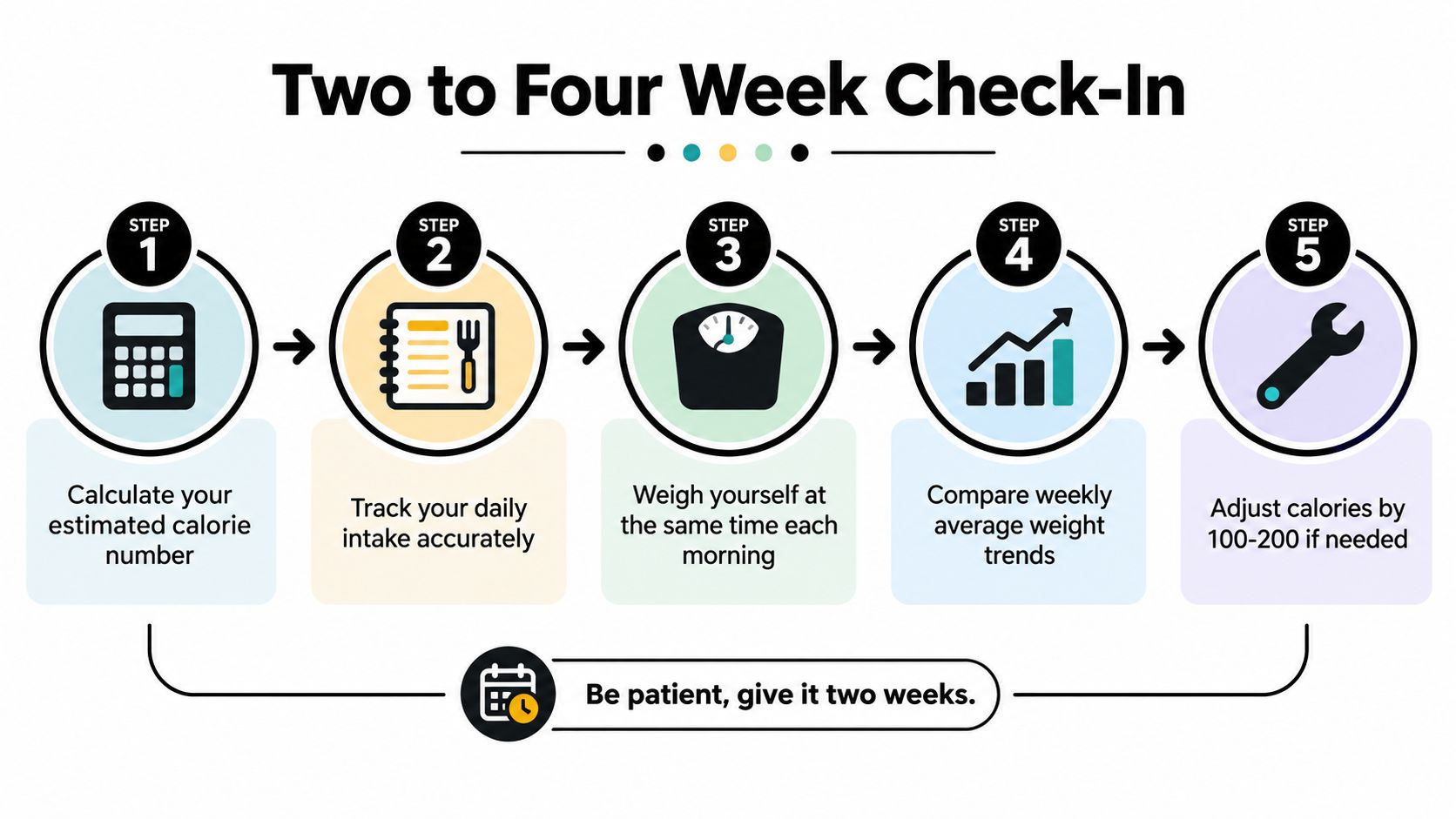
Daily weight can shift because of water, sodium, digestion, and other short-term factors. A brief jump or dip doesn't automatically mean your body has gained or lost fat. Look for a consistent direction across two to four weeks, rather than reacting to every morning's number. Estimate first, then validate against two to four weeks of trend data. That sequence is more reliable than any single number.
If the trend is moving faster than you intended, consider whether your intake is too low; if it's stalled relative to your goal, review your logging and routine before making a modest adjustment. Medical conditions, pregnancy, medications, unusually high training demands, and eating-disorder history call for individualized professional guidance.
Why You Should Not Eat Back Every Exercise Calorie
A fitness tracker can be helpful for noticing movement, but its calorie-burn estimate isn't necessarily accurate enough to treat as food credit. A 2025 meta-analysis of 56 Apple Watch studies reported average error of 27.96% for energy-expenditure estimates, according to this summary of the findings. The estimate is not a direct measurement of how much energy your body used.
That matters when you're working toward a calorie target. If a device overestimates what a workout burned and you eat the full reported amount back, you may erase some of the difference you intended to create. The reverse can happen too, which is why the display shouldn't dictate your food budget.
Keep your planned intake steady when starting a new routine, then use your multi-week weight trend, hunger, performance, and recovery to judge whether your overall plan needs more food. Treat exercise data as context about your activity, not as a precise allowance. For meal logging, an AI calorie counter can help record food, but photo-based estimates also need review when portions or ingredients are uncertain.
Putting It All Together with Calorie Genie
A usable estimate comes from combining your details, choosing an honest activity level, and checking the result against your own experience. Calorie Genie AI is one option for organizing that process: its onboarding asks about your goal, body details, and activity level, then provides personalized calorie and macro targets. You can also compare its features with a MyFitnessPal alternative before choosing a tracking approach.
The app supports photo-based meal logging, lets you correct an estimate in plain language, and offers weight and calorie trend views. Those features can make it easier to review what you're eating and notice patterns, but the numbers remain estimates. They don't replace medical advice or an actual in-person check-in.
Keep this practical checklist:
- Estimate BMR using your body details.
- Multiply by an honest activity factor to estimate TDEE.
- Choose a goal-based target without making an extreme change.
- Track intake and weight trends for two to four weeks, if tracking is appropriate for you.
- Use hunger, energy, and performance as context, not just the scale.
- Don't automatically eat back wearable exercise calories.
You don't need to find a perfect number before you begin. Start with a reasonable estimate, gather consistent feedback, and make small adjustments when the evidence from your own routine points in a different direction.
If you want a simpler way to put this plan into practice, visit Calorie Genie AI to explore its personalized targets, photo-based meal logging, and trend views. Use it to build a starting routine, review your estimates, and learn what fits your day-to-day life.