

A plain 8 fl oz (237 g) cup of black coffee has about 2 calories, 0 g carbohydrate, 0 g fat and 0.28 g protein. That's the baseline for black coffee nutrition facts, and it's so low that many people assume there's nothing else to learn.
The confusion starts after that first number. Your mug probably isn't 8 fl oz, your café pour is probably larger still, and two drinks that look identical can carry very different amounts of caffeine. Add a spoon of sugar or a splash of cream and the coffee itself becomes the smallest part of the total. So the useful skill isn't memorizing 2 calories. It's separating three things in your log: how much you drank, how much caffeine it delivered, and what else went into the cup. Get those three right and black coffee becomes one of the simplest entries in your day. Get them wrong and you'll undercount volume, miss hidden sugar, or wonder why you're wired at midnight from a drink you logged as almost nothing.
Table of Contents
- Calories and Macros in One Cup of Black Coffee
- How Cup Size Changes What You Should Log
- Quick Reference for Black Coffee Terms
- Caffeine Content by Cup Size and Drink
- How Milk, Sugar and Syrups Change the Numbers
- Whether Black Coffee Beats Sweetened Coffee for Health
- Logging Mistakes and How to Fix Them
- Choose the Source and Confirm the Entry Before Saving
Calories and Macros in One Cup of Black Coffee
One standard cup gives you the anchor for everything else. The USDA-derived nutrition record for brewed coffee lists an 8-fluid-ounce (237-gram) serving of plain brewed black coffee prepared with tap water at approximately 2 calories, 0 grams of total carbohydrate, 0 grams of dietary fiber, 0.28 grams of protein and 0.05 grams of fat, with no saturated fat, trans fat, or cholesterol and sodium at approximately 4.7 milligrams.
Why the numbers are so low
Brewed coffee is mostly water. Only small quantities of soluble compounds come out of the roasted grounds during brewing, so there's very little material that can supply energy. That's why the protein and fat figures sit close to zero rather than at zero exactly. You're logging traces, not a food portion in any meaningful sense.
For micronutrients, Verywell Fit's coffee nutrition summary describes a 240 g cup at about 2.4 calories with approximately 118 mg potassium and 7.2 mg magnesium. Those amounts won't cover your day's needs, but they're worth knowing if you track minerals as well as calories. If you're new to splitting entries this way, our guide to what macros are and how to count them explains how protein, carbohydrate and fat fit together in a daily target.
| Serving | Volume | Calories | Carbs (g) | Protein (g) | Fat (g) |
|---|---|---|---|---|---|
| Brewed black coffee | 6 fl oz (178 g) | about 1 | 0 | 0 | 0 |
| Brewed black coffee | 8 fl oz (237 g) | 2 | 0 | 0.28 | 0.05 |
| Brewed black coffee | 12 fl oz (355 ml) | about 3 | 0 | 0.42 | 0.08 |
| Espresso shot, black | 1 fl oz (30 ml) | about 1-3 | 0 | 0.1 | 0 |
Read the table as a scaling exercise. The 6 fl oz row is a smaller reference serving, the 8 fl oz row is the standard database cup, and the 12 fl oz row is that same coffee scaled up by half. An espresso shot is concentrated but tiny, so its calories stay in the same low range despite the stronger taste.
Practical rule: Log unsweetened black coffee at about 2 kcal per 8 fl oz, scale it by the volume you actually drank, and log anything added to it separately.
Treat every figure here as a reference estimate. Brew strength, roast, brewing method and serving size all shift the result slightly, and no database measured the exact cup in your hand. At these levels, though, a small error costs you a calorie or two. Volume and additions are where real mistakes happen.
How Cup Size Changes What You Should Log
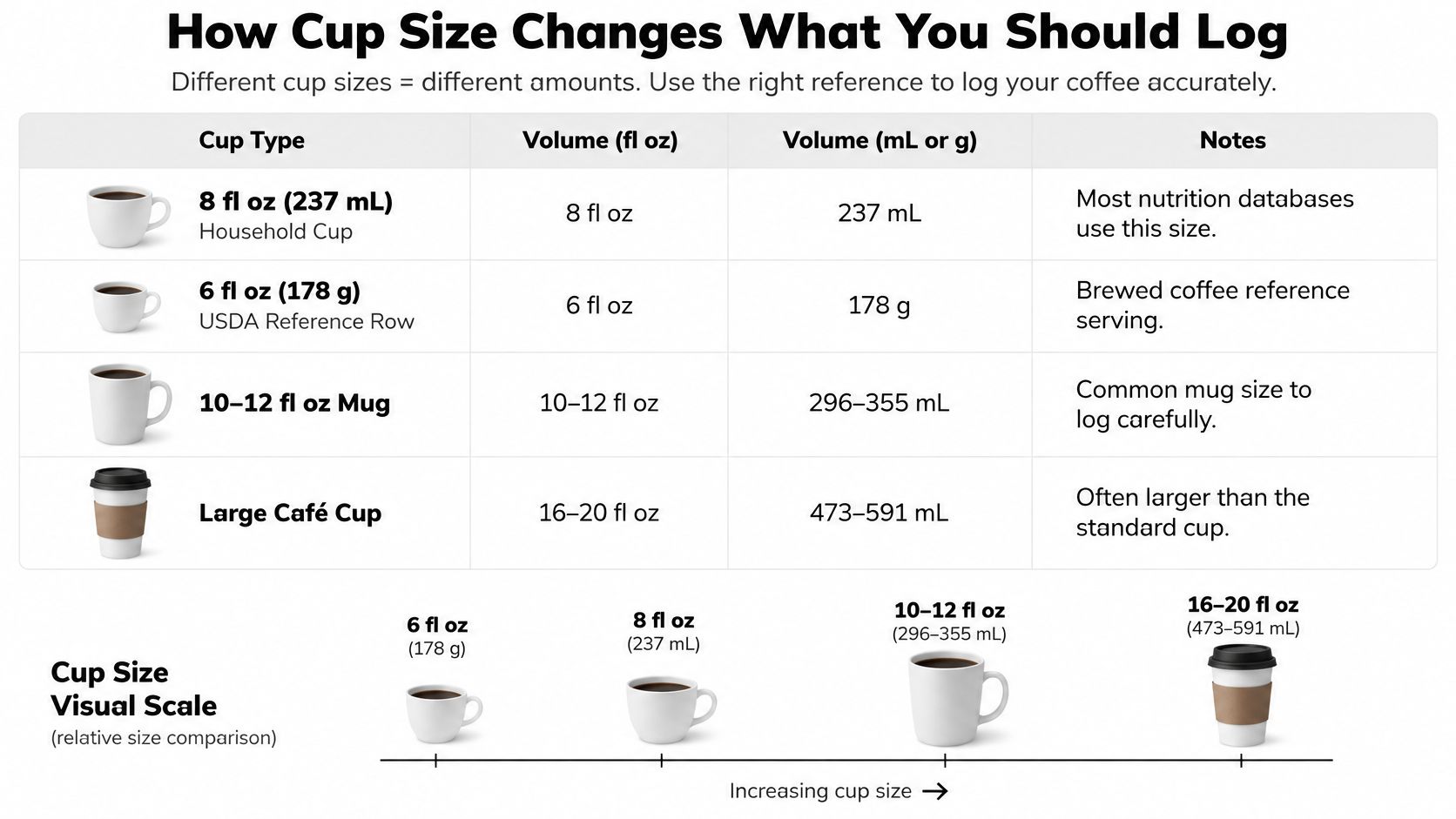
The word cup causes more logging errors than the coffee does. The USDA nutritive value reference lists brewed coffee at approximately 6 fl oz (178 g) with about 1 kcal, 0 g fat, 0 g carbohydrate and 0 g protein, while many nutrition databases use the 8 fl oz (237 mL) household cup, and mugs commonly hold 10 to 12 fl oz. Three different vessels, three different servings, one misleading word.
The scaling rule
Plain brewed coffee works out to roughly 0.25 kcal per fluid ounce, based on 2 kcal for 8 fl oz. That gives you simple maths for any pour:
- 12 fl oz mug: about 3 kcal, because 12 divided by 8 is 1.5 servings
- 16 fl oz café cup: about 4 kcal, or two standard servings
- 20 fl oz large cup: about 5 kcal, or two and a half servings
Now picture the common error. You order a 16 fl oz black coffee and log one 8 fl oz entry. You've recorded 2 kcal instead of about 4, which sounds trivial, and for calories it is. But you've also halved your caffeine record, and if that cup carried sugar or creamer, you've halved those too. The volume mistake multiplies through everything else in the drink.
The fix is to record measured or estimated volume in fluid ounces or millilitres, not the word cup. At home, fill your usual mug with water once and measure it, then reuse that number every morning. Volume beats weight here because brew strength changes what's dissolved in the liquid, while the amount you poured stays easy to judge. At a café, check the size printed on the cup or menu board before you save the entry.
This same habit of checking the reference serving before you trust a number applies to solid foods too, as you'll see in our breakdown of quinoa nutrition facts and cooked servings. For coffee, the rule you can apply anywhere is short: divide your volume by 8, then multiply the 2 kcal baseline.
Quick Reference for Black Coffee Terms
Coffee menus use short labels that change what you should log. Each term below gets one definition and one action, so you can scan it while the drink is still warm.
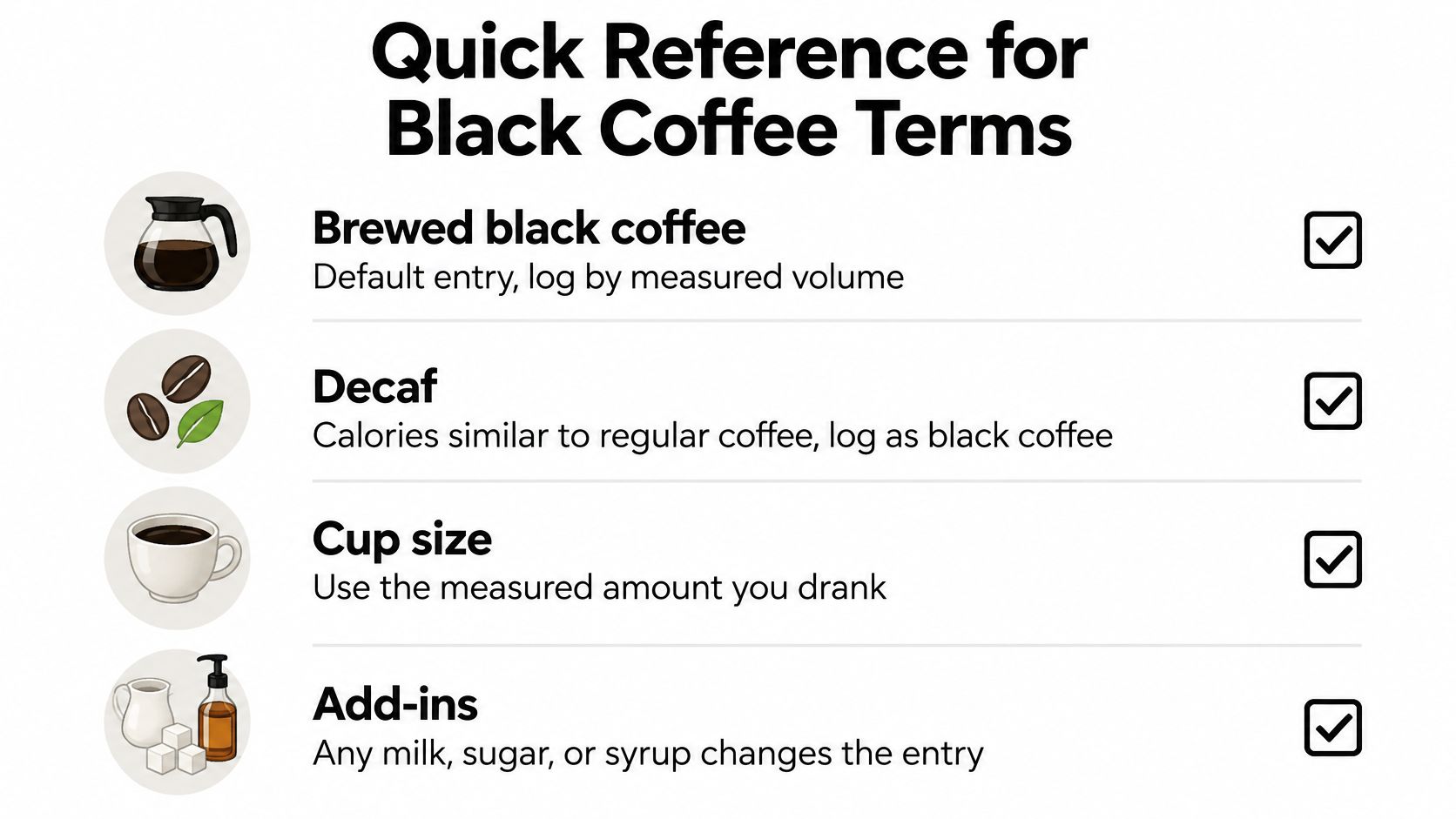
- Brewed black coffee: Hot water passed through ground coffee, served plain. This is your default entry, logged by measured volume.
- Decaf: Coffee processed to remove most caffeine. Calories stay similar to regular coffee, but caffeine drops a lot without reaching zero, so log it as its own entry type to keep caffeine totals honest.
- Cold brew: Coffee steeped in cold water for hours, often made as a strong batch. Log it as cold brew rather than regular brewed, because caffeine per fluid ounce can run higher.
- Concentrate: A strong brew meant to be diluted with water before drinking. Log the diluted volume you drank and check the dilution ratio on the label.
- Espresso: A small, concentrated shot of about 1 fl oz (30 ml). Log by shot count, so a double is two entries or one entry doubled.
- Instant coffee: Powder dissolved in hot water, usually about a teaspoon per cup. Check the package label, since blends with added ingredients won't match plain coffee.
- Black: No milk, cream, sugar, syrup or sweetener. The moment any of those go in, you're logging a composite drink, not black coffee.
If a term changes the caffeine, the volume or the ingredients, it changes the entry. The name on the menu is your first logging decision.
Caffeine Content by Cup Size and Drink
Calories barely move between cups. Caffeine moves a lot. The U.S. Food and Drug Administration caffeine guidance identifies 400 milligrams of caffeine per day as an amount not generally associated with negative effects for most adults, while noting that individual sensitivity varies. The same guidance estimates a typical 12-fluid-ounce serving of regular brewed non-specialty coffee at roughly 113 to 247 milligrams of caffeine.
What two cups can add up to
Run that range through a normal morning. Two 12-ounce cups could provide approximately 226 milligrams at the low end or 494 milligrams at the high end. The high end passes the 400-milligram benchmark before you've counted tea, cola, energy drinks, chocolate or medications containing caffeine. Both mornings look identical in a calorie log. They feel very different by 2 p.m.
| Drink | Caffeine (mg) | Notes |
|---|---|---|
| Regular brewed, 12 fl oz | 113-247 | FDA typical range for one cup |
| Two regular brewed, 12 fl oz each | 226-494 | Can pass the 400 mg daily benchmark |
| Single espresso shot, 1 fl oz | about 63 | Reference value; varies by beans and dose |
| Decaffeinated brewed, 12 fl oz | Low, not zero | Not zero; confirm with the product source |
The spread comes from bean variety, grind size, brewing time, coffee-to-water ratio and serving volume. A finer grind and a heavier dose of grounds pull more caffeine into the same amount of water. A longer brew does the same. That's why your home French press and a café drip can disagree even at the same volume.
Caffeine never appears in calorie, carbohydrate, fat or protein totals. A cup can be nearly calorie-free and still be physiologically active, which is the part a standard food diary hides. If you're pregnant, unusually caffeine-sensitive, or taking medicines affected by caffeine, you may need individualized guidance rather than the general adult benchmark. For everyone else, the practical habit is simple: record caffeine next to volume for each coffee entry, then review the daily total across all sources, not just coffee.
How Milk, Sugar and Syrups Change the Numbers
Start with one worked example. Say you stir three teaspoons of sugar into a 16 fl oz black coffee. The coffee itself contributes about 4 kcal. The sugar adds about 48 kcal, twelve times the base drink. That's the whole lesson in one cup: once you add anything, the additions run the total and the coffee becomes rounding error.
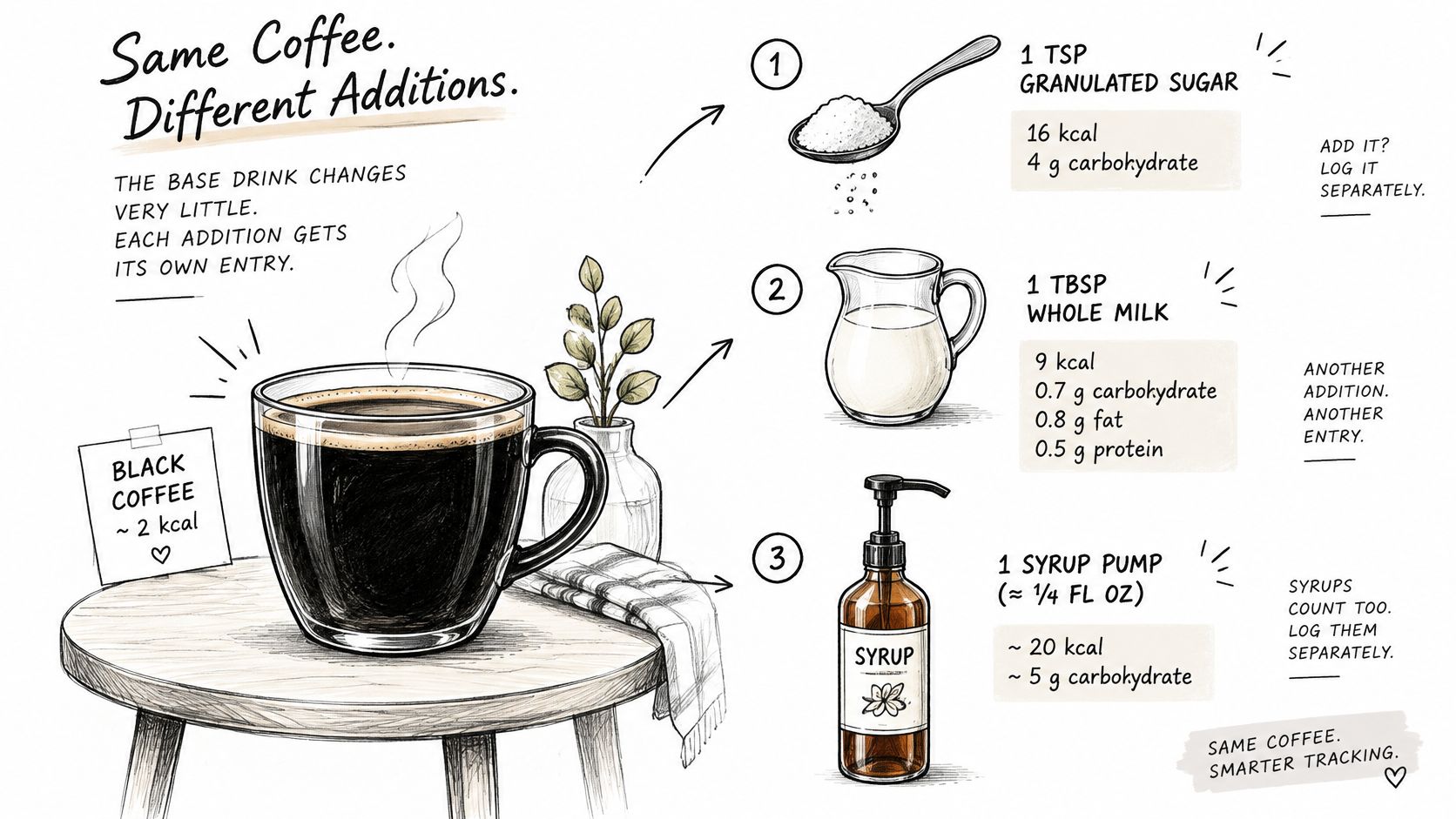
| Addition | Amount | Calories | Carbs (g) | Fat (g) |
|---|---|---|---|---|
| Granulated sugar | 1 tsp (4 g) | 16 | 4 | 0 |
| Honey | 1 tsp (7 g) | about 21 | about 6 | 0 |
| Whole milk | 1 tbsp | about 9 | about 1 | 0.5 |
| Half-and-half | 1 tbsp | about 20 | about 0.5 | 1.7 |
| Heavy cream | 1 tbsp | about 52 | about 0.5 | 5.5 |
| Liquid coffee creamer | 1 tbsp | about 35 | about 5 | about 1.5 |
| Café flavored syrup | 1 pump | about 20 | about 5 | 0 |
How to use the table
Notice the pattern by ingredient type. Sweeteners add carbohydrate with no fat, so sugar, honey and syrup push your carb total up. Dairy adds fat in small volumes, and heavy cream packs more calories into one tablespoon than sugar packs into three teaspoons. Flavored creamer does both jobs at once, which is why a free-poured splash can surprise you.
Café drinks stack several rows at once. A mocha with milk, flavored syrup and whipped cream isn't a black coffee with extras. It's a composite drink, and logging it as black coffee erases most of its calories. Build it from components instead: base coffee at its real volume, then each addition at the amount you saw poured.
Amounts deserve the same attention as ingredients. Pump counts vary by café, creamer pours vary by hand, and a heaped teaspoon isn't a level one. When you can't measure, estimate as accurately as possible and stay consistent, because a consistent estimate still shows you the trend across a week.
Component rule: If the drink isn't black, log the base coffee and each addition as separate entries so the difference shows up in your diary.
Whether Black Coffee Beats Sweetened Coffee for Health
The coffee itself contributes almost nothing to your log. The additions carry almost all of the calories, sugar and saturated fat, and that is where health comparisons start. A recent review of coffee additions and health outcomes reports that associations with lower disease risk and weight gain differ according to additions, with unsweetened coffee showing favorable associations in some studies while sugar-sweetened coffee did not. One large analysis in that review found mortality associations limited to black coffee or coffee with low added sugar and saturated fat, with higher amounts of additions nullifying those associations.
Association is not proof
Those findings come from observational research. People who drink coffee one way often differ from people who drink it another way in income, smoking, exercise and overall diet, and a study can only adjust for so much of that. The honest reading is narrow: heavy additions appear to erase the favorable pattern seen with plain coffee. That does not prove black coffee prevents disease, and it does not make one teaspoon of sugar a health crisis.
Compare your usual drink on four criteria rather than labeling the cup. Calories: plain coffee sits near zero, while sweetened café drinks climb with every pump and pour. Added sugar: the fastest mover, especially across several cups a day. Saturated fat: comes mainly from cream and richer dairy, in a dose-dependent way. Caffeine: similar across versions unless you switch to decaf, and governed by your own tolerance. A splash of milk in one morning cup scores very differently on that comparison than a large syrup drink twice a day, even though both count as not black. The daily pattern matters more than the label on a single cup.
Calorie Genie provides general nutrition and wellness information and is not a substitute for professional medical, dietary, or clinical advice. Calorie estimates are a guide, not medical advice, so treat this comparison as a way to compare drinks, not as a diagnosis.
Logging Mistakes and How to Fix Them
The most common black coffee error is logging a café cup at the 8 fl oz baseline. A 16 fl oz pour logged that way is undercounted by half, and every addition in it gets halved too. You'll usually spot these problems when your weekly totals drift away from what you expect, so check the weekly view before you blame your willpower.
| Symptom | Likely Cause | Fix |
|---|---|---|
| Calories look too low for the cup | Logged as 8 fl oz when the cup held 16 fl oz | Change the volume to the actual size |
| Weekly totals drift upward | Sugar, syrup or creamer not logged | Add each addition as its own entry |
| Drink tastes sweet but was logged as black | Café recipe includes syrup or a sweetened base | Check the menu recipe and log its components |
| Calories double in one day | Same cup logged from a photo and by hand | Keep one entry per cup and delete the duplicate |
| Caffeine feels higher than expected | Cold brew or concentrate logged as regular brewed | Log the correct type and volume |
| Bottle logged as one serving | Bottle holds more than the label serving | Divide the bottle volume by the label serving size |
Each fix takes seconds. Change a volume field to 16 fl oz, add a separate sugar entry, delete a duplicate. The harder part is catching the pattern, because a single wrong coffee entry looks harmless. Six wrong entries a week, every week, subtly bend your averages and your caffeine picture.
Duplicates deserve a special check if you log by photo and by hand. Pick one method per cup and stick to it. Prevention beats repair, and the pre-save check that follows catches most of these before they reach your diary.
Choose the Source and Confirm the Entry Before Saving
Not all nutrition numbers deserve equal trust. Rank your sources by how specific they are to the drink in your hand.
- Most specific first: Use a branded café nutrition page for a named drink, or the printed label on bottled or canned coffee. Watch the label serving, since it may be smaller than the container.
- Database baseline next: Fall back on the USDA reference of 6 fl oz (178 g) at about 1 kcal, or an 8 fl oz database entry scaled to your volume, when no specific source exists.
- Estimates last: Treat photo or manual-entry results as drafts. Check the volume and every addition before you save.
- Barcode when available: Let the tracker pull serving size and macros from the package, then edit the portion to match what you drank.
| Source | What It Measures | Best Use | Watch For |
|---|---|---|---|
| USDA reference records | Standard brewed coffee per gram and household measure | Baseline entries | Assumes typical brew strength |
| Branded café nutrition pages | Chain-specific sizes and recipes | Ordering a named drink | Recipes and sizes change; check the current menu |
| Packaged coffee labels | Serving size and calories printed on the package | Bottled or canned black coffee | Label serving may be smaller than the container |
| Photo or manual-entry tools | Estimate from a photo or typed input | Quick logs of a mug or café cup | Estimates; confirm volume and additions |
When sources disagree, note which one you used so tomorrow's entry matches today's. Consistency matters more than chasing the perfect database. If you're comparing tools for this job, our roundup of the best counting calories app options walks through what to look for.
The pre-save checklist
To log food, you point the camera at a meal, drink, barcode or whole restaurant menu, with no searching or weighing. After a scan, Genie returns calories, protein, carbs and fat with a health score, and you can tap any ingredient to change its portion before saving. Use that review moment well:
- Confirm the volume in fluid ounces or millilitres against the cup or menu size
- List every addition, with milk, sugar, syrup and creamer each as its own entry
- Choose the entry type, regular, decaf, cold brew or espresso
- Add a caffeine note if you're pregnant or unusually caffeine-sensitive
- Accept the estimate, because one small error matters less than consistent logging across a week
Calorie Genie is free to download on the App Store and Google Play. Finish by logging today's black coffee at its real volume, with its real additions, and compare the day's total with your target. That single honest entry teaches you more than a week of default cups.
Your next black coffee is probably already planned, so log it at its real volume, add every spoon and splash as its own entry, and keep an eye on the caffeine total your calorie log can't show you. With Calorie Genie AI you can snap a photo of your cup, check the estimated portion, adjust any ingredient in plain words before saving, and see how the drink fits your day in seconds. Download it free, scan tomorrow's coffee, and let one honest entry start your streak.