
A food can contain all nine essential amino acids and still not be a high-protein centerpiece. That distinction is central to quinoa nutrition facts: quinoa's protein is notable for its quality, but a cooked serving supplies a moderate amount, and the numbers in your tracker depend heavily on whether you logged the seed dry or after cooking.
Dry quinoa and cooked quinoa are both valid entries, but they aren't interchangeable. Cooking adds water, which changes the weight and lowers the calories and nutrients listed per 100 grams. Oil, stock, dressings, and toppings change the meal again. The guide below keeps those states separate so you can choose a sensible reference for package labels, meal prep, and photo-based logging.
Table of Contents
- Why Quinoa Nutrition Facts Need Two Reference Tables
- The Raw Profile Per 100 Grams of Dry Grain
- Cooked Quinoa Per 100 Grams and Standard Cup Measures
- How Quinoa Compares to Rice, Couscous and Other Grains
- How Preparation Changes What Gets Logged
- What Complete Protein Actually Means for Quinoa
- Building a Quinoa Bowl That Actually Fits Your Macros
- Fiber, Glycemic Impact and Gluten-Free Status
- Puffed, Flour and Ready-to-Eat Quinoa Products
- Quick Reference Lookup for Common Quinoa Portions
- Logging Quinoa Accurately in a Photo Tracker
- Common Questions About Quinoa Nutrition
Why Quinoa Nutrition Facts Need Two Reference Tables
The quickest way to get a misleading quinoa entry is to search for “100 grams” without checking whether the result means dry or cooked. Dry quinoa is more concentrated because it hasn't absorbed water. Cooked quinoa weighs more for the same amount of grain, so its calories and macros per 100 grams are lower. Neither number is wrong. Each answers a different question.
Use dry-grain values when you're weighing quinoa straight from the bag, checking a package's uncooked nutrition panel, or entering an ingredient into a recipe before it goes in the pot. Use cooked values when you're weighing food on your plate or estimating a prepared bowl. A tracker entry labeled “quinoa” may not make that distinction clear, so look for the food state before saving it.
Water isn't the only thing that affects the final log. Cooking quinoa in oil adds energy from the oil; using stock can change sodium; and dressings, vegetables, beans, or other toppings contribute their own nutrients. A plain cooked-quinoa entry is a useful starting point, not a complete description of a mixed meal.
Practical rule: Match the database entry to the state you weighed. Dry weight belongs with dry values, and cooked weight belongs with cooked values.
That distinction matters whether you're tracking calories, building a vegetarian meal, or checking how much protein a bowl contributes. The best quinoa nutrition facts are the ones tied to the actual food in front of you, not a number separated from its preparation.
The Raw Profile Per 100 Grams of Dry Grain
For package-level logging, the dry-grain reference is the useful anchor. FAO's compilation of USDA laboratory data gives this profile per 100 grams of dry quinoa: FAO's dry quinoa nutrient compilation.
| Nutrient | Per 100 g dry quinoa |
|---|---|
| Calories | 368 kcal |
| Protein | 14.12 g |
| Carbohydrate | 64.16 g |
| Dietary fiber | 7.0 g |
| Fat | 6.07 g |
| Calcium | 47 mg |
| Iron | 4.57 mg |
| Magnesium | 197 mg |
| Phosphorus | 457 mg |
| Potassium | 563 mg |
| Sodium | 5 mg |
The 64.16 grams of carbohydrate includes the grain's carbohydrate contribution, while its 7 grams of fiber are useful to note separately when you're comparing foods or checking a tracker's fiber total. The protein figure is substantial for a grain ingredient, but it describes 100 grams of dry quinoa, not a typical cooked serving.
The mineral values help explain why quinoa is often chosen as more than a plain starch. Magnesium, iron, phosphorus, and potassium all appear in the dry-grain profile. They're composition figures, not a promise that every quinoa product will supply identical amounts or that the body absorbs every listed mineral equally.
The 5 milligrams of sodium is a reference for the dry grain itself. Salt, broth, sauces, or seasoning can change the sodium in the prepared dish, so the dry value shouldn't be mistaken for the total in a finished bowl.
Cooking absorbs water and changes the basis of comparison. A dry-grain entry is right for weighing uncooked quinoa, but it will overstate the nutrient density of a cooked portion if you enter cooked weight against it. For the cooked reference, use the following section.
Cooked Quinoa Per 100 Grams and Standard Cup Measures
For a prepared portion, a USDA-derived reference puts cooked quinoa at approximately 120 calories, 4.4 grams of protein, 21.3 grams of carbohydrate, 2.8 grams of fiber, and 1.9 grams of fat per 100 grams. The FAO quinoa nutrition overview also describes cooked quinoa as a source of carbohydrate and protein, with values affected by preparation.
A standard cooked cup weighs about 185 grams, or roughly 6.5 ounces. Using the per-100-gram reference, multiply each value by 1.85: that gives approximately 222 calories, 8.1 grams of protein, 39.4 grams of carbohydrate, 5.2 grams of fiber, and 3.5 grams of fat. These are estimates from the stated cooked reference, so a tracker may show slightly different totals depending on its database entry and the quinoa's final moisture content.
For a gram-based portion, 100 grams cooked is about 3.5 ounces. If you serve 200 grams cooked, double the per-100-gram values; a 400-gram cooked portion is four times those values. That makes a kitchen scale particularly useful for meal prep, especially if you portion a batch into containers.
The reverse calculation is useful when you weigh grains before cooking. A cooked cup of about 185 grams can come from roughly 45 grams of dry quinoa, depending on how much water the seeds absorb and how the grain is prepared. If you start with dry weight, log the dry amount once for the batch, then divide the batch entry among the portions you serve. Don't log the dry weight and then add the cooked portion as a second entry.
How Quinoa Compares to Rice, Couscous and Other Grains
Quinoa stands out among some familiar grains for protein, but the comparison is more useful when you look at the actual cooked serving. One cup of cooked quinoa provides about 8.1 grams of protein, compared with approximately 3.3 grams in couscous and 4.3 grams in long-grain white rice. Those figures come from the verified portion comparisons in the European Commission Horizon Magazine discussion of plant-based protein.
The serving is also a carbohydrate food. Quinoa can offer more protein than these grain alternatives while still supplying a meaningful amount of carbohydrate, so it may work well as a bowl base or side dish. Its particular strength is not that it replaces every other food group. It's that it provides a useful mix of grain-like energy, fiber, and plant protein.
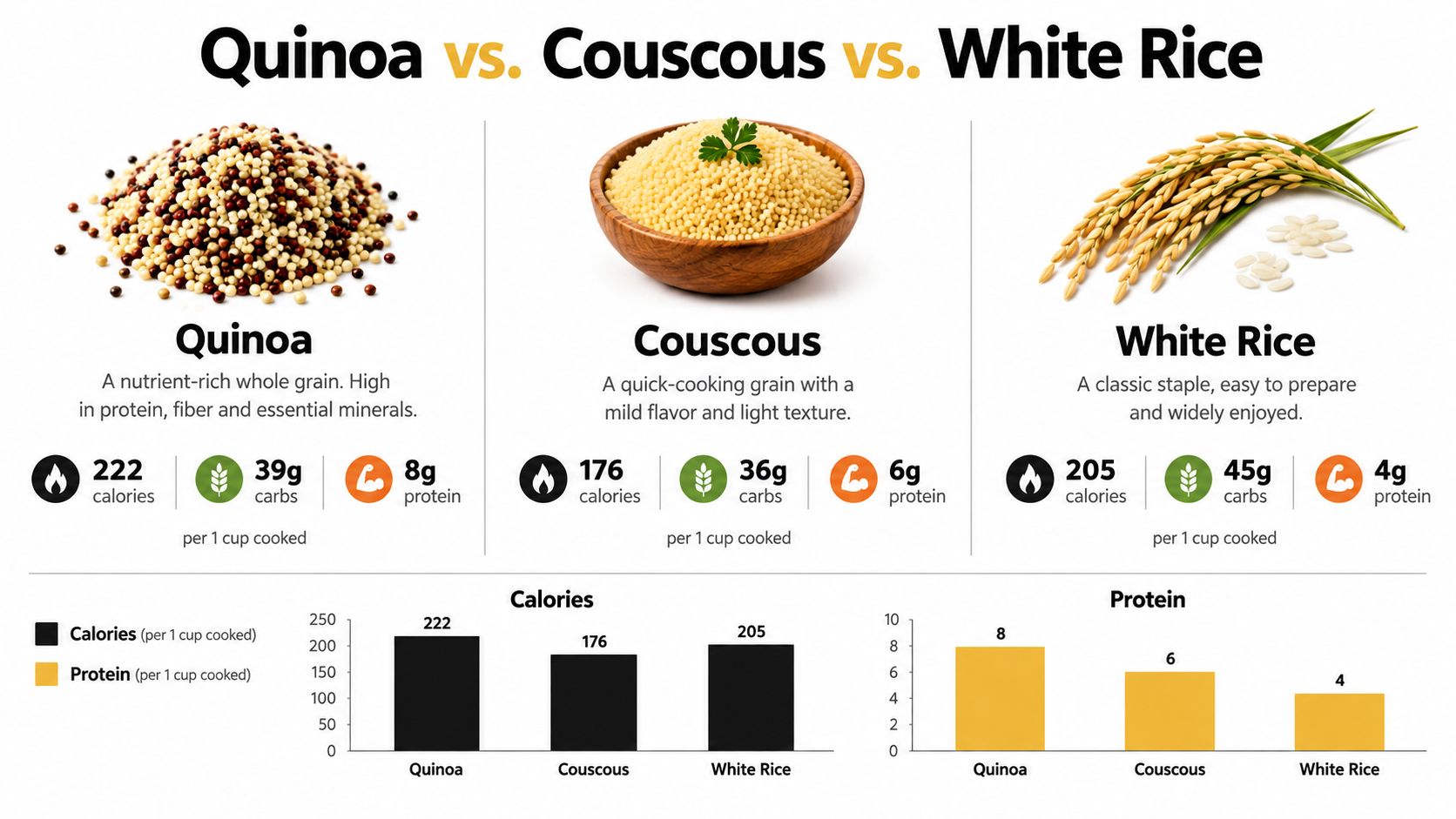
A grain serving still isn't equivalent to a concentrated protein food such as eggs, dairy, fish, meat, or protein-rich legumes. If you're aiming for a protein target, count the quinoa as one contributor and consider what else is on the plate. A bowl with tofu or beans has a different protein profile from a bowl made with quinoa and vegetables alone.
That distinction leads to a common point of confusion: complete protein describes amino-acid coverage, not how much protein a serving contains. Quinoa can be notable for the first and moderate in the second.
How Preparation Changes What Gets Logged
A quinoa entry describes more than the grain itself. Rinsing removes surface saponins, compounds that can add bitterness, and mainly affects flavor. Soaking before cooking can shorten cook time and may slightly reduce surface minerals. These steps don't make the cooked grain equivalent to a dry entry: use the preparation state that matches the portion being tracked.
Fermentation changes the food in a different way. It can affect protein digestibility and the availability of bound phenolics, so fermented quinoa products may differ from plain cooked quinoa. Product recipes and methods vary. Check the label or choose a tracker entry for the specific fermented product rather than treating it as a standard bowl of cooked grain.
Added ingredients can change the total more than rinsing or soaking. One cup of quinoa cooked in water is about 222 calories using the cooked reference above. If cooked with a tablespoon of olive oil, that portion comes to about 295 calories, with the oil adding energy beyond the grain.
Stock, butter, oil, and sauces each affect what belongs in the log. Stock may add sodium, while oil and butter add calories and fat. Log toppings separately unless the selected database entry already includes them. Puffed quinoa, quinoa flour, and ready-to-eat products have different forms and recipes, so a plain cooked-grain entry may not match their nutrition.
What Complete Protein Actually Means for Quinoa
Quinoa's complete protein label describes its amino-acid mix: it contains all the essential amino acids, which the body cannot make on its own. FAO's quinoa overview lists lysine and arginine among its notable amino acids, with one reported profile of about 6.9 grams of lysine and 14.0 grams of arginine per 100 grams of protein. That profile speaks to protein quality, not how much protein a portion provides.
For a clearer comparison of quantity, quinoa supplies roughly 3.7 grams of protein per 100 cooked calories. That is a useful contribution for a grain, though less protein per calorie than tofu, at about 11 grams per 100 calories. The figures answer different questions: amino-acid completeness is about which building blocks are present, while protein per calorie shows how much protein comes with the food's energy.
For vegetarian or vegan meals, quinoa can contribute protein alongside beans, tofu, or another protein source. Eggs, yogurt, chicken, and fish can fill a similar role for people who eat animal products. Combining foods helps a meal provide more protein overall.
Amino-acid completeness and protein quantity answer different questions. Consider both when deciding whether a quinoa meal fits your goals.
For muscle-focused tracking, include quinoa's protein in the meal total, then account for its other ingredients too. The grain contributes, but the rest of the meal determines how much protein the full plate provides.
Building a Quinoa Bowl That Actually Fits Your Macros
Start with the grain, then build the bowl ingredient by ingredient. A base of 200 grams of cooked quinoa contributes about 240 calories and 8.8 grams of protein, using the cooked values above. Vegetables add their own nutrients, while the protein choice and any dressing or cooking oil can shift the totals further.
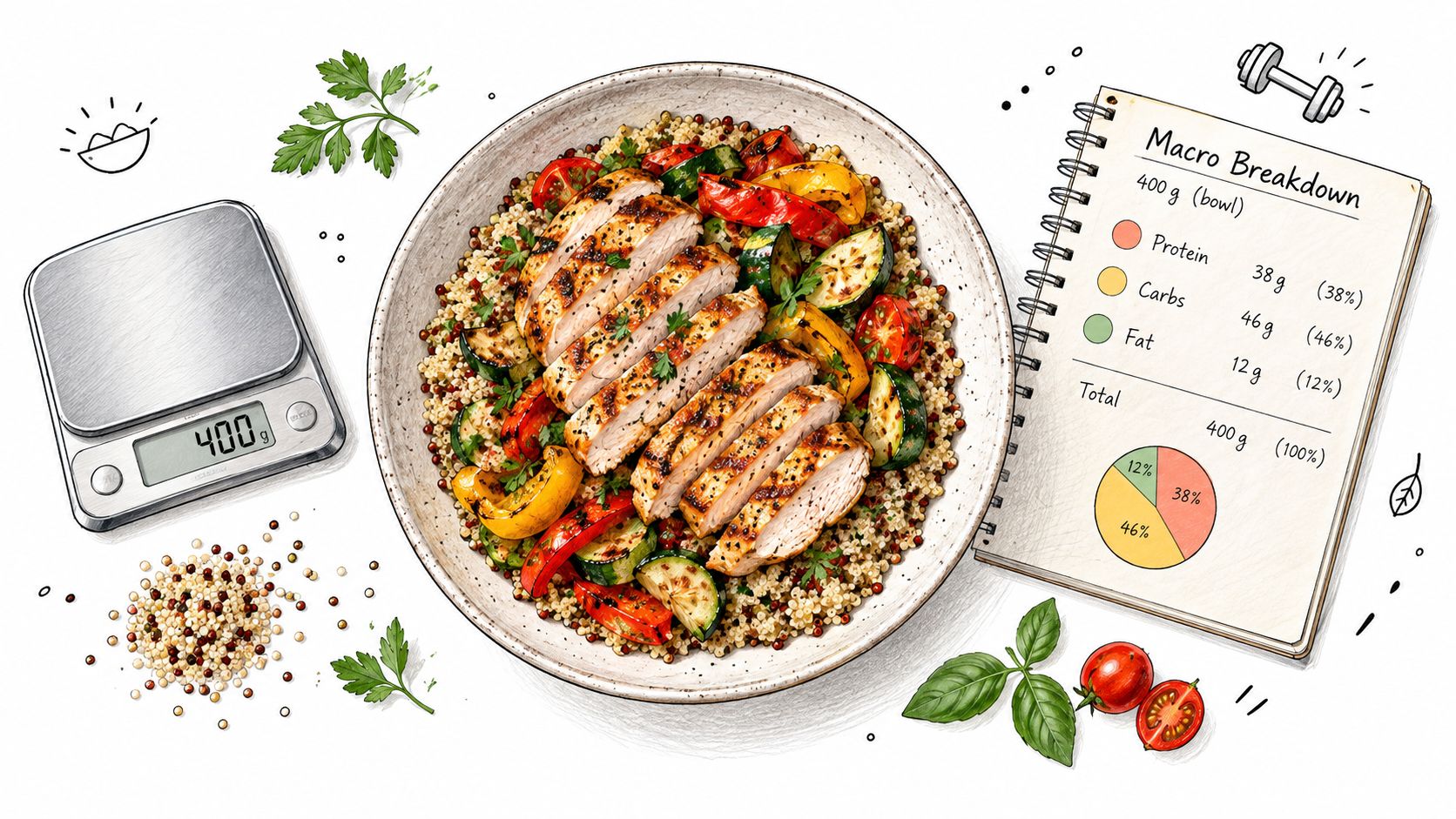
Instead of treating the bowl as one generic “quinoa meal,” record the base and toppings as separate ingredients. A chicken bowl, a tofu bowl, and a black-bean bowl may look similar in a photo, but they won't have the same macros. The calories in sliced turkey breast guide offers another example of why naming and portioning the protein ingredient matters when you're logging a mixed meal.
A simple workflow is to log the cooked quinoa first, then add the protein, vegetables, dressing, and any oil used during cooking. If you use a photo-based tracker, describe important details that may not be obvious in the image, such as whether the quinoa was cooked in oil or whether the bowl includes a substantial dressing.
For a visual demonstration of food and portion tracking, you can also watch this meal-logging video.
A useful starting point is to think of quinoa as the bowl's grain base, not the entire macro story. Your protein selection, cooking fat, and sauces determine what the finished meal adds up to.
Fiber, Glycemic Impact and Gluten-Free Status
Cooked quinoa supplies about 2.8 grams of fiber per 100 grams, according to the cooked reference used above. Fiber is one reason quinoa can be a satisfying grain choice, while the dry profile also lists 7 grams per 100 grams. Keep the two figures attached to their respective states so a cooked portion isn't compared with a dry one.
Minerals complement that picture. The dry-grain table lists magnesium, iron, and phosphorus, but those are composition values rather than guarantees of how much the body absorbs. As discussed in the preparation section, rinsing, soaking, cooking, fermentation, and the rest of the meal can all affect how nutrition values should be interpreted.
Quinoa is naturally gluten-free, which makes it relevant for people who avoid gluten. Packaged products can still face cross-contact during processing, so people who need to avoid gluten should check product labeling and manufacturing information rather than relying only on the ingredient name.
Quinoa's carbohydrate content also means it isn't a carbohydrate-free food. If you're tracking carbohydrate intake, log the portion you eat and consider the rest of the meal. Pairing it with vegetables and a protein source can make a more balanced bowl, but it doesn't change the quinoa's own carbohydrate entry.
Puffed, Flour and Ready-to-Eat Quinoa Products
The cooked-grain numbers don't automatically apply to every food made with quinoa. Puffed quinoa is dry and airy, so a small-looking portion can weigh much less than a bowl of cooked seeds. Use the package's serving information or weigh the product, rather than selecting a cooked-quinoa database entry.
Quinoa flour is another distinct ingredient. It's used in baking and should be logged by its flour weight or package serving, not by the cooked-grain reference. When you use it in a recipe, the finished food also includes the other ingredients, such as oil, eggs, sweeteners, or dairy alternatives.
Ready-to-eat products can combine quinoa with other grains or ingredients. A packaged cup, breakfast puff, or quinoa-based pasta may include added ingredients that change the nutrition profile. For packaged foods, the barcode or nutrition panel is more relevant than a generic entry for plain quinoa.
Choose the entry for the product you're actually eating, not just the word “quinoa” on the label.
That simple check helps prevent a common mismatch: using values for moist cooked seeds to log a dry, processed, or mixed product. If the package provides a serving size and nutrition panel, start there and adjust for the amount you ate.
Quick Reference Lookup for Common Quinoa Portions
The table below uses the verified dry and cooked references. Cooked portion values are calculated by scaling the cooked per-100-gram figures, while the cup estimate uses a cooked cup of about 185 grams.
Quinoa Nutrition Per Common Portion
| Portion | Calories | Protein (g) | Carbs (g) | Fiber (g) | Fat (g) |
|---|---|---|---|---|---|
| 50 g dry | 184 | 7.1 | 32.1 | 3.5 | 3.0 |
| 100 g dry | 368 | 14.12 | 64.16 | 7.0 | 6.07 |
| 1 cup cooked, about 185 g | 222 | 8.1 | 39.4 | 5.2 | 3.5 |
| 100 g cooked | 120 | 4.4 | 21.3 | 2.8 | 1.9 |
| 200 g cooked | 240 | 8.8 | 42.6 | 5.6 | 3.8 |
| 400 g cooked | 480 | 17.6 | 85.2 | 11.2 | 7.6 |
For batch cooking, log the dry amount that went into the pot or divide the finished batch into weighed cooked portions. Use one method consistently, and don't count both states for the same quinoa. Add oil or butter separately, just as you would when logging a bowl of homemade vegetable soup, where the ingredients and additions determine the finished total.
Logging Quinoa Accurately in a Photo Tracker
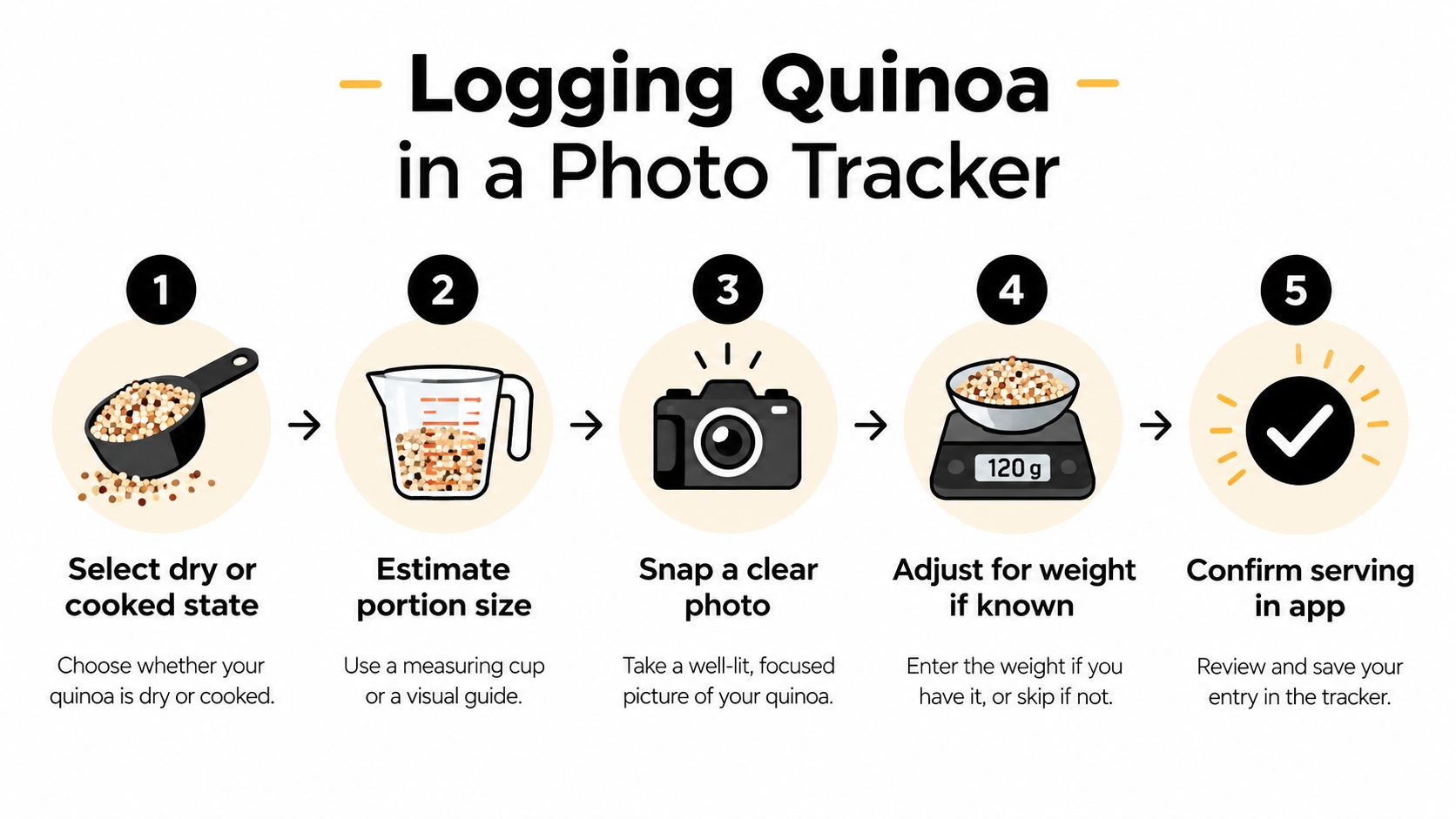
A photo can help identify a meal, but a useful quinoa log still depends on a few details. Follow this checklist before saving the entry:
- Select the state. Decide whether the portion is dry or cooked.
- Estimate the amount. Use grams when you know the weight; otherwise choose the closest portion.
- Show the food clearly. A photo with the grain and toppings visible gives the tracker more context.
- Adjust for weight if known. Choose the reference that matches the weighed portion.
- Confirm the ingredients. Add oil, sauces, vegetables, and protein separately when needed.
If you use Calorie Genie's AI calorie counter, you can photograph a meal and review the estimated calories and macros, then adjust ingredients or portions if the image misses details such as added oil or the amount of quinoa. Treat a photo estimate as a starting point, especially when the dry-versus-cooked state is unclear.
Common Questions About Quinoa Nutrition
Is quinoa healthier than rice for weight management?
There isn't one answer that fits every meal or goal. Quinoa offers a different protein and fiber profile from white rice, but portion size and the rest of the meal still matter. Choose the grain you enjoy and can log in the correct state.
Does rinsing quinoa change its nutrition?
Rinsing helps remove saponins that can contribute bitterness. It's a useful preparation step, but it doesn't remove the need to match your tracker entry to the quinoa's dry or cooked state.
How should I log quinoa salad with dressing?
Log the cooked quinoa, vegetables, and dressing as separate ingredients when possible. Dressings can add calories and fat, so a plain cooked-quinoa entry won't represent the whole salad.
Can quinoa be a vegetarian's primary protein source?
Quinoa can contribute plant protein, but a cooked cup supplies a moderate amount rather than a large serving of protein. Pair it with beans, tofu, or another protein source, and use your overall meals to meet your individual needs.
If you want a quicker way to log a quinoa bowl, Calorie Genie AI can estimate calories and macros from a meal photo and lets you adjust ingredients or portions when needed. Visit Calorie Genie AI to explore meal photo logging and keep your quinoa entries grounded in what you ate.