
For a worked example, a homemade plate with 150 g cooked flank steak, 1 tablespoon of oil, moderate sauce and vegetables could land around 430-510 calories, or roughly 640-720 with a cup of cooked white rice, depending on the ingredients counted. Those are illustrative plate estimates, not a universal calorie range for beef stir fry.
The surprising part is that a plate full of vegetables can still contain a substantial amount of energy from ingredients you can barely see. Oil coats the food, sauce collects beneath it, and rice may sit under the beef. The most useful estimate is a sum of parts, not a single database entry called beef stir fry.
Table of Contents
- Typical Calorie Range for a Beef Stir Fry
- Beef Cut and Portion Set the Base Calories
- How Oil, Sauce and Starch Add Up
- Why Serving Size Changes the Number on Your Plate
- Published Recipe Values Compared
- Estimate, Photograph and Log Your Plate
Typical Calorie Range for a Beef Stir Fry
A beef stir fry can be a relatively lean plate or a calorie-dense takeaway meal under the same name. The dependable way to estimate it is to price each component separately: beef sets the base, oil and sauce add concentrated energy, and rice or noodles can outweigh the vegetables.
Use the versions below as portion scenarios, then adjust the row toward your pan. The ranges are approximate because sauce sweetness, oil in the wok and starch portion vary more than the name “stir fry” does.
Estimated calories per beef stir fry plate by version
| Version | Beef and cooking oil | Starch | Estimated calories per plate |
|---|---|---|---|
| Lean, vegetable-heavy, light sauce | 120 g cooked lean beef, 1 tsp oil, measured light sauce | None | About 300-380 |
| Standard homemade | 150 g cooked flank steak, 1 tbsp oil, moderate sauce and vegetables | None | About 430-510 |
| Standard homemade with rice | The same beef, oil, sauce and vegetables, with rice counted separately | 1 cup cooked white rice | About 640-720 |
| Restaurant or takeaway | Larger beef portion, extra wok oil, sweeter sauce | Large rice or noodle portion | About 750-1,000+ |
These are example builds, not claims about how every restaurant serves the dish. The lean row lands lower because the beef portion is smaller, the oil is measured by the teaspoon and the sauce stays light. The restaurant row has no tidy ceiling because free-poured oil, sugary sauce and a heaped starch base can keep adding energy after the plate looks “full.”
Read the plate by components
Start with beef weight, then ask what else would still leave energy if the vegetables were free. Oil coats everything. Sauce pools under the meat. Rice hides underneath and turns a vegetable-heavy-looking plate into a much larger meal.
Skipping rice can still leave a high number if the cook used fatty beef or added extra oil. Compare quantities before comparing names.
A plate description is useful only when it tells you what the calorie estimate includes.
When the estimate feels off, change one part at a time: beef first, then oil, sauce and starch. That keeps the math tied to the plate in front of you.
Beef Cut and Portion Set the Base Calories
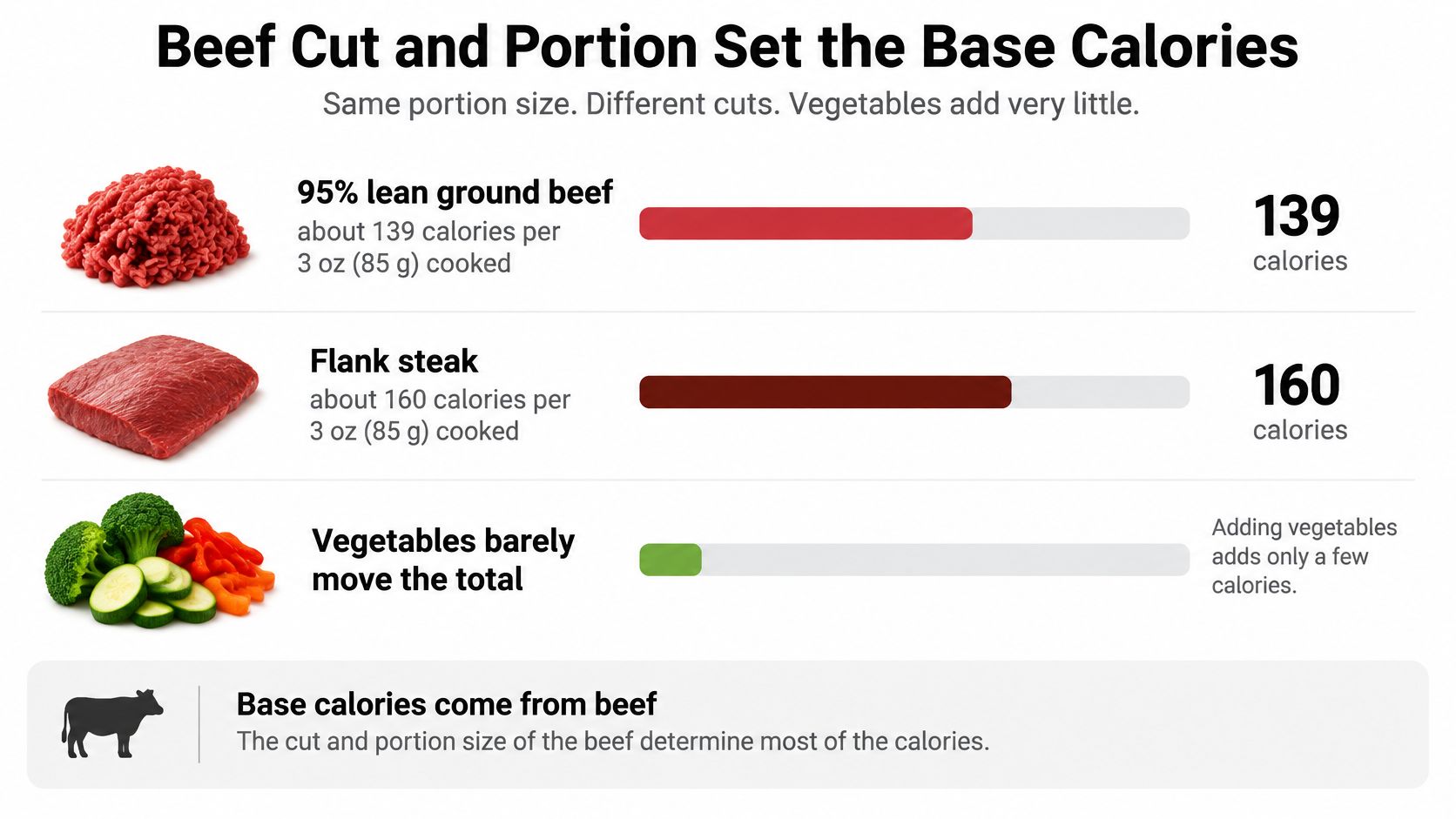
Two plates of beef stir fry can look identical and still differ by more than a hundred calories before a drop of oil reaches the wok. The reason sits in the beef itself: the cut and the portion set the starting number, and every other ingredient builds on top of it.
The Nutrition Fact Label beef-cut comparison gives approximately 139 calories for 95% lean ground beef, 163 for flank steak and 209 for 80/20 ground beef per 3 oz cooked. The table below uses those values and scales them proportionally to a larger portion.
Calories in common cooked beef cuts
| Beef cut | Calories per 3 oz cooked | Calories per 5 oz cooked |
|---|---|---|
| 95% lean ground beef | About 139 | About 232 |
| Flank steak | About 163 | About 272 |
| 80/20 ground beef | About 209 | About 348 |
Choosing 95% lean over 80/20 at the same 5 oz portion trims roughly 115 calories without changing anything else on the plate. The spread comes from fat: marbling and lean-to-fat ratio differ by cut, so equal cooked weights rarely deliver equal energy.
These figures are reference estimates, not measurements of your specific steak. Trimming, preparation, and the database entry you match against all affect the actual number, which is why identifying the beef is worth doing before adjusting smaller ingredients.
Match cooked weight to a cooked entry
Raw weight and cooked weight describe the same meat at different moments. Cooking drives off water, and that works like reducing a sauce: the calories stay while the mass shrinks, so each cooked ounce carries more energy than a raw ounce did.
That concentration creates a common logging error. You weigh a cooked portion, select a raw-beef entry, and the estimate comes out low because the raw figure assumes water that has already left the pan. Match the condition on your scale to the condition named in the entry. If the label says raw, weigh raw; if you can only weigh cooked, choose a cooked entry. For a whole recipe built from raw ingredients, keep every quantity raw so the arithmetic stays consistent.
For a single plate, place a bowl on the scale, tare it, and weigh the cooked beef before sauce and vegetables join it. Check the packaging for the cut or the lean-to-fat percentage rather than picking the first result labeled "beef."
Richer cuts need their own reference point. When a recipe uses a marbled steak, the ribeye steak calorie guide gives a closer benchmark than any lean-beef entry. And when the cut is unknown, log an honest mid-range estimate rather than recording an unidentified steak as precisely weighed flank.
How Oil, Sauce and Starch Add Up
Oil is easy to overlook because it doesn't remain a distinct mound on the plate. Sauce and starch are easier to see, but their quantities still need their own entries.
This illustration highlights the ingredients to separate when building your estimate.
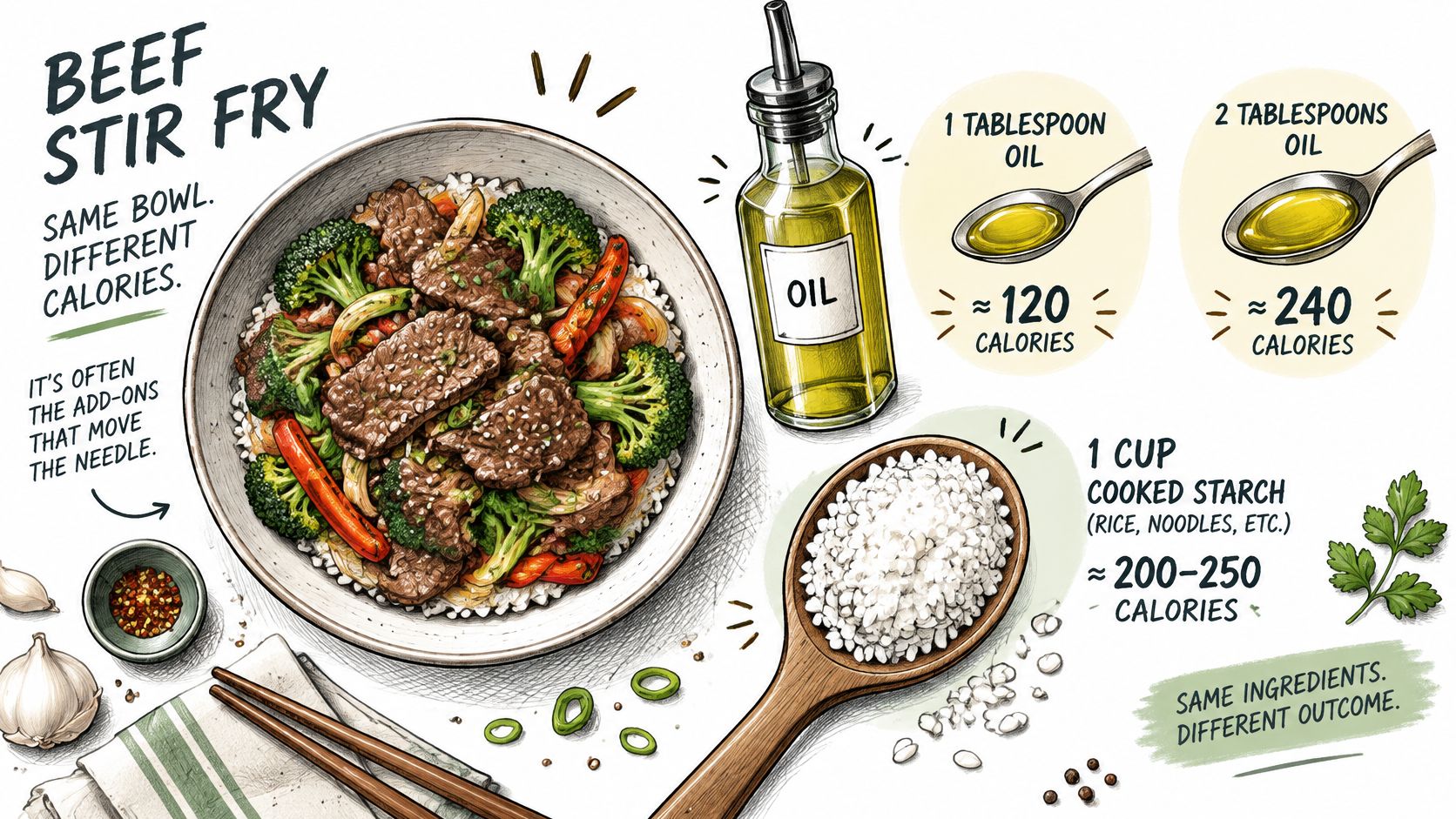
The Avocalo cooking-oil reference lists approximately 119 calories per tablespoon of olive oil, meaning a pan made with two tablespoons contains about 238 calories from added oil. Divided across four portions, that's approximately 60 calories per portion; using one tablespoon instead saves nearly 30 calories per portion.
Calories added by oil, sauce, starch and vegetables
| Add-on | Amount | Approximate calories |
|---|---|---|
| Cooking oil | 1 tbsp (13.5 g) | About 120 |
| Cooking oil | 2 tbsp | About 238 |
| Cooked white rice | 1 cup | Use a matching cooked-rice nutrition entry |
| Cooked egg noodles | 1 cup | Use the package's cooked-serving information |
| Sweet soy or teriyaki sauce | 2 tbsp | Calculate from the specific sauce label |
| Light soy sauce | 1 tbsp | Use the bottle's stated serving value |
| Mixed vegetables such as broccoli, peppers and onion | 1 cup | Add the vegetables actually used |
The non-oil amounts are example measuring portions. There isn't enough information in a food name alone to assign an accurate calorie value to a particular sauce or vegetable mixture.
Count what you add, then allocate it
For home cooking, counting the oil poured into the pan is a practical starting point. Some may remain behind, so the amount eaten can be lower than the amount added. Absorption doesn't create additional calories, and the oil contribution can't exceed what you put in.
Include oil used in a marinade or finishing drizzle, not just the oil used for searing. For sauce, count the ingredients in a homemade mixture or use the nutrition label on the bottle.
Plate calculation: Total calories are roughly cooked beef + cooking oil eaten + sauce + starch + vegetables.
Measure rice or noodles in the form you're logging. A cooked serving must match a cooked-food entry, not a dry-weight entry. The jasmine rice calorie guide can help you distinguish rice portions from the stir-fry topping.
For a cooking demonstration alongside your ingredient notes, use the video below.
A lean, vegetable-heavy stir fry can still have a higher total than another homemade plate if you serve it with more sweet sauce and a generous starch portion. The useful question isn't whether those ingredients are allowed. It's how much of each ingredient you're eating.
Why Serving Size Changes the Number on Your Plate
A recipe total and a plate total answer different questions. You can calculate every ingredient carefully and still log the wrong amount if you misunderstand the recipe's serving size.
The FDA's guide to calories on nutrition labels explains that calorie information is generally stated per serving and that eating two servings provides twice the listed calories. Applied to a hypothetical pan containing 1,800 calories across four servings, a quarter contains about 450 calories, while half contains about 900.
Choose a portioning method
You don't need to divide a mixed dish perfectly. Choose a method you can repeat without making dinner feel like a laboratory exercise.
- Weigh the finished food. Transfer it into a tared bowl, record the total cooked weight, and weigh the amount you serve. Log the same share of the recipe's calories.
- Portion before eating. Divide the cooked dish into the recipe's intended servings, including any containers for leftovers. Count how many of those portions reach your plate.
- Estimate your share of the pan. If weighing isn't practical, judge the fraction you ate using the serving bowl and the remaining food as guides.
For a hypothetical recipe defining a serving as two cups, a plate holding three cups is one and a half servings. Selecting one serving in a tracker would undercount the food, even if the recipe's nutrition calculation were otherwise sound.
Practical rule: Record how much the pan makes and how much you ate, then log only that share.
Keep separately served rice or noodles separate in your diary unless the recipe explicitly includes them. For a restaurant meal, don't assume the whole container equals the serving used by a nutrition listing. Look for a stated portion description, and account for leftovers rather than automatically logging everything served.
Published Recipe Values Compared
Published recipes provide useful reference points because they describe actual ingredient combinations. Their calorie figures still belong to their own recipes and serving definitions, not to every plate of beef stir fry.
Published beef stir fry calorie values
| Source and year | Dish | Serving size | Calories per serving |
|---|---|---|---|
| Slender Kitchen, 2023 | Beef stir fry | 2 cups | 301 |
| Natasha's Kitchen, 2024 | Beef stir fry | Recipe-defined serving | 259 |
| Allrecipes, 2025 | Ground beef stir fry | Recipe-defined serving | 463 |
These figures aren't directly comparable without checking the recipes. A lower number might reflect a smaller portion, leaner beef or less added fat. It doesn't establish that the same volume of food would contain fewer calories.
Check the definition before borrowing the number
Before using a published calorie value, inspect the recipe rather than just its nutrition box.
- Serving measure. Look for a weight, cup measure or clearly stated fraction of the finished recipe.
- Cooking fat. Confirm that the oil you use is included, including extra oil added while cooking.
- Sauce ingredients. Check whether sugar, bottled sauces and thickeners are part of the calculation.
- Starch inclusion. Determine whether rice or noodles are included or merely suggested for serving.
You can use the recipe's nutrition estimate when you follow its ingredients and divide the finished food as directed. If you change the beef, add extra sauce or serve a different portion, adjust those components instead of assuming the original number still applies.
The same issue arises with saucy mixed dishes such as those discussed in the chicken tikka masala calorie guide. A familiar dish name doesn't define a fixed recipe.
A useful screening test is to inspect the beef, oil and serving size together. A light sauce alone doesn't guarantee a lower-calorie plate, and a sweet sauce alone doesn't tell you the total without its quantity.
Estimate, Photograph and Log Your Plate
For a home-cooked meal, gather the information while you're cooking. A kitchen scale, measuring spoon and the sauce bottle are more useful than trying to reconstruct every ingredient after you've eaten.
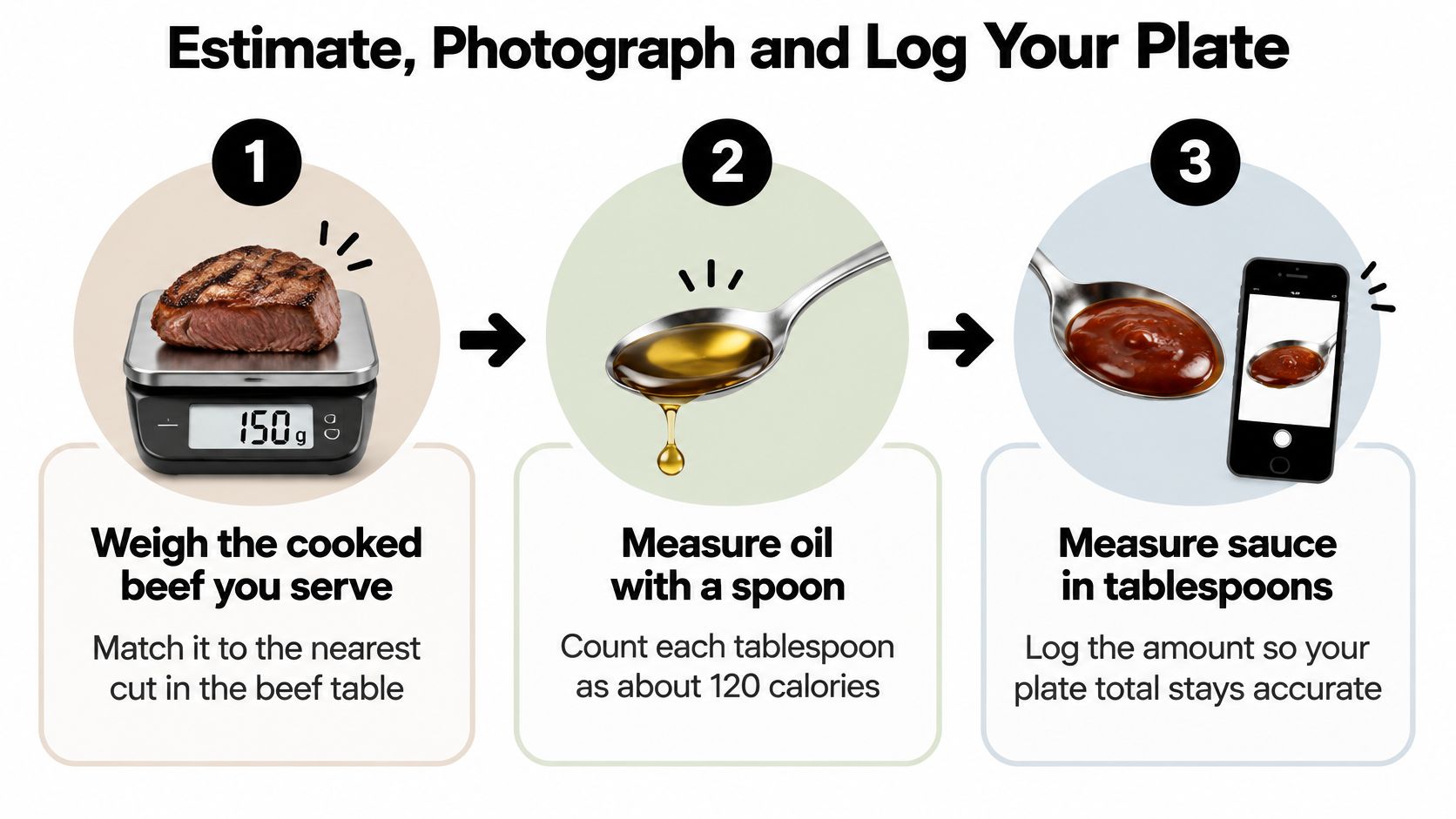
The visual below captures the measurements that are easiest to miss in a mixed dish.
Build a usable ingredient record
Weigh the cooked beef you serve. Match it to the nearest appropriate cooked cut or lean-to-fat ratio. If you calculated the entire recipe from raw ingredients instead, keep that method consistent.
Measure oil with a spoon. Record all additions, including marinade oil and a finishing drizzle. Avoid entering cooking oil again if your selected recipe entry already includes it.
Measure sauce in tablespoons. For bottled sauce, use the label's serving information. For homemade sauce, enter the ingredients and allocate the amount used to the dish.
Measure starch as cooked rice or noodles. Select an entry that matches the cooked food you're measuring. Keep fried rice or dressed noodles distinct from plain versions.
Add the vegetables. Record the mixture you cooked rather than using a calorie allowance for every possible combination. Include calorie-containing dressings or toppings separately.
Add the parts and divide by the share you ate. Keep a whole-pan calculation separate from a single-plate calculation. Otherwise, it's easy to divide an ingredient twice or assign the entire pan's sauce to your plate.
Photograph, then correct
Photograph the plate from above in even light, with the rice, beef and vegetables visible where possible. Take the picture before mixing everything together, and note details a camera can't establish, such as the cooking oil and sauce recipe.
A photo is a starting estimate, not a measurement of hidden ingredients. At a restaurant, describe what you can identify and leave room for uncertainty rather than assigning an exact quantity to oil you didn't measure.
- Review the ingredient list before saving. In Calorie Genie AI, a plate photo returns estimated calories, protein, carbs and fat, plus a health score with a short explanation. Tap any ingredient to adjust its portion or swap it, paying particular attention to the beef, oil, sauce and starch.
Keep precision in perspective
Even packaged-food calorie figures aren't always displayed as unrounded calculations. FDA nutrition-labeling guidance generally rounds calorie values of 50 or less to the nearest 5, and values above 50 to the nearest 10; a calculated 452 calories could therefore appear as 450.
Recipe uncertainty is separate from that rounding. An unidentified beef cut or unmeasured oil addition matters more than polishing the final total to an apparently exact number.
Aim for a useful, correctable record. Choose the plate description closest to your meal, replace guesses with measurements where practical, and save only the portion you ate. These estimates are a guide, not medical advice.
Calorie Genie AI offers photo-based estimates of calories and macros with editable ingredients, so you can adjust a beef stir fry for the beef, sauce, oil and rice on your plate. Visit Calorie Genie AI to explore meal scanning and review your next plate before saving it.