
Macros are protein, carbohydrate and fat, the three nutrients that supply calories in food, measured in grams and providing about 4, 4 and 9 kcal per gram, respectively.
If your calorie total looks right, why bother knowing where those calories came from? Because a calorie total describes energy, while macros help describe the food supplying it. You don't need to treat either number as exact to make that distinction useful.
Table of Contents
- What Macros Are and Why They Matter
- What Protein, Carbs and Fat Each Do
- How Macros Turn Into Calories
- Macro Values in Everyday Foods
- How to Set Your Daily Macro Targets
- Why Macro Numbers Are Only Estimates
- Start Tracking Your Macros Today
What Macros Are and Why They Matter
Macros, short for macronutrients, are nutrients your body needs in relatively large amounts. Protein, carbohydrate and fat supply energy and support your body's structure and everyday functions. The word macro means large, in contrast to micronutrients such as vitamins and minerals, which you need in much smaller amounts.
Think of a monthly budget. Total calories are the overall spending amount, while macros are the main categories within that budget. You can stay within the same total while allocating it differently.
A lunch of rice, chicken and avocado makes the idea concrete. Rice contributes mainly carbohydrate, chicken mainly protein, and avocado mainly fat, although these foods aren't pure packets of a single nutrient. Even a simple boiled egg contains both protein and fat.
Useful distinction: Calories describe how much energy food supplies. Macros describe the mix of nutrients supplying that energy.
Why people pay attention to the mix
Someone training regularly may pay particular attention to protein and carbohydrate. Someone eating vegan meals may use macro tracking to check how beans, tofu, grains and other foods fit together. Neither person needs to see macros as a special diet system.
The practical question isn't whether a meal has macros. It's whether its overall composition suits your needs and preferences.
Choose a meal you ate today and identify its main protein, carbohydrate and fat sources. If you already have a label or recipe entry, jot down rough gram amounts. A reasonable estimate is enough to begin.
What Protein, Carbs and Fat Each Do
The three macros at a glance
| Macro | Energy per gram | Main job in the body | Everyday sources |
|---|---|---|---|
| Protein | About four kcal | Builds and repairs tissue; provides material for enzymes | Chicken, fish, eggs, Greek yogurt, lentils, tofu |
| Carbohydrate | About four kcal | Supplies fuel for the brain and muscles | Rice, oats, bread, potatoes, fruit |
| Fat | About nine kcal | Supports cell membranes, hormone production and fat-soluble vitamin absorption | Olive oil, nuts, seeds, avocado, fatty fish, butter |
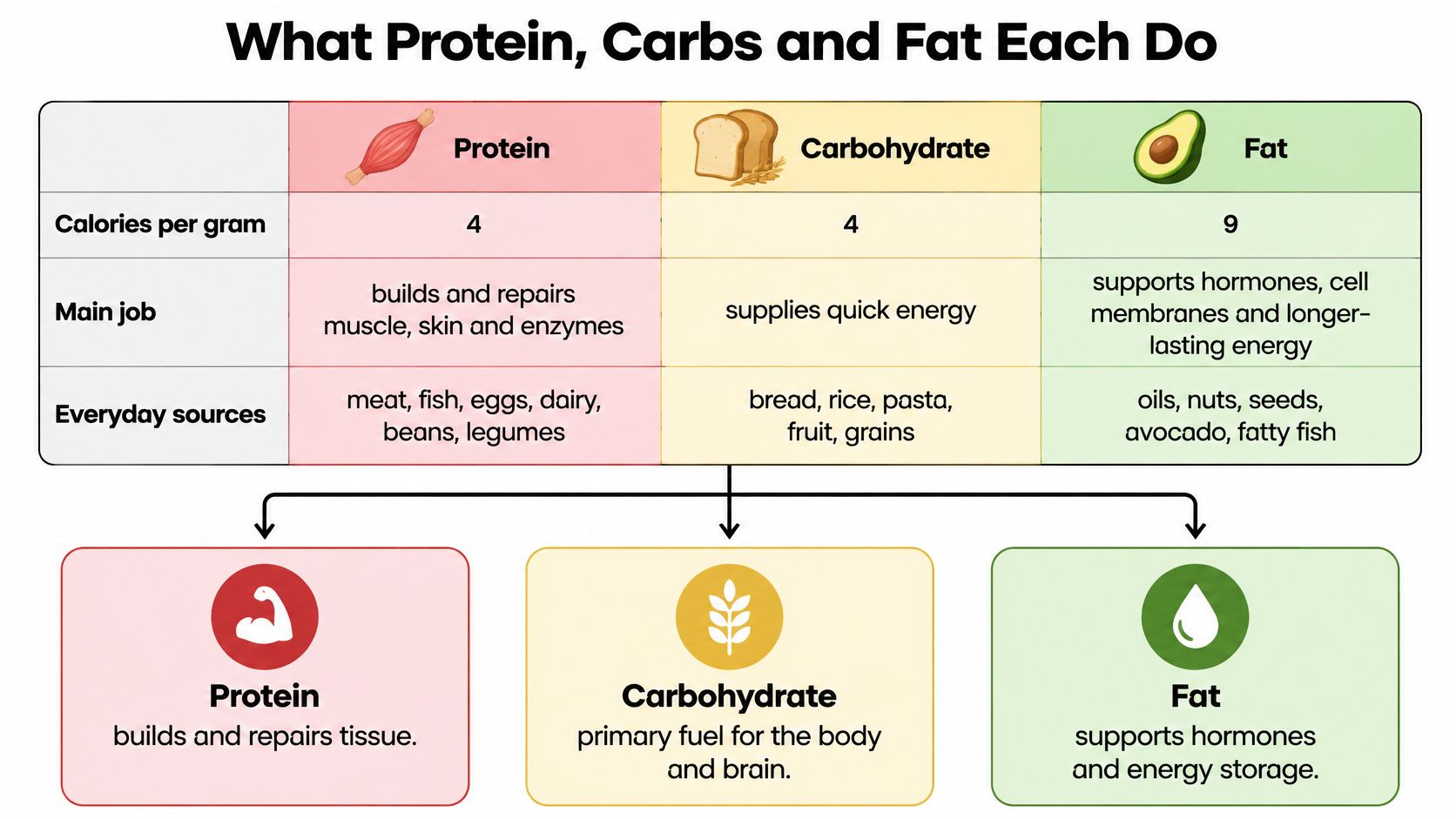
The comparison below connects each nutrient with familiar foods and functions.
Protein and carbohydrate do different jobs
Protein is the building crew in a simple household analogy. Your body uses its components to maintain and repair tissues and make functional proteins, including enzymes. Chicken and fish are familiar sources, but lentils, tofu and yogurt can contribute too.
A protein-containing food isn't necessarily only protein. Lentils also contribute carbohydrate, while eggs contain fat. That's why identifying a food's main macro is a useful shortcut, not a complete nutrition breakdown.
Carbohydrate is the fuel in the tank. Your body uses digestible carbohydrate for energy and stores some as glycogen in the liver and muscles. Bread, potatoes, rice and fruit can all contribute, despite looking quite different on a plate.
Fiber belongs within carbohydrate, but it doesn't behave like digestible sugar or starch. Keep that distinction in mind when comparing a food's total carbohydrate with the energy listed on its label.
Fat is more than stored energy
Fat is the most energy-dense macro. The garage-reserve analogy captures its role in energy storage, but fat also contributes to cell membranes and helps your body absorb fat-soluble vitamins.
Oil, nuts and avocado are everyday examples. Our guide to calories in avocado offers a closer look at a food people often recognize as nutritious without considering the portion.
Don't turn these categories into a ranking from best to worst. Protein and essential fats must come from your diet, and carbohydrate-containing foods can provide useful fuel and fiber. The practical question is how to combine foods, not which entire category deserves blame.
How Macros Turn Into Calories
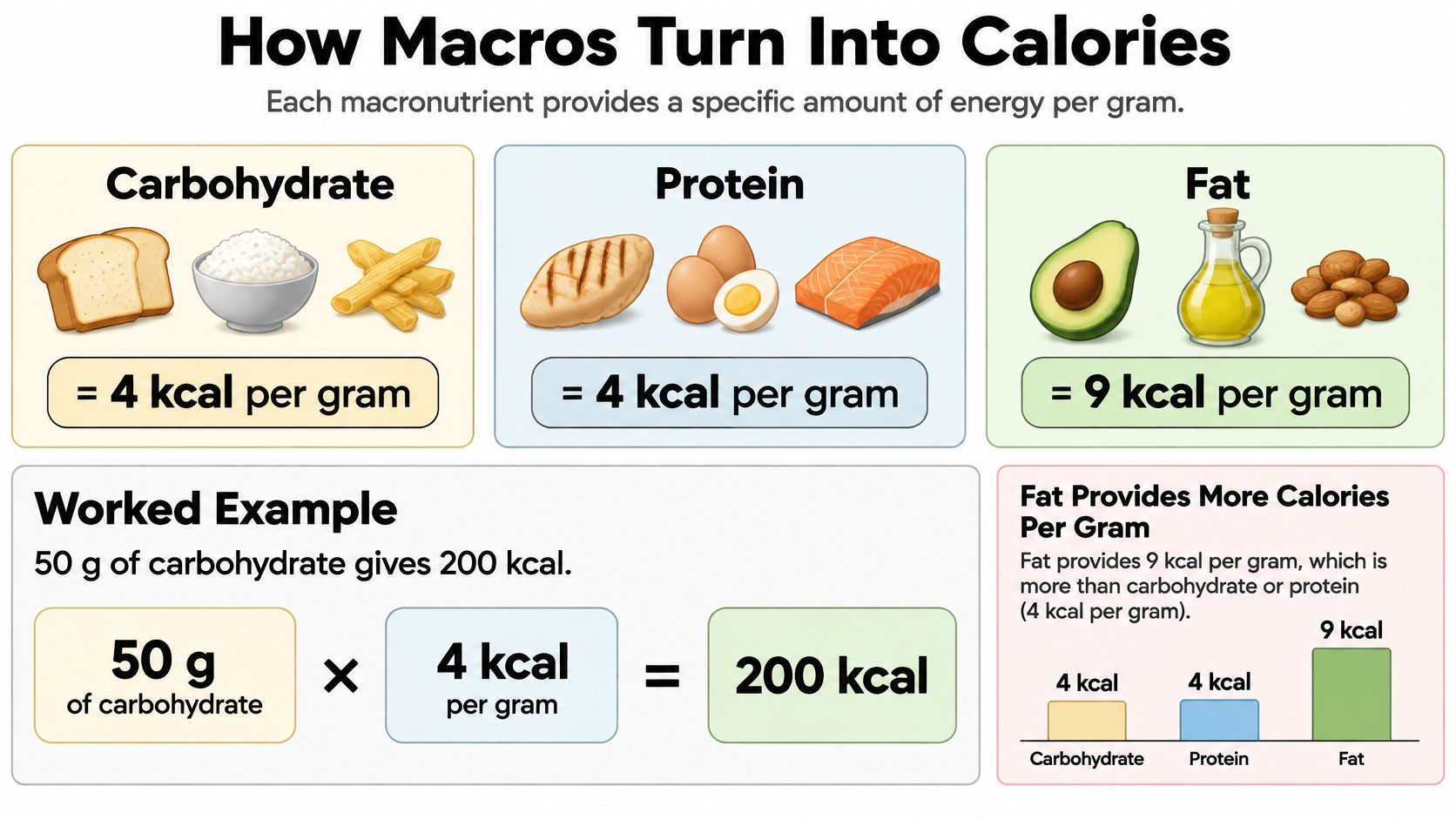
The standard Atwater factors assign approximately 4 kcal per gram to carbohydrate and protein and 9 kcal per gram to fat, as described in the National Academies' dietary reference material.
On food labels, Calories usually means kilocalories, abbreviated kcal. You don't need separate calculations for the everyday label term and the scientific abbreviation.
This visual shows the conversion before you apply it to a meal.
Work through a lunch estimate
Say you log a rice bowl containing chicken, vegetables and dressing. For this hypothetical meal, the ingredient entries total the following amounts.
| Macro | Worked arithmetic | Estimated energy |
|---|---|---|
| Carbohydrate | 50 g × 4 kcal per gram | 200 kcal |
| Protein | 30 g × 4 kcal per gram | 120 kcal |
| Fat | 20 g × 9 kcal per gram | 180 kcal |
| Total | 200 + 120 + 180 | 500 kcal |
These are assumed totals for the example, not a nutrition claim about every chicken-and-rice bowl. Your own recipe could produce a different result.
Notice that the largest gram amount doesn't necessarily make the largest contribution per gram. Using the same factors, 10 g of fat supplies about 90 kcal, while 10 g of protein or carbohydrate supplies about 40 kcal. That's why a small amount of dressing or cooking fat deserves attention when you estimate a meal.
Use the equation without expecting perfection
The planning rule is straightforward:
Estimated calories = carbohydrate grams × their energy factor + protein grams × their energy factor + fat grams × their energy factor.
The result remains approximate. Fiber isn't completely metabolized like digestible carbohydrate, and food-label conventions, sugar alcohols and rounding can affect the comparison.
For planning, consider both grams and share of total energy. Grams help you assemble portions; energy shares help you understand the overall balance.
For a video explanation alongside the arithmetic, use the player below.
Macro Values in Everyday Foods
Macros in common everyday servings
A lookup table works best when it gives you numbers to start from, so the figures below are typical gram values drawn from standard USDA FoodData Central entries. Treat each one as an approximation: brand, cooking method and serving weight can affect the actual values, which is why a packaged food still deserves a quick label check.
| Food and serving | Protein in grams | Carbohydrate in grams | Fat in grams |
|---|---|---|---|
| Cooked white rice, 1 cup (about 158 g) | ~4 | ~44 | under 1 |
| Cooked lentils, 1 cup (about 198 g) | ~18 | ~40 | ~1 |
| Large egg, 1 egg (about 50 g) | ~6 | under 1 | ~5 |
| Plain nonfat Greek yogurt, 100 g | ~10 | ~4 | under 1 |
| Avocado, 100 g edible flesh | ~2 | ~9 | ~15 |
| Almonds, small handful (about 28 g) | ~6 | ~6 | ~14 |
Read across a row and a pattern appears. Rice is mostly carbohydrate, an egg splits fairly evenly between protein and fat, and almonds carry more fat than anything else listed. No single food delivers all three macros in large amounts, so a meal gets its balance from the combination of parts, never from one ingredient doing everything.
Matching an entry to what you ate still matters. Cooked rice and dry rice are different entries with different values per cup, and an avocado figure should describe the flesh on your plate rather than the peel and stone you discarded. For packaged yogurt or almonds, your brand's label may sit slightly above or below the typical figure, and either number is fine for estimating.
Build the meal from its parts
For chicken, rice and olive oil, work through the ingredients separately:
- Chicken: Choose an entry that matches the cut, cooked state and whether you ate the skin.
- Rice: Match the cooked portion to a cooked-rice value like the one above, or calculate it from your batch recipe.
- Olive oil: Include the oil used in the dish, divided across the portions the recipe produced. A tablespoon contributes roughly 14 g of fat on its own.
- Sauce: Check whether it was already counted in the recipe before adding it again.
Then sum each ingredient's protein, carbohydrate and fat. A quick check using the table: rice plus lentils gives you roughly 84 g of carbohydrate and 22 g of protein before anything else touches the plate. Remove the oil from the recipe and subtract its contribution from the total as well, rather than leaving the original figure unchanged and assuming the difference is small.
Compare foods without grading them
A different grain changes the meal's composition without making the original choice wrong. Swapping rice for quinoa shifts the balance toward protein, and the numbers in quinoa nutrition facts let you compare it directly with the grain you normally serve.
Every figure here is a starting point. Refine it with your own labels and portions, and let the estimate stay approximate.
How to Set Your Daily Macro Targets
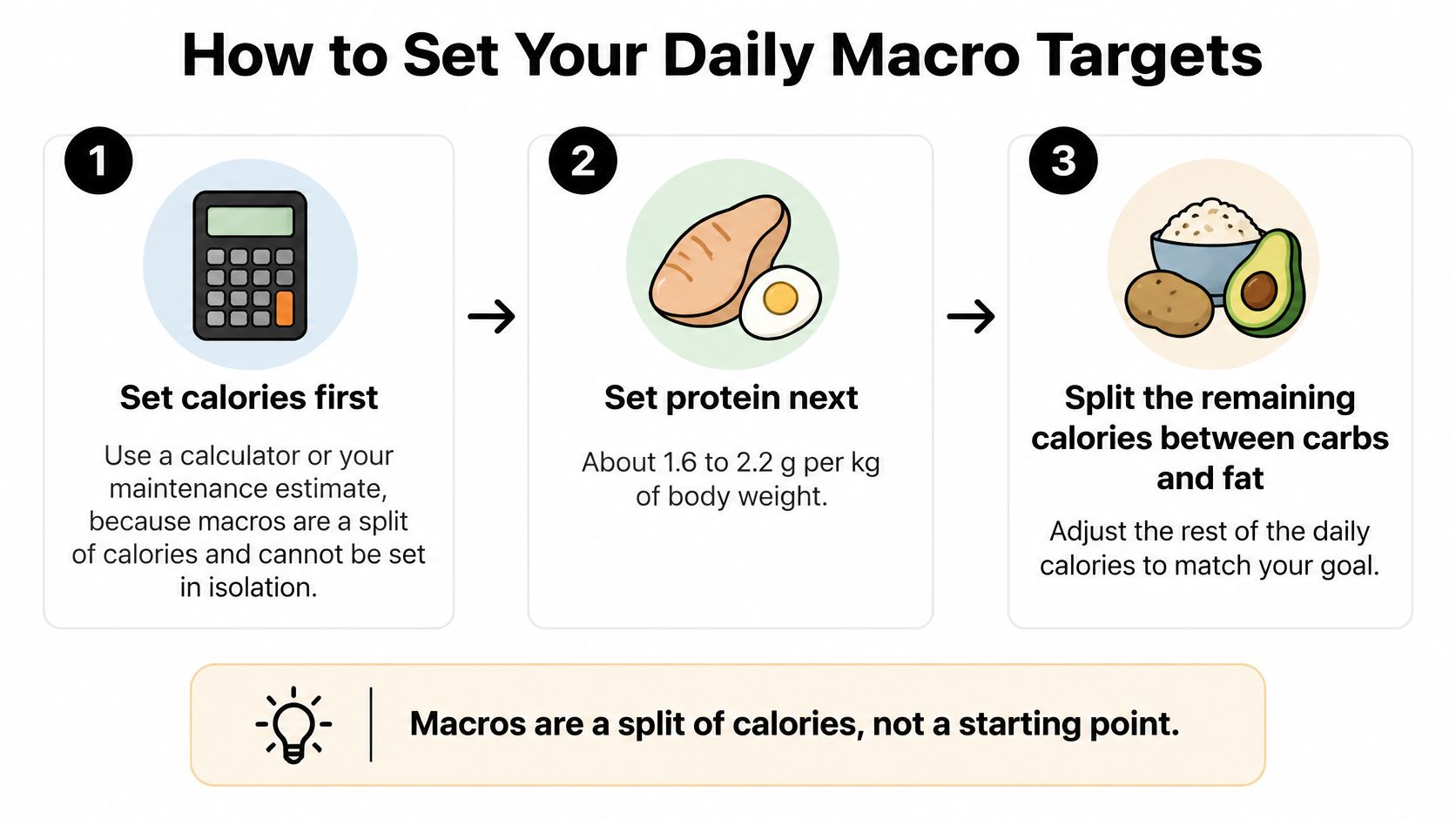
Set the calorie context before choosing a macro split. Otherwise, you're dividing a budget without knowing its total.
Your starting point should reflect your goal, body size, activity and food preferences. A calculator can provide an initial estimate, but its result isn't a personalized medical prescription.
Build a starting plan
Estimate total energy needs. Choose a starting calorie target appropriate to maintenance, weight management or training goals. If you're unsure how to do this safely, a registered dietitian can help.
Choose a protein target. Consider your activity, usual food intake, and dietary requirements. Don't borrow someone else's gram target just because they have a similar goal.
Allocate carbohydrate and fat. Consider the meals you enjoy and the fuel demands of your activities. A plan built around foods you dislike is difficult to maintain, even if its arithmetic looks tidy.
Convert energy allocations into grams. Use the relevant energy factor for each macro. Keep rounded figures as working targets rather than trying to make every displayed total match perfectly.
Check the plan against real meals. Sketch a normal breakfast, lunch, dinner and snacks. If reaching the targets requires constant substitutions or uncomfortable portions, revise the starting plan.
For a more detailed walkthrough, use our guide on how to calculate macros.
The process illustration below summarizes the order of operations. Its body-weight protein suggestion shouldn't be treated as a universal prescription.
Understand a split before adopting it
A split expresses how you allocate energy, not the relative weights of food on your plate. Equal-looking portions of chicken, rice and avocado won't automatically produce equal macro energy shares.
| Planning question | What to check |
|---|---|
| Is the protein target practical? | Whether your normal meals can supply it comfortably |
| Does carbohydrate suit your activity? | Whether your eating pattern supports training and daily energy |
| Does fat fit the calorie total? | Whether oils, spreads, nuts and dressings are included |
| Is the plan sustainable? | Whether it accommodates your preferences, budget and routine |
A workable target should help you decide what to eat, not require you to redesign your life around a calculator.
Review your weight trend where relevant, along with hunger, energy and training performance. Change a specific part of the plan deliberately rather than repeatedly replacing the entire approach.
Why Macro Numbers Are Only Estimates
Macros are targets, not precise daily pass-or-fail scores. A tracker displaying exact-looking digits doesn't make the underlying meal measurement exact.
In the United States, serving sizes reflect what people typically consume rather than what they should consume, and the FDA's Nutrition Facts label guide explains per-serving information and rounding conventions, including that calories under 5 may appear as zero.
A serving is therefore a reference amount, not an instruction to finish that amount or stop eating there. Check how much you consumed before comparing the label with your diary.
When an app and a label disagree
For a packaged product, check the exact brand, serving weight and preparation instructions. A generic database entry may describe a different formulation, while your app may be displaying a different portion.
For home cooking, investigate the recipe. Roasting vegetables with oil isn't the same entry as cooking them without it, and a sauce may be included in a recipe calculation or listed separately.
- Correct known details: Update an incorrect ingredient, portion or preparation method.
- Accept remaining uncertainty: You usually can't reconstruct every ingredient in a restaurant meal.
- Use a consistent method: Similar logging decisions make your records easier to interpret over time.
Drop the two common misconceptions
Carbohydrate isn't bad. A food's usefulness depends on the whole eating pattern, its composition and your needs, not whether it contains carbs.
Every gram doesn't need to match. A small difference between a target and your logged intake isn't evidence that you've failed. Judge patterns across your eating routine rather than treating an isolated meal as a final score.
Aim for a reasonable range most days. Consistency and honest corrections are more useful than a perfectly matching dashboard built from uncertain entries.
Start Tracking Your Macros Today
Choose a starting macro target and keep your logging method steady long enough to learn from it. Begin with an ordinary meal rather than waiting for a day when every ingredient is easy to measure.
Record the complete meal: include drinks, spreads, dressings and preparation ingredients. A kitchen scale can help when it's convenient, while package information and recipe notes provide useful context.
Review before you save
Check that your entry describes the food you ate. For photo-based or automatically filled entries, correct obvious ingredient and portion errors instead of accepting the result without review.
Any suitable tracker or spreadsheet can organize the arithmetic. During our Calorie Genie setup, you share your goal, body stats and activity level, and we set daily calorie and macro targets that you can adjust at any time in Settings.
Start small: Log a familiar meal carefully, then use that experience to make the next entry easier.
Review hunger, energy, training and any relevant weight trend before changing your plan. Adjust deliberately, not in response to a single unusual day.
This is general nutrition information, not medical advice. If you have a medical condition or a history of disordered eating, speak with a doctor or registered dietitian before changing your diet or beginning detailed tracking.
Calorie Genie AI estimates calories, protein, carbohydrate and fat from a meal photo, with editable ingredients and portions. Visit the site to explore photo-based macro tracking, then review your first meal estimate using the preparation details you know.