
A calorie log can look complete and still miss a substantial share of what someone ate. That makes calorie counter accuracy a question of more than which app you use. The useful question is where your estimate goes wrong, because a forgotten snack, an oversized serving and an uncertain restaurant recipe need different fixes.
Table of Contents
- How Accurate Calorie Counters Really Are
- Why Nutrition Labels Are Estimates Too
- How Manual Logging Undercounts Your Intake
- Why Photo Estimates Miss Portion Size and How to Correct Them
- Restaurant Calories and the Margin of Error
- How to Test Your Own Tracking Error
- Build a Tracking Routine You Can Trust
How Accurate Calorie Counters Really Are
Typical calorie-tracking error by method
| Tracking method | Typical error | Main source of error | What it means for you |
|---|---|---|---|
| Nutrition label | A regulated tolerance, not an exact measurement | Ingredient variation, laboratory measurement and serving assumptions | Match the serving to what you actually ate |
| Manual food record | Substantial under-reporting in dietary-assessment studies | Forgotten snacks, guessed portions and hidden oil | Weigh familiar staples and record extras |
| 24-hour recall | Understatement of intake on average | Memory gaps and missed foods | Record meals while the details are fresh |
| AI photo estimate, ChatGPT and Claude | Substantial average absolute energy error in standardized-photo testing | Portion mass and hidden fats | Correct oil and portion assumptions first |
| AI photo estimate, Gemini | Large errors across nutrients in standardized-photo testing | Uncertain quantities and macronutrient estimates | Don't treat an uncorrected photo as exact macro tracking |
| Restaurant calorie label | Meaningful differences between listed and measured energy | Preparation variability, portions and sauces | Start with the label, then account for known differences |
| Wearable exercise calories | Underestimated overall, with errors in either direction | Sensor limitations and activity type | Keep exercise estimates separate from food intake |
These aren't interchangeable measures of accuracy. A legal tolerance describes regulatory compliance. Mean absolute percentage error describes the size of errors without allowing overestimates and underestimates to cancel. Under-reporting describes a directional shortfall.
That distinction matters when comparing methods. You can't rank a nutrition label against a photo model by putting their percentages side by side. They were assessed against different reference points, in different settings, using different calculations.
A precise tool can still produce an uncertain total
A kitchen scale illustrates the problem. It can give you a precise ingredient weight, but a recipe cooked from memory may include an unrecorded pour of oil, a different cut of meat or a larger serving than intended. The weight measurement doesn't correct the recipe assumptions.
A calorie counter works the same way. Its arithmetic may be correct while its inputs are incomplete. Before changing apps, ask whether the weak point is food identification, quantity, nutrition information or completeness of logging.
Practical rule: Correct the uncertain input before worrying about the precision of the final total.
Calorie counters are best treated as tools for comparing eating patterns and building repeatable habits, rather than judging the exact energy content of an isolated meal. Plan around an error band, not the apparent certainty of a single number.
An error band isn't a universal percentage to attach to everything. It should reflect what you know about the meal and how you recorded it. Calorie estimates are a guide for general information, not medical advice.
Why Nutrition Labels Are Estimates Too
A printed nutrition panel is regulated, but it isn't a laboratory measurement of the particular serving on your plate. As Cleveland Clinic explains, U.S. rules allow calories and several nutrients people generally seek to limit to be up to 20% above the declared amount, meaning a serving labeled 100 calories could contain approximately 120, while a 500-calorie frozen meal could contain about 600 within that allowance.
That isn't a reason to assume every manufacturer understates calories. It's a reason not to confuse a permitted tolerance with a prediction about an individual product. Adding the full allowance to every packaged food would replace one uncertain assumption with another.
Why the printed value can differ
Agricultural ingredients aren't identical from batch to batch. Manufacturers also work with variation in recipes, production, laboratory measurements and serving assumptions. A nutrition panel summarizes those inputs rather than guaranteeing an identical energy value in every package.
The serving is especially important. If you eat more than the declared serving, you increase both the logged estimate and the possible absolute discrepancy. A perfectly copied label can still produce a poor entry when the amount eaten doesn't match the amount listed.
Use these habits when logging packaged foods:
- Compare the units. Check whether the panel describes a package, a serving or a weight, then match it to your portion.
- Check preparation. Confirm whether the values describe the food as sold or after preparation with other ingredients.
- Keep the estimate grounded. Use the declared value as your baseline instead of automatically increasing or decreasing it.
- Standardize repeat foods. Save the correct product and usual portion rather than repeatedly choosing a similar-looking database entry.
Our guide to reading a nutrition label can help you interpret the serving information before logging.
The practical distinction is between uncertainty you can't remove and entry errors you can correct. You can't test every package in a laboratory, but you can stop recording a full package as a smaller serving.
How Manual Logging Undercounts Your Intake
A diary can contain the right foods and still understate intake. The gap often comes from eating occasions and ingredients that never make it into the record.
A dietary-assessment study published in the European Journal of Clinical Nutrition reported these 2016 study averages:
- Estimated energy expenditure: 2,540 kilocalories per day.
- Food-record intake: 1,774 kilocalories per day, about 30% below estimated expenditure.
- 24-hour-recall intake: 1,658 kilocalories per day, about 35% below estimated expenditure.
The comparison below shows the difference between estimated expenditure and reported intake.
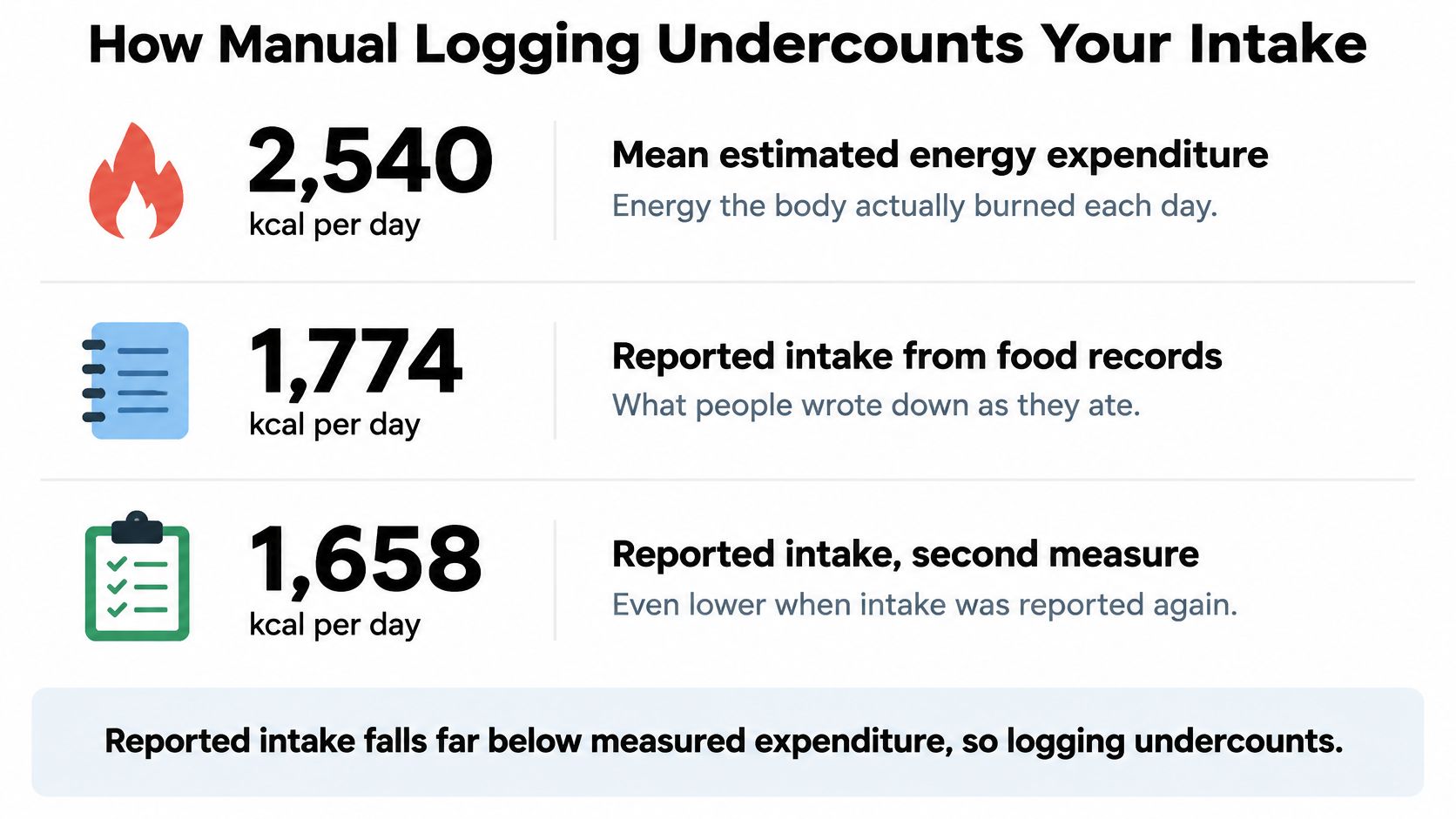
These averages are not a correction factor for an individual diary. Participants did not all miss the same proportion, and automatically increasing a food log by 30% or 35% would not establish what one person ate. The figures show that a detailed-looking record can still be incomplete.
Where the missing entries come from
Some omissions are easy to overlook because they happen outside a planned meal. Others are hard to recall later:
- Snacks between meals. A handful taken from a shared bag may never become a diary entry.
- Tastes while cooking. Sampling a sauce or finishing an ingredient can disappear from memory by dinner.
- Oil and butter. Recording the main food without its cooking fat leaves the recipe incomplete.
- Sauces and dressings. The salad may be logged while its dressing is only estimated.
- Drinks. Milk, sweeteners and other additions need to be recorded too.
- Remembered portions. Reconstructing a serving later relies on memory for both the food and its quantity.
These gaps reflect the work involved in logging, not a lack of effort. Eating, cooking and remembering are separate tasks; a diary captures only what someone notices and enters.
Automation can reduce the delay between eating and recording. Photographing a meal while it is in front of you creates a prompt, but the image cannot establish how much oil went into the pan or whether you finished everything shown.
A more reliable routine separates capture from review: log promptly, then check for ingredients and portions the entry may have missed. Faster logging is useful when it helps make records more complete, not when it turns an estimate into an unquestioned number.
Why Photo Estimates Miss Portion Size and How to Correct Them
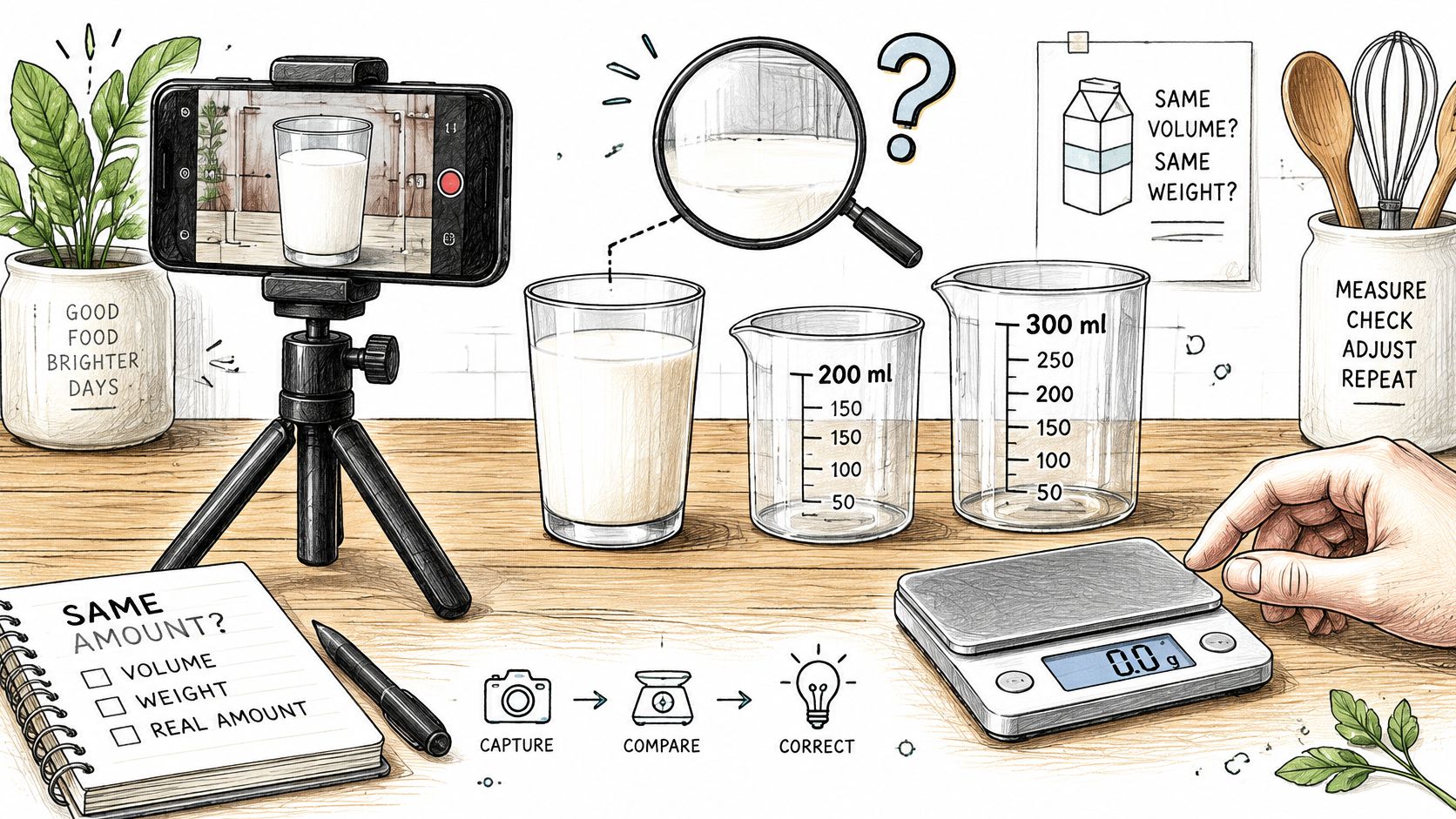
A photo of a glass of milk can identify the drink without establishing how much the glass holds. The image may show its outline clearly while leaving its depth, capacity and fill volume uncertain. Recognizing milk and measuring milk are different tasks.
A USDA-supported study of portion-size estimation aids found average misestimation across foods within ±20%, yet fewer than one-third of participants estimated any particular food within ±20%; three-dimensional aids performed somewhat better than two-dimensional aids, but neither reliably measured an individual's exact intake.
That result highlights a trap in averages. A method can look reasonable across a group of foods while remaining unreliable for the specific serving you're about to eat. A reassuring average doesn't establish confidence in your plate.
The useful complement to a photo is a measurement of the quantity the image can't establish.
Identification isn't quantity estimation
A model may correctly identify chicken and rice while making uncertain assumptions about their weights. It may also miss oil absorbed during cooking, a sauce beneath the rice or ingredients inside a mixed dish. Each missing detail changes the calculation without necessarily changing the visible food category.
In a 2025 evaluation of standardized food photographs, ChatGPT-4o and Claude 3.5 Sonnet had energy mean absolute percentage errors of about 35.8%, while Gemini 1.5 Pro's errors ranged from 64.2% to 109.9% across nutrients; all three systems systematically underestimated larger portions, and macronutrient estimates were especially problematic.
These findings describe the evaluated systems and photographs, not a validated accuracy score for every photo calorie counter. They also don't establish that a model with an acceptable calorie estimate has correctly estimated protein, carbohydrate and fat.
A total can appear plausible even when its components are wrong. For someone using a macro tracker, that distinction matters: a calorie result alone doesn't verify the protein result.
Correct assumptions in order of impact
Treat the initial result as a draft, then review the variables most likely to change the meal total.
Check cooking oil and fat first. Look for omitted butter, oil or other cooking fat. If you're logging a shared recipe, assign your share rather than the entire pan's ingredients.
Inspect sauces and dense toppings. Check dressing, mayonnaise, cheese, nut toppings and creamy sauces separately. Don't assume the main dish entry includes them unless its description says so.
Replace guessed quantity with known quantity. Use a measured weight when available, matching a cooked weight to a cooked-food entry. If you don't have a scale, use a familiar container or serving utensil consistently.
Specify preparation. Fried, baked and steamed versions shouldn't be treated as interchangeable when their ingredients differ. Describe the preparation rather than expecting the image to reveal it.
Review macros independently. Ask whether the protein-containing ingredient, carbohydrate portion, and added fats each make sense. Don't approve all of them just because the calorie total looks familiar.
For a more repeatable reference, use our guide to figuring out portion size.
This video provides an additional visual reference alongside the measurement checks.
Confidence should follow the available information
A separately served food with a known weight gives you a different basis for confidence than an unfamiliar casserole. Review effort should reflect that difference. Spend more attention on meals with concealed ingredients, uncertain portions or unclear preparation.
A correction to a major missing ingredient is more useful than polishing several minor details in an incomplete recipe.
Consistency can make a log useful for comparing patterns, but consistent underestimation doesn't become accurate through repetition. It can still distort an absolute target, and it may stop being consistent when your meals change.
For precise athletic or clinical nutrition, don't rely on uncorrected photo macros. A useful app should expose ingredients and portions, allow correction and communicate uncertainty rather than presenting a highly specific total as proof of measurement.
Restaurant Calories and the Margin of Error
A posted menu number doesn't settle the question of what arrived at your table. In a study of calorie-labelled food from English out-of-home outlets, the average absolute percentage difference between listed and measured energy was 21%, and 35% of sampled items differed by more than 20%, with substantial discrepancies in both directions.
That last detail matters. Restaurant values aren't always too low. Automatically adding the same buffer to every dish would overlook the possibility that the displayed value already overstates its measured energy.
Use the menu as a baseline
A menu scanner or calorie ranking starts with information that may itself be uncertain. Its useful role is decision support, not certification of the meal's energy content. A small displayed difference between dishes may be less meaningful than a clear difference in portion or preparation.
Use a practical sequence when ordering:
- Record the listed value. Keep the restaurant's figure as the starting point instead of substituting an unrelated generic dish.
- Check what's included. Establish whether sides, dressings, dips and optional toppings belong in that entry.
- Flag uncertain preparation. Fried foods, creamy sauces and mixed pub-style meals deserve closer review when ingredient amounts aren't available.
- Adjust known differences. Record extra sauce, a substituted side or an unfinished portion when you can identify it.
- Keep unknowns visible. Use a note or working range rather than inventing an exact correction.
A conservative estimate can be reasonable when you have a specific reason to suspect an omitted ingredient or larger portion. It shouldn't become a penalty automatically attached to eating out.
For example, if a creamy pasta arrives with extra sauce that wasn't described on the menu, preserve the listed baseline and record the addition separately where possible. If you can't estimate that addition credibly, mark the meal as uncertain rather than claiming you've calculated a reliable upper limit.
Our guide to calories on menus explains how to use displayed information when choosing a meal.
The aim is a reasonable, consistent choice. You don't need to solve an unknown restaurant recipe to make a useful entry, but you do need to distinguish what the restaurant stated from what you inferred.
How to Test Your Own Tracking Error
A kitchen scale can help you test portion and logging assumptions. It can't turn a nutrition database into laboratory truth, so treat this as a comparison against a better-documented reference, not a measurement of your true calorie intake.
Run a short meal audit
Choose a small set of meals you eat regularly and compare your usual method with ingredient-based logging. Repeat the comparison over a week so you're not judging your routine from an unusually simple or complicated meal.
Select repeat meals. Include the meals that contribute most to your normal routine, not just the easiest foods to weigh.
Create a reference record. Weigh ingredients, include cooking fats and sauces, and record the cooked yield for shared recipes. Weigh your served portion so you can assign its share.
Log normally before checking. Use your usual photo estimate, database selection or serving guess. Saving that result first prevents the weighed record from influencing your normal estimate.
Compare like with like. Check the difference between the usual entry and the ingredient-based reference. Express the gap as the usual estimate minus the reference, divided by the reference.
Keep both direction and spread. Note whether you usually log below or above the reference, and which meals produce the largest gaps.
A negative result means your normal entry was lower than the reference. A positive result means it was higher. Neither tells you that the reference itself is exact.
Audit insight: Your most useful finding may be a recurring cause, such as unlogged dressing, rather than an average percentage.
Use the result carefully
Don't turn a small meal audit into a permanent correction for every food you eat. Use it to identify which entries need a saved recipe, a measured portion or a better description.
The observed spread is a working error band for those meals and methods, not a statistical confidence interval. Recheck it when you change your main meals or logging habits.
Build a Tracking Routine You Can Trust
A useful routine doesn't require equal effort for every meal. It requires a stable method, deliberate checks where uncertainty is high and restraint when interpreting the result.
Start with these decisions:
- Choose a main logging method. Keep it consistent enough that changes in your records mean something.
- Match packaged-food servings. Record the amount eaten rather than accepting the default.
- Review uncertain meals selectively. Focus attention on consequential ingredients and portions.
- Separate exercise from intake. Don't automatically convert a workout estimate into additional food.
Don't let a wearable set the food budget
Exercise estimates add another measurement problem. A systematic review and meta-analysis covering consumer activity monitors found overall underestimation of energy expenditure, with a pooled effect size of −0.23 and reported primary-study errors ranging from −21.27% to +14.76%; adding physiological signals such as heart rate or heat sensing generally reduced error.
The pooled effect size isn't a percentage correction you can apply to your watch. Nor does average underestimation mean your particular workout was underestimated. Device and activity differences prevent that shortcut.
Keep workout expenditure visible but separate from food intake. Before routinely adjusting your food target for exercise, consider how your activity was already represented in the target and whether you're counting it again.
Compare logged intake with multi-week body-weight trends before changing targets. That provides a more useful check than reacting to an isolated meal, workout or weigh-in, although it still doesn't isolate the exact source of every discrepancy.
Make review part of saving
In Calorie Genie, a scan returns calories, protein, carbs and fat with a health score, and you can tap any ingredient to change its portion before saving. During setup, you share your goal, body stats and activity level; the app sets a daily calorie and macro target that you can adjust at any time in Settings.
Use those controls to correct information you know, not to force the estimate to match a number you hoped to see. An editable estimate is useful because you can improve its assumptions, not because editing guarantees accuracy.
At your weekly check, review the overall trend and identify the most plausible logging issue. Change a specific habit, such as recording cooking fat or standardizing a repeat meal, before changing several variables together. Keep the uncertainty visible while you assess whether the routine is becoming more consistent.
Calorie Genie AI offers photo-based calorie and macro estimates with editable ingredients and portions, so you can review what the camera couldn't establish before saving. Visit Calorie Genie AI to explore a tracking workflow built around quick capture and practical corrections, with estimates treated as a guide rather than exact measurements.