
Portions of salty snacks grew 60% between 1977 and 1996, soft drinks grew 52% and hamburgers 23%, according to a JAMA analysis of national food surveys covering more than 60,000 Americans. The food didn't change. The amount everyone agreed to call a normal serving did.
Which is why learning how to figure out portion size is less about willpower than about calibration. Your idea of a normal plate was learned in a food environment that kept enlarging the plate, so trusting your eye harder won't fix anything. Giving your eye a reference to check against will.
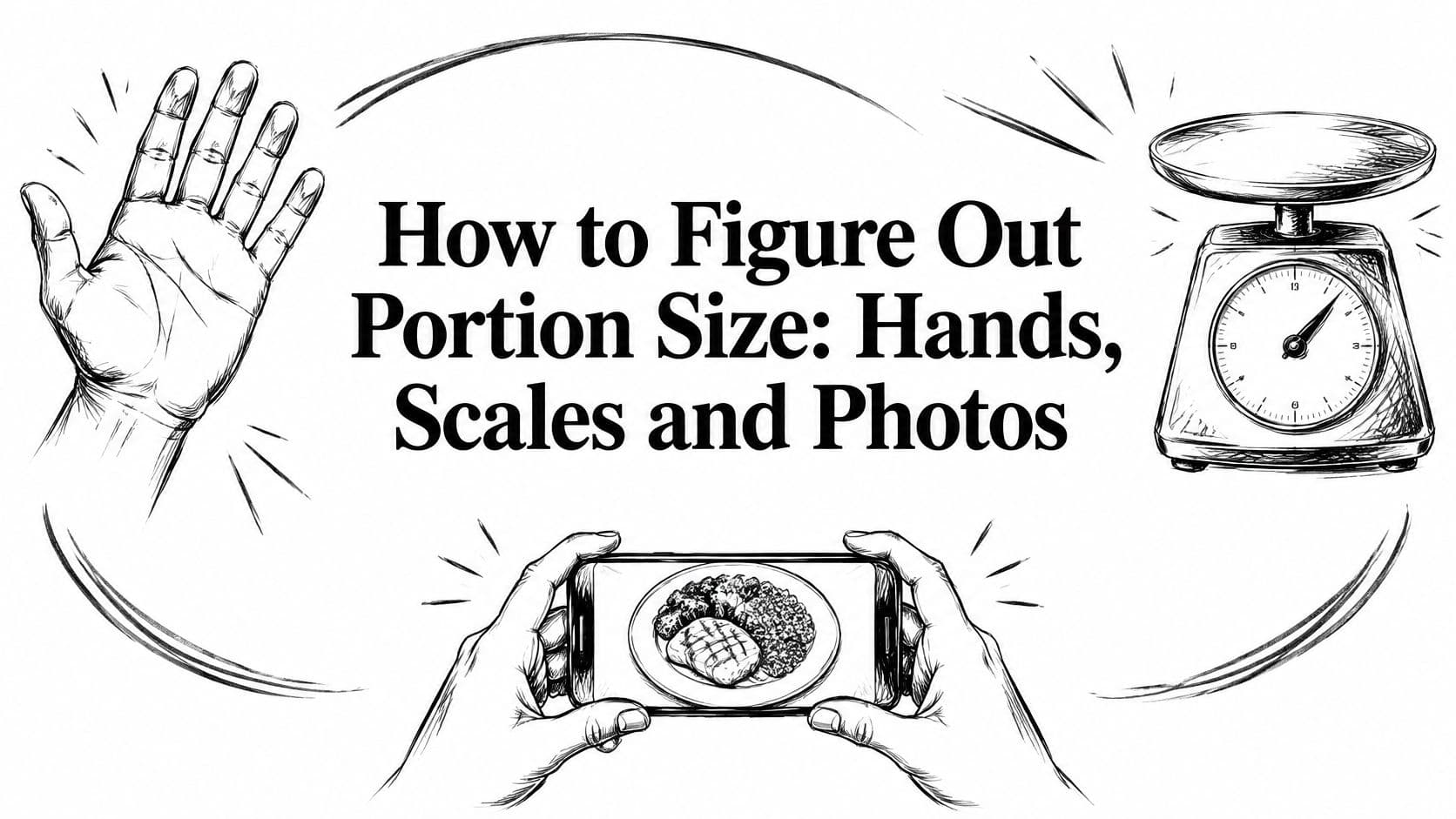
The methods here run from cheapest to most accurate: your hand, the label, a finger used as a ruler, a photograph, and one weighing of a food you eat every week. Each one has a known failure mode. Knowing which method you're using matters more than the precision of any single number.
Table of Contents
- Standard Portions You Can Measure with Your Hands
- Label Serving, Eaten Amount and Typical Portion
- Estimating Portions Without a Scale, Step by Step
- Portions from Photos, Restaurants and Menus
- Build Your Personal Reference and Choose a Method
Standard Portions You Can Measure with Your Hands
Get the reference numbers into your head first. These are the amounts a typical adult serving lands near, with the hand shape that stands in for each one.
| Food | Standard amount | Hand or household measure |
|---|---|---|
| Cooked rice or pasta | 1/2 cup (about 100 g) | One cupped hand |
| Cooked meat, fish or tofu | 3 oz (about 85 g) | One palm, without fingers |
| Cheese | 1.5 oz (about 40 g) | Two thumbs |
| Nuts or seeds | 1 oz (about 28 g) | One small handful |
| Fresh fruit | 1 medium (about 150 g) | One fist |
| Cooking oil or butter | 1 tsp (5 ml) | Tip of your thumb |
| Dry breakfast cereal | 3/4 cup (about 30 g) | One and a half cupped hands |
| Leafy vegetables | 2 cups raw or 1/2 cup cooked | Two cupped hands raw, one cupped hand cooked |
Read the hand column as a shape, not a promise. A cupped hand holds about half a cup of loose grains when your fingers sit together and the palm is slightly hollowed; a flat, open palm holds noticeably less. A palm-sized piece of protein means the width and length of your palm with the fingers excluded, at roughly the thickness of your little finger. Two thumbs of cheese is a piece the length of your thumb from knuckle to tip, doubled over.
Why hands work at all
Hand measures scale with the body holding them, which is the reason they survive in almost every printed nutrition guide. A taller person with a bigger hand usually needs more food, and the measure moves with them instead of against them. The corollary matters just as much: your hand gives you a range, not a reading, and two people comparing palms will produce different gram weights for the same shape.
Three places the method slips:
- Oil and butter. A thumb-tip of oil is easy to double without noticing, and it's the densest thing on the plate.
- Amorphous piles. A cupped hand of rice, pasta or mash changes with how loosely it's packed.
- Thin spreads. Peanut butter, mayonnaise and jam on a cupped-hand-sized slice of bread are invisible to hand measures.
Pick the two or three foods you eat most weeks, whether that's rice, chicken, cereal or oil, and check one serving against your own hand this week. Measure half a cup of cooked rice into your cupped hand once, and you'll carry a personal calibration around for years.
Label Serving, Eaten Amount and Typical Portion
Three different numbers get called a portion, and blurring them is the most common reason a calorie log drifts by hundreds of calories a day. The label serving is a unit of measurement printed on packaging. The amount eaten is what left the plate. The personal portion is what suits your body, your goal and your appetite that day. Only the middle number belongs in a log.
The FDA's guidance on the Nutrition Facts label is explicit that serving sizes are not recommendations. They have to reflect how much people eat. When intake data shifted, the agency moved the reference amounts: ice cream went from 1/2 cup to 2/3 cup, soda from 8 to 12 ounces and yogurt from 8 to 6 ounces. A larger number on a label describes eating habits. It isn't a permission slip.
Packages make the point concrete. A 600 ml bottle of a juice drink usually carries two or three labelled servings, so finishing it is two or three log entries, not one. A sharing bag of crisps works the same way. The label describes a fraction of the container, and the container is what's in your hand at nine in the evening.
A label serving is a unit of measurement, not a target. It exists so the calories printed beside it mean something.
Your eye won't rescue you here. A Rutgers study of young adults published in 2006 asked participants to serve themselves typical portions, then compared those portions with the reference amounts on Nutrition Facts labels. Fewer than 45% of breakfast portions landed within 25% of the reference. For lunch and dinner, only about 30% did. Orange-juice portions were more than 40% larger than the portions people called typical two decades earlier.
The three-step check
- Find the serving in grams. Ignore the cup and the "about 3 pieces" for a moment and work from the gram weight, because it's the only figure that converts cleanly.
- Measure what you ate. A scale is best, a hand estimate is fine, and guessing is what got you here.
- Divide. Four servings eaten from a three-serving pack means 1.33 times the calories on the front of the label.
Recording that number is what turns it into a habit, and a food diary kept in grams makes the division checkable a week later, when memory has already rounded it down.
This week, take one snack you eat regularly, pour it into a bowl instead of eating from the packet, and count the servings you've taken before you read the calorie line. You may discover the packet was never one serving, and that correction is worth more than any diet rule you could have borrowed instead.
Estimating Portions Without a Scale, Step by Step
Most meals never meet a scale. What closes the gap is a fixed sequence run the same way each time, because a consistent error can be corrected and a random guess can't.
Take the plate apart before you estimate anything. Here's the shape of the whole process:
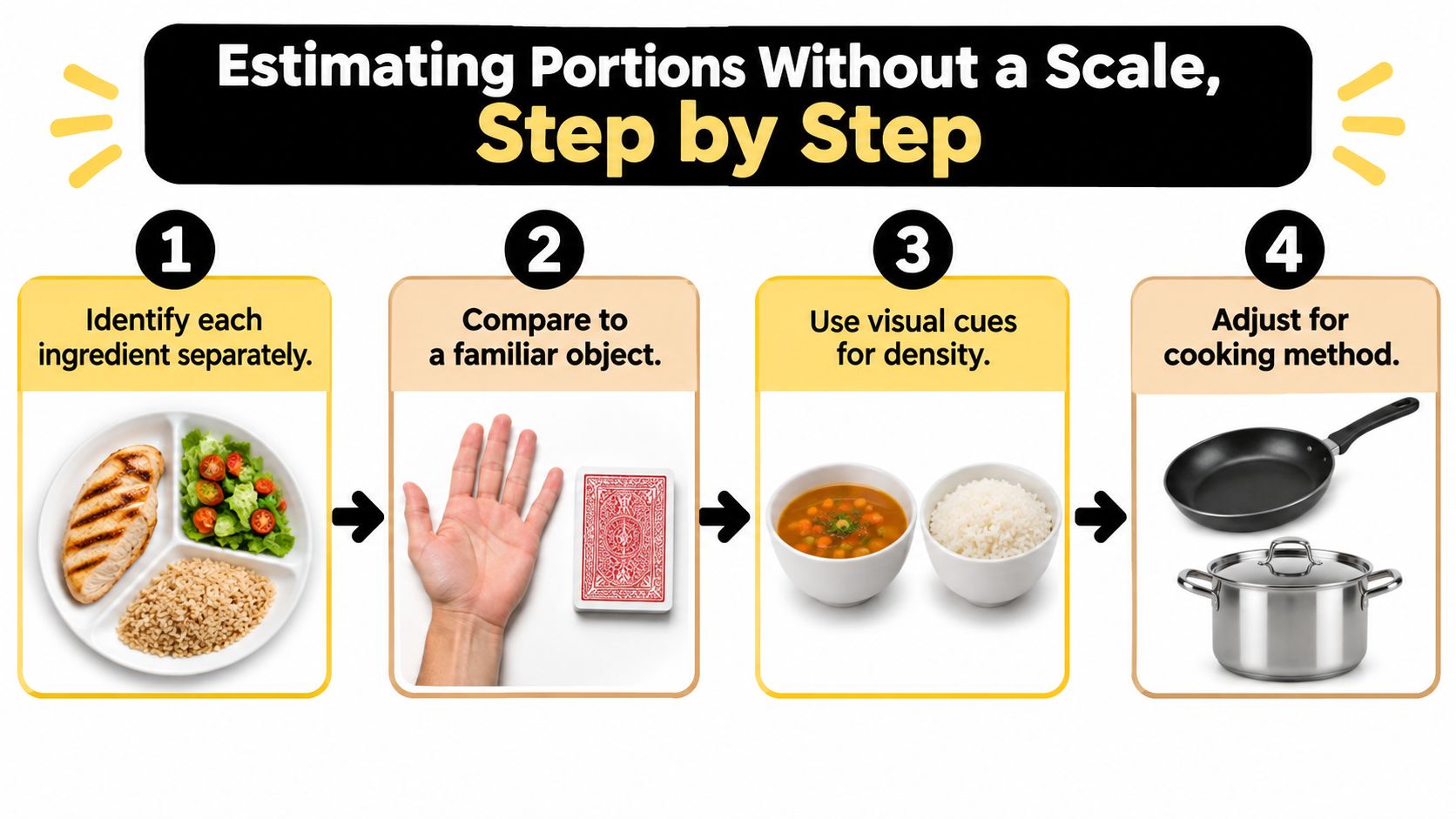
Identify each ingredient separately. Rice, protein, vegetables, sauce and cooking oil each carry a different calorie density, so one guess for the plate averages foods that behave nothing alike. The usual slip is logging the whole plate as a single item, which lets the densest component vanish.
Classify the shape. Regular shapes (a fillet, a block of cheese, a slice of cake), liquids, and amorphous foods such as rice, pasta, mash, casseroles and salad each need their own approach. The slip here is treating a loose pile as though it has a predictable volume.
Estimate the dimensions using your finger as the ruler. Measure the width of your index finger at the middle joint once and remember it; most adults land near a couple of centimetres. A chicken fillet two finger-widths thick and a palm long is a very different meal from one finger-width thick. Forgetting depth is the most common error at this step, because we read area and ignore thickness.
Convert volume to weight. A cup of rice, a cup of soup and a cup of dry cereal weigh wildly different amounts, so use a density reference for that specific food rather than a generic one. Borrowing a density from the wrong food is where a small error turns into a large one.
Audit the added fats. Oil, butter, dressing, mayonnaise and sauces carry more calories than most of the vegetables on the plate and are the easiest thing to leave off a log entirely. A tablespoon of oil in the pan counts whether or not you can see it on the food.
The geometry approach has been tested properly. In a controlled study of 67 participants estimating 42 pre-weighed foods and liquids, the finger-width method placed 80% of geometric foods and liquids within 25% of true weight, against 29% for household measures. Within 10% of true weight, the two methods managed 13% and 8%. The same study is candid about the limits: mixed dishes, loose foods and amorphous items are exactly where shape and packing density make the method unreliable.
Working rule: use finger-width geometry for anything with a predictable shape, and record amorphous foods as a range instead of a single number.
That range is also the most useful thing to hand on. When you correct a log, describe the change in kitchen language, "add two tablespoons of oil", "the salmon was twice as thick", "half the rice was left", because a vague size label can't be checked by anyone later. For a worked example of how much one food moves, this guide to the size of an average chicken breast shows the gap between a small fillet, a supermarket standard and a restaurant cut.
Portions from Photos, Restaurants and Menus
A photo feels objective, and that's the trap. A 2025 study of image-based portion estimation found accuracy depended on both the food and the camera angle. Cooked rice was estimated correctly 74.4% of the time from a single 45° image, rising to 85.4% when several angles were combined. Soup came out worse, and was more often overestimated than underestimated.
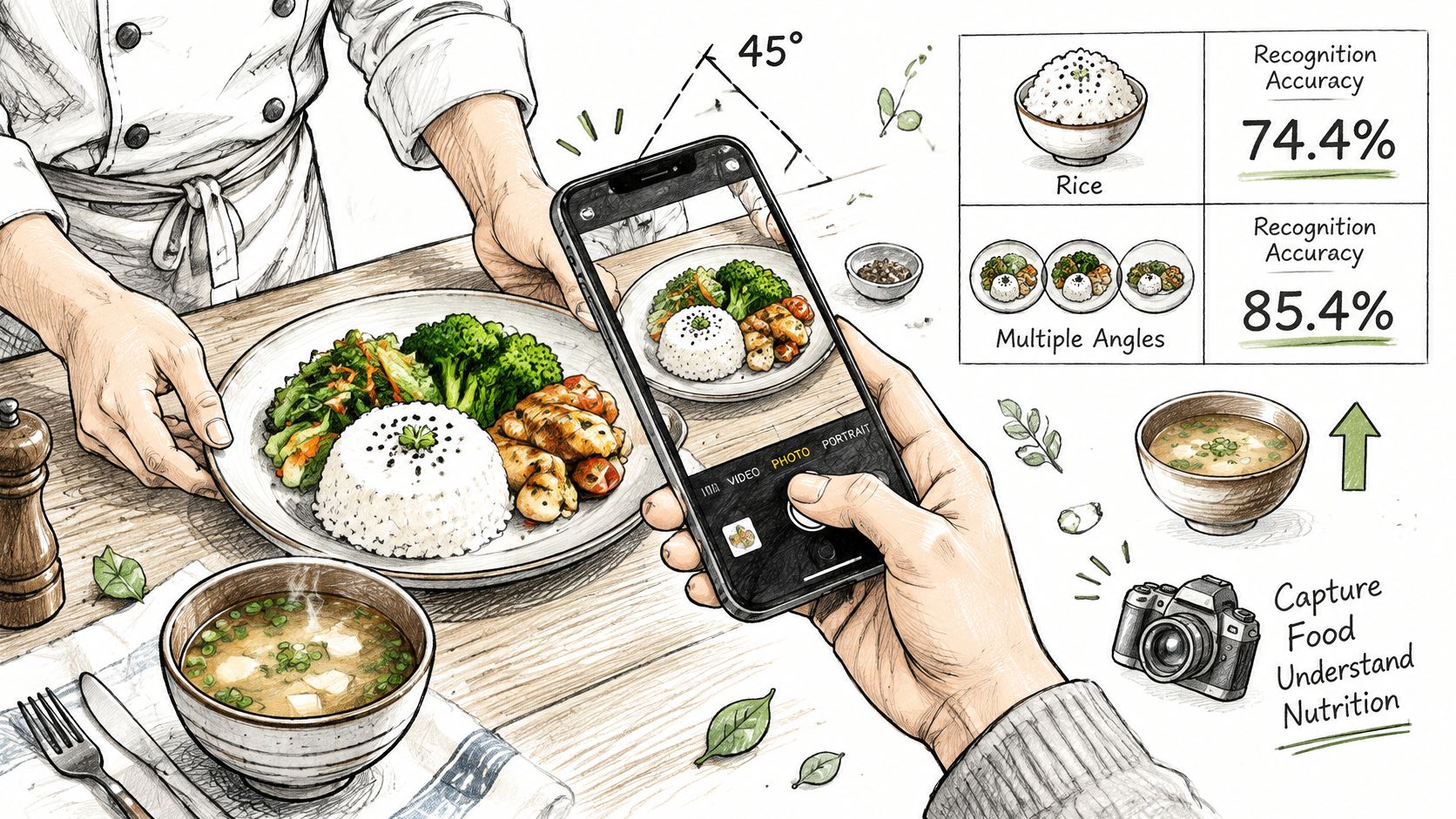
The reason is depth. One image flattens a bowl into a disc, hides whatever sits under the surface, and can't see the oil in the pan or the dressing under the leaves. Any dish whose volume is mostly hidden is a dish where a single overhead shot will guess wrong, and you won't know which direction until you check.
| Food | Known accuracy or main risk | What to add to the log |
|---|---|---|
| Cooked rice | 74.4% correct from a 45° photo; 85.4% with multiple angles | A second angle and a scale reference such as a fork |
| Soup or stew | Lower accuracy and more often overestimated | Bowl size and whether the broth was fully eaten |
| Stir-fry with sauce | Oil and sauce add calories a photo cannot show | The amount of oil and sauce used |
| Restaurant fries and soft drinks | Restaurant portions are often the largest; drinks add calories with little visual bulk | Size ordered in ounces or ml |
| Salad with dressing | Dressing is calorie-dense and hard to see in a photo | Dressing amount in tablespoons |
Match the food in front of you to its row before you accept any estimate. Rice photographed from two angles is close to solved; a cream-based soup is not, and pretending otherwise is how a log drifts by a few hundred calories a week.
Restaurants stack the odds further. Fast-food outlets generally serve the largest portions, and the items that grow the meal, fries, soft drinks, dressings and extra sauces, add calories without adding much visible bulk on the tray. Note the size you ordered in ounces or millilitres while you're ordering, because the cup is gone by the time you sit down to log it.
If you want to see the estimating process worked through on a real plate before adding any app to the routine, this is a decent place to start.
Choosing between photo-based tools comes down to two things: how quickly you can correct a wrong estimate, and how the app handles mixed dishes. This comparison of apps that scan food for health covers those differences properly. In Calorie Genie you point the camera at a plate, a drink or a whole restaurant menu, then fix anything that's off in plain words such as "the salmon was twice as thick", and the menu scan ranks each dish against the calories you have left for the day.
Uncertainty is food-specific. Two angles of rice is a small problem. A bowl of soup with a cream base is a bigger one.
Build Your Personal Reference and Choose a Method
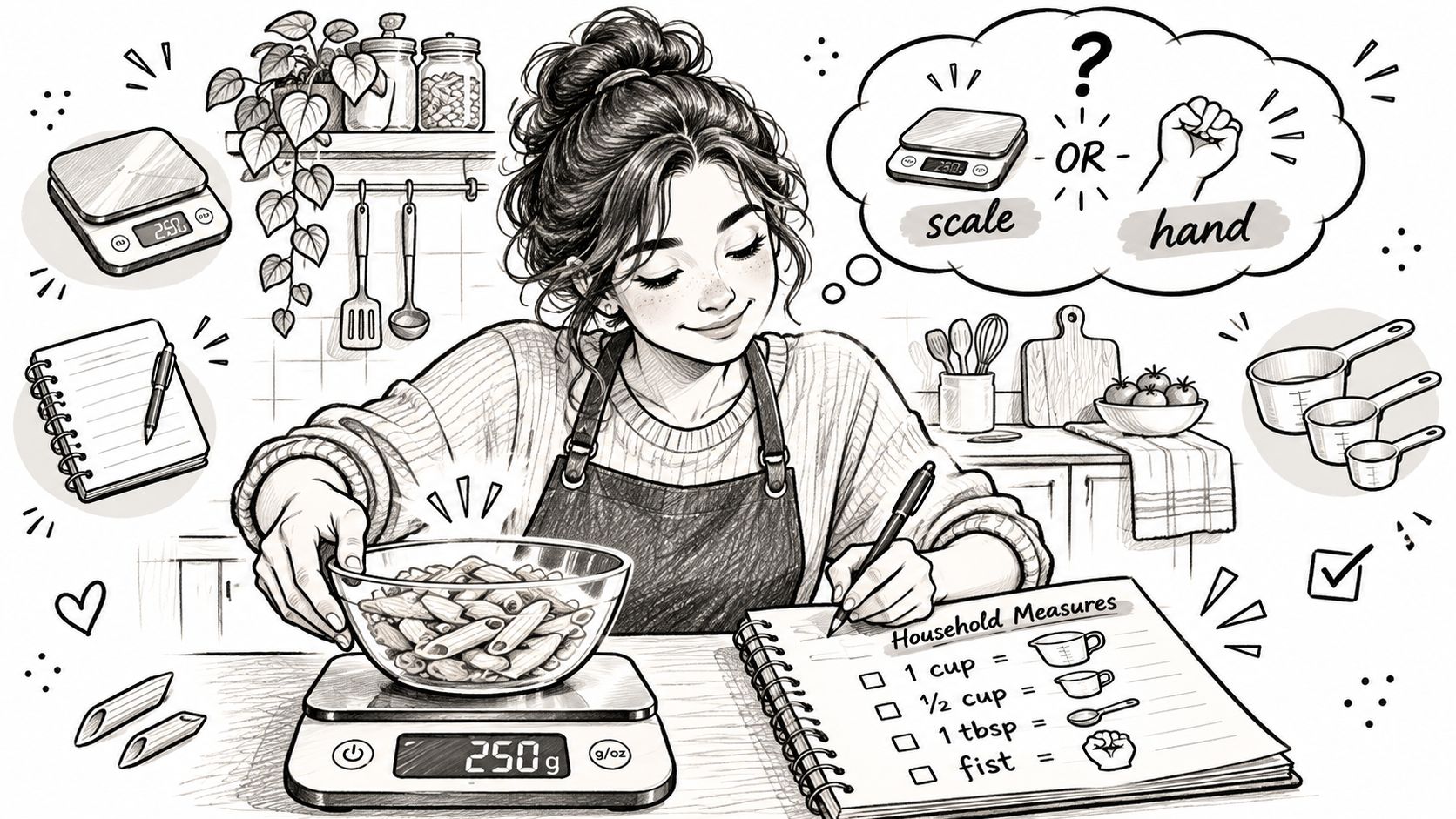
One weighing does more for your accuracy than another chart. Pick a food you eat most weeks, breakfast oats, the rice you cook on a Sunday, or the chicken you grill, and weigh one representative serving once on a kitchen scale.
The one-weighing calibration
That single number only stays useful if you store it the way you cook.
- Write down the household measure. "One cupped hand plus a little", "two ladles", "one and a half fists". Use the phrase you'd say in your own kitchen, not a metric conversion you'll never repeat.
- Photograph it. Same plate, same angle, same height each time, so later comparisons are honest rather than flattering.
- Label it as yours. It describes your serving on your plate, not a standard anyone else follows.
- Measure against it. Next time you cook that food, start from the reference instead of from scratch.
Keep three amounts separate. The label serving is the standardized figure on the pack. The eaten amount is what left the plate. The personal portion is the serving you weighed once, in your pan, on your plate. Hand measures and phone photos sit further from that personal number once sauce, oil or a heaped spoon is involved. For a food you repeat, the weighed reference is the one worth keeping.
Which method to use when
Daily staples: your hand is enough, and it is fast enough that you'll still do it on a busy week. Weekly foods: spend the ten seconds on the one-weighing reference. It beats a generic visual cue because it is already matched to your plate, your pan and the amount you serve.
Mixed plates, layered dishes and anything sauced need a photo, a correction and a confidence note. A single confident number for a curry is a fiction. Mark those entries: high for a weighed fillet, medium for a hand-measured bowl of rice, low for a restaurant dish with an unknown amount of oil.
Portion guides help you stay consistent. They are estimates, not laboratory measurements. Treating them as lab data is how tracking gets abandoned after a frustrating week.
The routine I recommend is short. Weigh one staple once and save the photo with the household phrase. Log mixed meals with a confidence note rather than false precision. After a week, change one habit the comparison exposed. Then do today's meal: estimate it by hand, check it against your reference, and keep the number that survives.
Calorie estimates are a guide, not medical advice.
Calorie Genie AI handles the slow part of logging. Point the camera at a meal, a drink, a barcode or a whole restaurant menu. It identifies each food, estimates the portion and returns calories, protein, carbs and fat, and you can tap any ingredient to change the portion before you save. A photo is still an estimate, not a lab result. It does put a reference number on the plate in the time a paper diary used to take. Visit Calorie Genie AI and try it on your next meal.