
“Just choose the lowest-calorie item” is popular advice, but it skips the part that often matters most: what you'll eat with it. A main dish isn't necessarily a complete meal, a small numerical difference isn't necessarily useful, and a label can't influence an order you've already decided to place.
Calories on menus are a clue, not a score. They're most useful when you're still choosing between meals you'd enjoy and you compare the full order, including sides and drinks. They're less persuasive when dinner is a celebration, convenience comes first, or your usual order is already on your tongue.
Table of Contents
- What a Menu Calorie Number Includes
- How Large a Calorie Gap You Can Trust
- One Dinner Read From Starter to Drink
- Where Labels Change Orders and Where They Do Not
- Which Restaurants Must Show Calories
- Hidden Calories the Printed Number Misses
What a Menu Calorie Number Includes
The figure beside a dish describes the energy in the restaurant's standard serving, prepared according to its usual recipe. Read it as information about that listed item, not a measurement of your exact plate or a judgment about whether you should eat it.
The important word is item. A sandwich line might cover the sandwich alone, while a meal-deal line might include selected accompaniments. The description and footnotes establish the boundary, so don't assume everything pictured beside the food is included.
Calories also don't tell you how much protein, fiber, or sodium the dish contains. A meal can fit your energy goal yet leave you hungry, or provide useful nutrients while taking up more of your daily allowance than you intended.
Place the item within your own day
Start with your own daily target, if you use one, rather than treating a menu's general nutrition message as a personal prescription. Consider what you've already eaten and what you still want to enjoy later.
Where a menu calorie sits in your day
| Meal slot | What it still leaves open |
|---|---|
| Breakfast | Whether a latte or pastry is part of breakfast or an addition |
| Lunch | Whether you want room for a side, dessert, or an afternoon snack |
| Dinner | Whether the main leaves room for accompaniments and later eating |
| Drink, sauce or side | Whether it has already been included in the listed meal |
This isn't a rigid meal plan. Someone eating a substantial breakfast and late lunch may approach dinner differently from someone who's had a light day. Exercise, appetite, preferences, and individual nutrition needs also affect what makes sense.
Say you're considering a bean bowl for dinner. Place the bowl in your dinner allowance first, then ask what else belongs to that occasion: a drink, chips for the table, dressing, or dessert.
Read the serving before the total
A restaurant menu and a packaged-food label require the same basic question: How much food does this number describe? Our guide to reading a nutrition label explains why serving size matters before you compare totals.
Look for words such as each, per serving, with dressing, or includes side. If the listing is ambiguous, ask whether the displayed value covers the dish as ordered or only its starting configuration.
Treat the printed figure as a line on a receipt that isn't finished yet.
That approach avoids both common mistakes: dismissing menu calories entirely and giving them more precision than they deserve. You're using the restaurant's description to build a reasonable picture of dinner, not trying to turn eating out into a laboratory exercise.
How Large a Calorie Gap You Can Trust
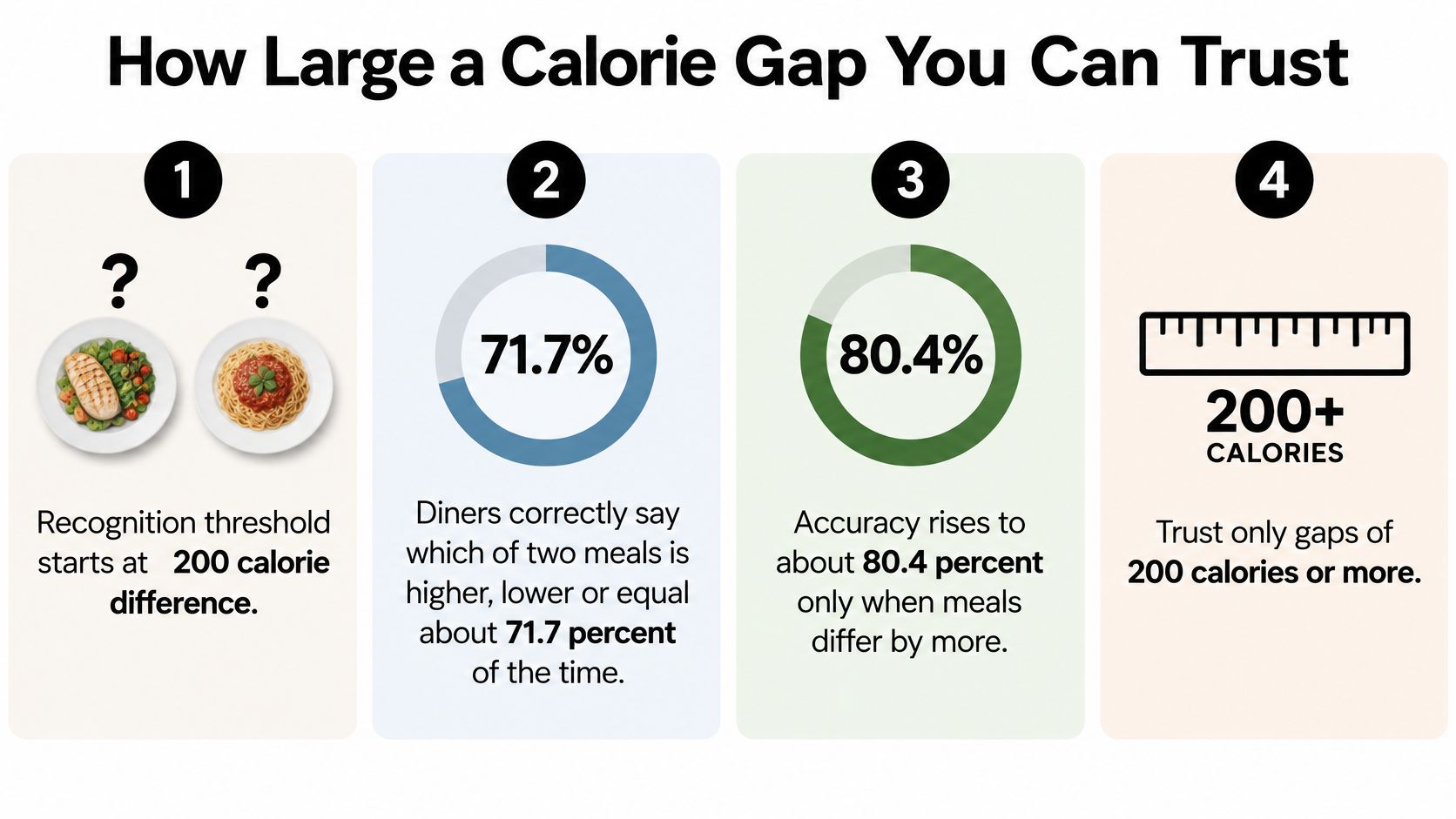
A substantial gap is easier to recognize than a small one. In the USDA report on estimating restaurant-food calories, consumers correctly identified which of two meals was higher, lower, or equal in calories in 71.7% of comparisons, rising to 80.4% when meals differed by at least 200 calories.
That finding needs a careful interpretation. It describes people's ability to compare meals, not a guarantee that every posted value is accurate within a particular margin. It doesn't establish a universal rule that smaller differences are meaningless.
For a hypothetical comparison, consider a sandwich and a wrap that initially look equally substantial. If the wrap's listed total is much higher, its apparently lighter format shouldn't override the information in front of you. A wrap is a container, not a promise about energy content.
Use this visual as a comparison aid, not an accuracy certificate.
Make the comparison decision-ready
The useful question isn't which number is smaller. It's whether the complete meals differ enough to change your choice without leaving you dissatisfied.
Check what's left in your day. Note food already eaten and anything you still plan to have. Use your own target if you track intake, but don't treat a remaining allowance as an instruction to ignore hunger or a medical nutrition plan.
Shortlist dishes you'd enjoy. Start with realistic alternatives rather than comparing your favorite dinner with an item you don't want. Read the listed configuration of each dish before adjusting anything.
Complete each order. Add the bread, fries, sauce, toppings, starter share, and drink you intend to consume. Keep included accompaniments inside the main's total so you don't count them twice.
Don't overinterpret a close result. When totals are similar, use protein, fiber, vegetables, sodium, appetite, and likely satisfaction to decide. A larger serving than the listed standard is a reason to revise upward, not assume the original value still covers it.
Handle missing information openly. Compare an unlisted dish with a similar standard item, then review the portion that arrives. A guide to figuring out portion size can help you distinguish a plausible estimate from a guess based only on the dish's name.
Choose a satisfying meal. The smallest total isn't automatically the best dinner. If you leave part of the food, record what you ate rather than treating everything served as consumed.
Keep the uncertainty visible
Some differences are easy to describe but difficult to quantify: a heavier hand with oil, a larger scoop of rice, or dressing mixed through the salad. You don't need to invent an exact correction. Record the uncertainty and avoid making a major decision on a tiny apparent advantage.
Practical rule: Favor a clear full-meal difference over a narrow comparison between incomplete entrée totals.
At Calorie Genie AI, our restaurant menu scanner ranks every dish against your goal and what you have left for the day, with filters for best for you, healthiest, or lowest calorie. Calorie Genie is free to download on the App Store and Google Play; scanning requires Premium. Use the ranking to build a shortlist, then check the actual order, because calorie estimates are a guide, not medical advice.
One Dinner Read From Starter to Drink
You're sitting at a casual chain with a friend. The crispy chicken sandwich sounds good, but so does a bean bowl. Before deciding, you read the descriptions and build the orders you would send to the kitchen.
The diagram highlights why the sandwich alone isn't the whole comparison.
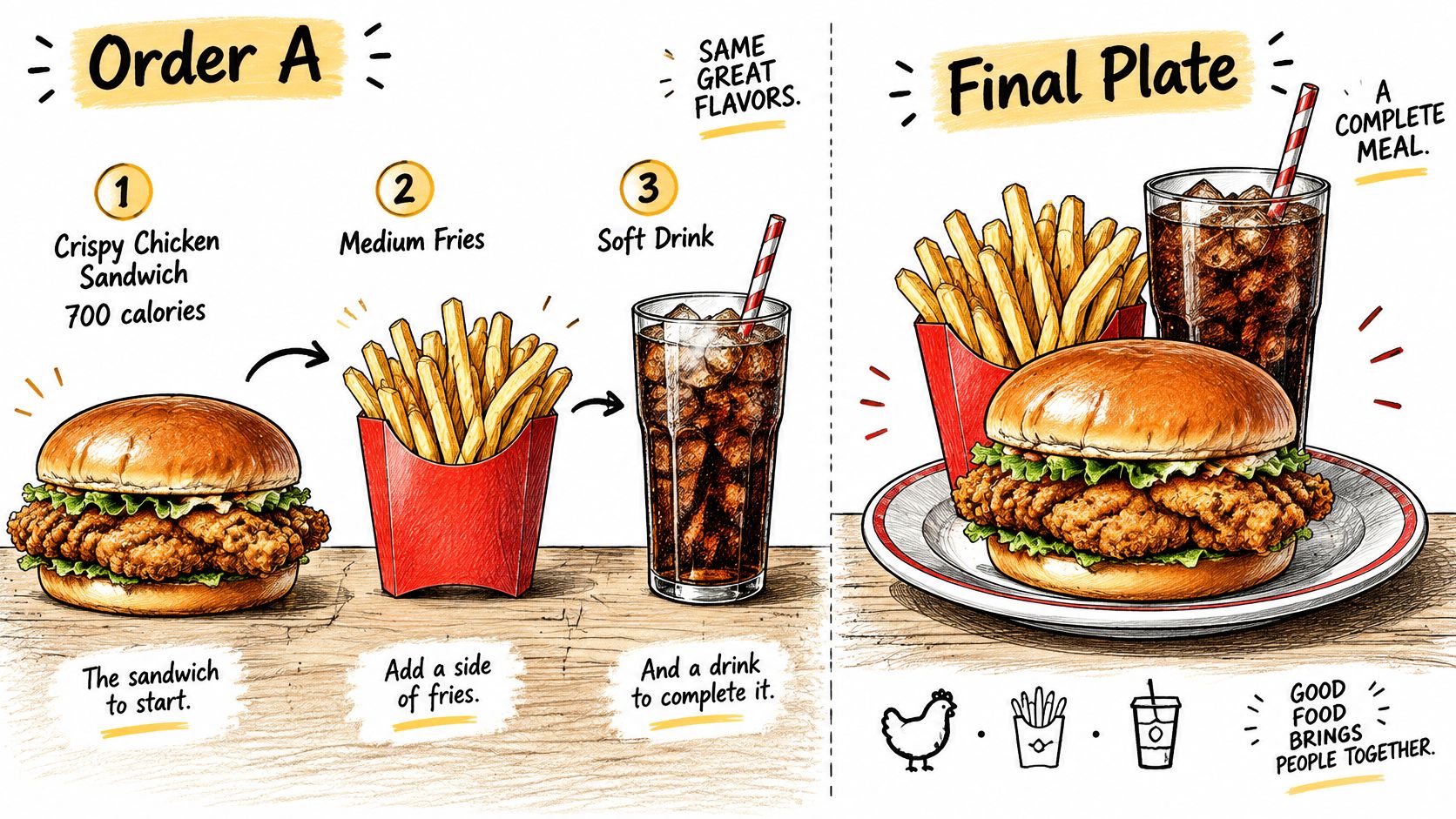
Build both orders before choosing
The following numbers are invented solely to demonstrate the arithmetic, not typical values or nutrition information for a real restaurant. In this example, the sandwich is listed at 700 calories, fries at 350, soda at 200, and your share of a starter at 250. The alternative is a bean bowl at 600 calories, a salad without creamy dressing at 120, and water at zero.
You don't total either dinner until every intended item is included. You also confirm that neither main's listing already includes its side.
Two dinners once sides and the drink are on the plate
| Order | Items and typical calories | Plate total |
|---|---|---|
| Order A | Hypothetical values, not typical menu data: sandwich 700, fries 350, soda 200, starter share 250 | 1,500 calories in this worked example |
| Order B | Hypothetical values, not typical menu data: bean bowl 600, undressed salad 120, water 0 | 720 calories in this worked example |
The main dishes initially looked fairly close. The full dinners don't, because you've changed the side, drink, and starter as well as the entrée.
That distinction matters. It would be misleading to attribute the entire difference to choosing beans instead of crispy chicken.
Send the order you actually want
If the bowl appeals to you and fits your appetite, the order could be: bean bowl, salad without creamy dressing, and water. Skip the starter if you don't particularly want it, rather than eating it automatically because it's on the table.
If you strongly prefer the sandwich, you still have options. Keep the sandwich and reconsider the drink, choose a different side, or share the starter more deliberately. You don't have to replace the centerpiece of dinner to make a meaningful adjustment.
For another cuisine-specific comparison, our guide to healthier choices at a Mexican restaurant can help you think through bowls, toppings, and accompaniments.
The video offers another way to engage with the topic.
The habit to keep is simple: total the dinner you intend to eat, not the main dish you noticed first.
Where Labels Change Orders and Where They Do Not
Menu labels don't produce the same result everywhere. Some diners change purchases, some don't notice the information, and others notice it but reasonably prioritize taste, company, or convenience.
The evidence also measures different things. Calories purchased per transaction aren't necessarily calories eaten by an individual, and an association after labeling doesn't prove that every customer changed behavior because of the label.
What the studies actually measured
When posted menu calories shift what people order
| Setting | What the labels did | Limit |
|---|---|---|
| 2,329 Mexican-inspired fast-food restaurants | Labeling was associated with 24.7 fewer calories purchased per transaction over 3–24 months, persisting into the second year, in the JAMA Network Open cohort study. | An association across a chain setting, not a guaranteed response from each diner |
| 104 U.S. fast-food restaurants | An immediate reduction of approximately 60 calories per transaction, about 4%, was followed by an increase of roughly 0.71 calories per transaction per week during the following year in the BMJ natural experiment. | The initial reduction weakened over time |
| 19-study meta-analysis | The average reduction was 18.13 kilocalories ordered per meal; the six controlled restaurant studies showed a smaller, statistically non-significant reduction of 7.63 kilocalories, according to the menu-labeling meta-analysis. | Overall results were modest, and controlled restaurant results were less convincing |
| 424 California fast-food restaurants | A separate analysis found no meaningful difference between labeled in-store and unlabeled drive-through purchases. | The ordering environment and comparison method matter |
| England after national calorie labeling | No significant reduction in calories purchased or consumed was found in an evaluation of the policy. | Posting information alone didn't establish a reduction in intake |
| Eye-tracking diners | Many participants didn't recall seeing labels, and the small calorie reduction wasn't statistically significant. | Attention and existing goals affected whether people used the information |
The contrast is more useful than a simple verdict that labels work or fail. An average reduction across restaurants can coexist with many unchanged orders. Likewise, a statistically non-significant result doesn't mean no individual found the information helpful.
Availability, attention, and action are separate steps. A diner has to encounter the number, understand what it covers, and still be willing to change the order.
Use the label while the decision is open
A routine weekday lunch offers a useful opportunity. If you're choosing between comparable mains and don't have a strong preference, the information can resolve the choice without much sacrifice.
A birthday dinner is different. You might deliberately choose a richer dish because that's the experience you came for. In a drive-through, you may have selected your order before reaching the board, leaving little opportunity for new information to matter.
These are practical explanations for why labels may be less useful, not proof that the studies established each diner's motivation.
- Before a routine order: Compare complete meals while you're still deciding.
- When choosing a treat: Decide intentionally rather than expecting a number to cancel your preference.
- When ordering with others: Consider what you'll share, not just your individual main.
- When the order is habitual: Pause long enough to check whether it still suits your appetite and goals.
The lowest-calorie option isn't the universal winner. The useful label is the one that helps you make a choice you understand, whether that means changing the order or keeping it.
Which Restaurants Must Show Calories
Whether you see calories on menus depends on the rules covering the business and location. Don't assume an independent café has the same obligations as a large chain, or that a menu format you recognize means every customization has been calculated.
In England, rules took effect on 6 April 2022 for food businesses with 250 or more employees, covering food and drink prepared for immediate consumption and requiring energy information in kilocalories, as described in the menu-labeling policy summary.
A kilocalorie is the unit people ordinarily mean when discussing food calories. The difference in wording doesn't make England's menu figures a different kind of nutrition measure.
Coverage isn't the same as usability
The implementation figures below describe assessed outlets, not a promise that every branch or item meets the same standard.
What England's menu-calorie rules changed
| Measure | Result | What it means at the table |
|---|---|---|
| Outlets with any calorie labeling | Increased substantially after implementation | You're more likely to encounter a figure |
| Outlets meeting every assessed labeling criterion | Full compliance remained limited | A number can be present without all supporting information |
| Information not presented clearly | Clarity remained a problem at some outlets | You may need to ask what the number includes |
| Information not legible | Some information was difficult to read | A posted label isn't necessarily easy to use |
| Average change per item across reviewed UK chains | A small overall reduction | Disclosure didn't mean wholesale recipe changes |
| Sit-down versus fast food | Average changes went in different directions | Restaurant categories didn't respond uniformly |
For a diner, the distinction is practical. You need a readable number beside an identifiable serving, not merely nutrition information somewhere on the premises.
If you can't tell whether a side is included, ask a direct question: “Does that calorie total include the accompaniment?” If the answer remains unclear, keep your estimate broad rather than assigning false precision.
A posted number doesn't certify your plate
In the United States, chain-menu disclosure developed through different regulatory settings. A familiar-looking board isn't enough to establish which rule applies, and historical local requirements shouldn't be mistaken for a complete description of current national law.
The restaurant's current nutrition information is the useful starting point for your order. Check the exact item name, size, and included components rather than borrowing a figure from a similar-looking dish elsewhere.
At the table: Ask what the label covers before asking how precise it is.
Recipe changes can make the food itself different, while labeling changes can make existing information more visible. Neither guarantees that the serving arriving at your seat matches the standard preparation exactly. Use the disclosure to orient your decision, then account for the order you receive.
Hidden Calories the Printed Number Misses
The easiest calories to overlook aren't necessarily secret ingredients. Often, they're foods whose relationship to the printed line is unclear: the basket rather than the serving, the combo rather than the sandwich, or the finished bowl rather than its base.
Read the wording before assuming the restaurant omitted something. Sometimes the total already includes dressing or a default side, and adding it again would overestimate the meal.
Check the boundaries of the listing
- Per item or per serving: A wing, slice, or listed serving may describe only part of what arrives.
- Base or finished build: Cheese, extra protein, creamy sauce, and other additions may have separate entries.
- Shared or personal: Estimate the portion you eat from a starter rather than ignoring it because it wasn't your individual order.
- Included or separate: Check bread, alcoholic drinks, refills, and accompaniments against their own listings.
- Standard or customized: Extra oil, substituted sides, and additional dressing move your order away from the standard recipe.
“Dressing on the side” describes where the dressing arrives, not how much you consume. The useful adjustment comes from what you leave uneaten, not from the wording of the request.
Seeing the number is only the beginning
Early New York evidence illustrates the attention problem. Among surveyed New York customers, 44.5% didn't notice calorie information, 41% noticed but didn't use it, and only 14.5% both noticed and used it, according to the New York and Newark restaurant-customer study.
That split challenges the assumption that printing information automatically changes an order. A visible label can support a decision, but a diner still needs a reason and an opportunity to use it.
Before ordering, scan the description as carefully as the number. After the food arrives, check whether the serving and accompaniments match what you understood, then account for what you eat.
You don't need perfect arithmetic to make this worthwhile. You need an honest boundary around the meal and a comparison that reflects your appetite, preferences, and goals.
At Calorie Genie AI, we offer restaurant menu scanning to help you compare dishes against your goal and the calories you have left for the day. Visit us before your next meal out, build a shortlist you'd enjoy, and check the sides and drinks before you choose.