

Those building muscle usually eat a modest surplus above estimated maintenance, gain weight gradually, and keep protein high. The right starting point depends on training experience and body fat, so one bulking target will not fit everyone.
A 2025 review in Sports Medicine found that three expert documents recommended increasing energy intake by 500-1,000 kcal per day to raise body mass or fat-free mass. That broad range is not a personal prescription. For a smaller person, its upper end may create a large surplus, with more energy stored as fat rather than supporting muscle growth.
Use your estimated maintenance as a starting point, then treat any surplus as a hypothesis to test against your weight trend. Training age, body size, and how quickly your weight changes all help determine whether the target is appropriate. A steady increase can support muscle gain, while a sharp rise may signal that the surplus is larger than needed.
If you already carry notable body fat, maintenance or a small deficit may be a better starting choice than bulking. Adjust the target as your circumstances and weekly trends change.
Table of Contents
- Calorie Targets for Muscle Gain at a Glance
- Why Muscle Gain Needs a Surplus and Why More Is Not Better
- Estimate Your Maintenance Calories in Three Steps
- Choose a Surplus Your Body Can Build On
- Protein Targets That Turn Calories Into Muscle
- Adjust Your Calories From Weekly Trends
- Start Your Surplus This Week
Calorie Targets for Muscle Gain at a Glance
Those building muscle eat roughly 5-20% above estimated maintenance, and training experience plus body fat pick the point inside that band. The weekly figure below is a body-weight pace, not a guarantee of new muscle.
| Starting point | Surplus over maintenance | Target gain per week | Protein per kg per day |
|---|---|---|---|
| Beginner, under about one year of lifting | 10-20% | up to 0.5% of body weight | 1.6-2.2 g |
| Intermediate lifter | 5-15% | 0.25-0.5% of body weight | 1.6-2.2 g |
| Advanced lifter | 5-10% | about 0.25% of body weight | 1.6-2.2 g |
| Carrying notable body fat | Maintenance to 5% | about 0.25% of body weight | 1.6-2.2 g |
Match the row to where you are now. Don't borrow the biggest surplus because it looks more serious.
Beginners, with under about a year of consistent lifting, can start toward the top. New training plus enough food builds lean tissue more readily than the same surplus will later. Intermediate lifters sit in the middle and let the weekly average decide the next move. Advanced lifters use smaller surpluses and slower gains of about 0.25% of body weight per week. Past that pace, extra weight is mostly fat, and stripping it later costs training time.
Protein doesn't change with the row. 1.6-2.2 g per kg per day is the working target whether you're adding 10% or holding steady.
When a surplus is the wrong first move
If you already carry notable body fat, maintenance, or at most a 5% bump, is the better start. Muscle can still grow at energy balance, and in some cases in a deficit, when lifting and protein are in place. A review of body recomposition describes that path at energy balance or even in a deficit, and it also notes that large surpluses can produce disproportionate fat gain. Use the last row if the waist is the thing you most want to stop growing.
Practical rule: Pick the row by training age and body fat, then get a maintenance number. Every surplus is a percentage of that baseline, so a bad baseline makes every later target wrong.
Why Muscle Gain Needs a Surplus and Why More Is Not Better
Building muscle takes energy. Your body repairs muscle fibers, replenishes glycogen, and supports daily activity while training provides the reason to adapt. When intake regularly falls short of what you use, there is less energy available for that work. A surplus can help, but it is not a fixed requirement for every person or every phase of training.
The 2017 International Society of Sports Nutrition position stand describes a caloric surplus as a foundation of diets intended to increase lean mass. It also emphasizes that the appropriate surplus depends on training status, body composition, and the size and composition of the surplus. In other words, there is no single calorie add-on that suits every lifter.
Calories are building material; training is the blueprint. Extra energy cannot direct muscle growth on its own. Without progressive resistance training, more of a surplus is likely to be stored. With a sound program, muscle gain is still limited by factors such as training experience and recovery. Food beyond that capacity does not automatically become muscle.
The limit on extra food
Eating more may support growth, but muscle gain does not rise in proportion to calorie intake. Faster weight gain tends to bring a larger share of fat alongside muscle, and individuals can respond differently to the same approach. A surplus that seems manageable for one person may push another's weight up too quickly.
The practical point is simple: a bigger plate does not guarantee a stronger training effect. Once food intake exceeds what your training and recovery can use for muscle growth, additional calories are more likely to increase fat gain than to speed up hypertrophy. That is why an aggressive bulk can create more work later without improving the result you wanted.
What the scale is actually counting
A kilogram gained over a month is not necessarily a kilogram of muscle. Scale weight includes muscle, fat, water, and glycogen. A salty meal, starting creatine, or a demanding leg session can shift weight temporarily without indicating new tissue. One weigh-in is therefore a poor guide to whether your calorie target is working.
Judge a surplus over several weeks, alongside waist measurement and whether the main lifts are still moving up.
Treat your calorie target as an adjustable hypothesis, not a permanent rule. Compare your weight trend, waist, training progress, and recovery with the pace you intended. If weight rises faster than planned, reduce intake; if weight and performance remain unchanged for weeks, a small increase may make sense. Maintenance, or a modest deficit, can be a better starting point when reducing body fat matters more than gaining weight quickly. The goal is a level of intake that supports your current priorities, not the largest surplus you can tolerate.
Estimate Your Maintenance Calories in Three Steps
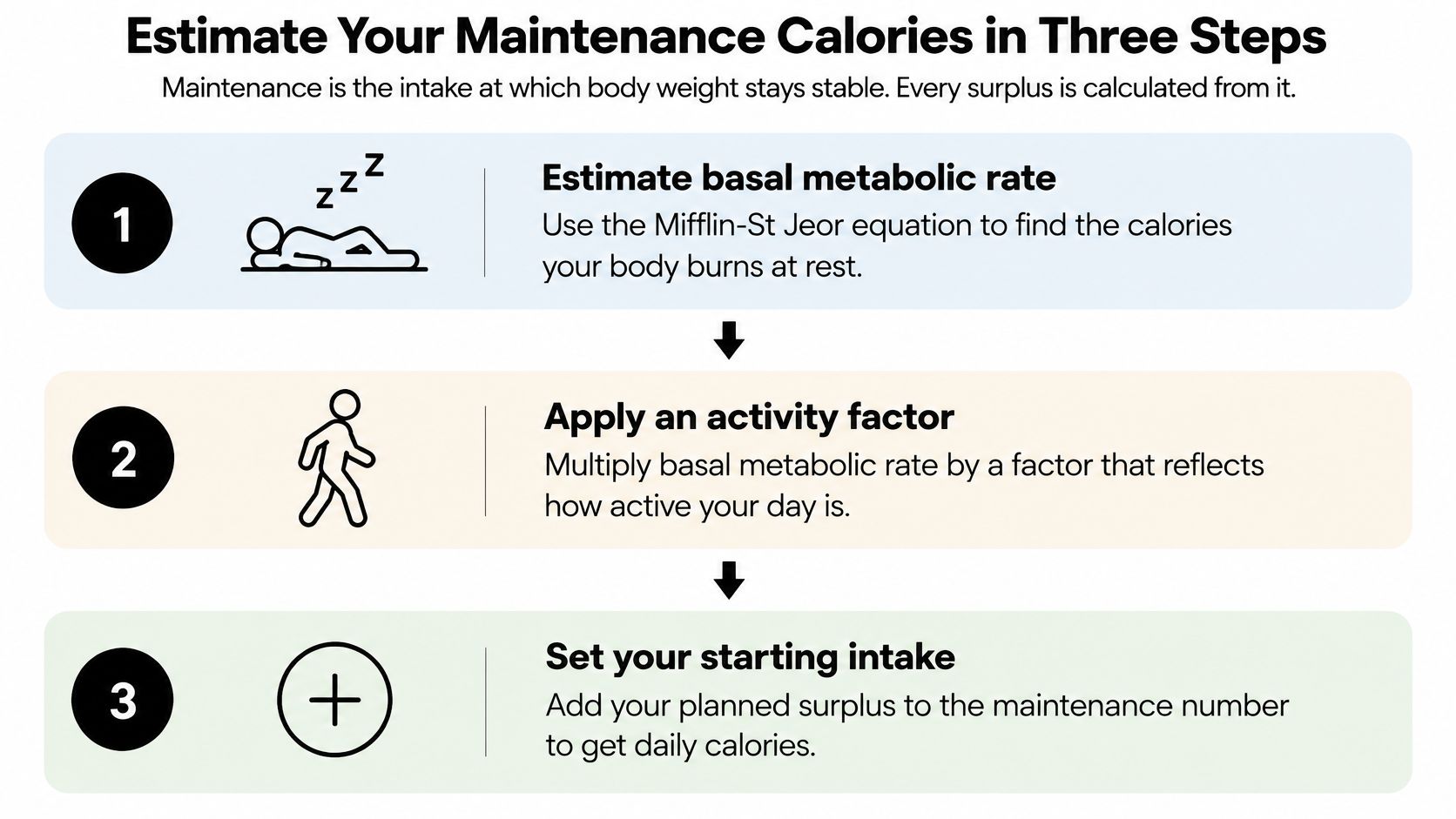
Maintenance is the intake at which body weight stays stable. Every surplus in the table is a percentage of it, so this is the number you need before you add anything.
The three steps below turn a formula into a tested intake. Use them in order, and don't skip the test just because the equation looks precise.
1. Estimate calories burned at rest
Use the Mifflin-St Jeor equation for basal metabolic rate, the calories you'd burn lying still.
For men: 10 × weight in kg + 6.25 × height in cm − 5 × age + 5. For women: the same sum, with minus 161 instead of plus 5. A 30-year-old man at 80 kg and 180 cm lands near 1,780 kcal before activity. The equation ignores muscle mass and daily fidgeting, so it's a starting sketch, not a diagnosis.
2. Multiply by how you actually move
Multiply that resting figure by an activity factor.
- 1.2 if you mostly sit.
- 1.375 for light exercise one to three days a week.
- 1.55 for moderate training three to five days.
- 1.725 for hard training six or seven days, or a physical job.
That same 1,780 kcal at a moderate 1.55 becomes about 2,760 kcal. People who lift and also walk a lot often under-pick the factor, then wonder why weight falls on a "surplus." If your job is on your feet, use the higher factor and let the next step correct you.
3. Eat it and watch the weekly average
Eat the calculated amount for two to three weeks. Weigh daily, under the same conditions, and average each week. Daily noise from water will scare you if you react to it. The weekly average won't.
If the average holds steady, that figure is your maintenance. If it falls, raise intake by about 5%. If it climbs, lower it by about 5%, then run another two weeks. Formulas commonly miss by a few hundred calories. The measured trend beats the equation.
If you'd rather see the same arithmetic written out as a day-to-day target, our guide on how many calories you need a day walks through maintenance before any surplus. A short video of the same three steps is below if you want the math spoken rather than read.
Stop when you can write one maintenance number on a card. You'll add a percentage to it next, and you'll change the percentage only after the weekly trend tells you to.
Choose a Surplus Your Body Can Build On
Start modest. Take the maintenance number you just tested and add 5-20%, with beginners toward the upper end and advanced lifters at the lower end. Then convert that choice into a weekly gain of about 0.25-0.5% of body weight. A percentage of your weight keeps a 60 kg lifter and a 100 kg lifter from chasing the same kilogram.
Say maintenance is 2,600 kcal. A 10% surplus is 260 kcal, so the day is about 2,860 kcal. That is a hypothesis, not a prescription. Research has not established a universally optimal surplus or a precise calorie count that maximizes muscle while minimizing fat, as the ISSN body-composition position stand makes clear. You increase estimated maintenance gradually, then watch the weekly weight trend, training performance, waist, and recovery.
Beginners and people coming back
A beginner, or someone returning after a layoff, can often gain muscle with less overfeeding than an advanced lifter. Training is a new stimulus, and the body responds to it before the surplus gets huge. Start around 10% if you're new and relatively lean, closer to 5% if you're returning and you'd rather not regain fat you just lost. Let bar speed and reps tell you whether food is keeping up. If the work sets are grinding and weight is flat after a few weeks, add food. If the waist jumps in the first fortnight, you started too high.
Intermediate and advanced lifters
Experienced trainees gain lean mass more slowly. A smaller surplus matches that slower rate. An intermediate lifter at 75 kg would aim for roughly 0.2-0.4 kg per week, which is 0.25-0.5% of body weight. At the low end that's about 200 g. At the high end, about 400 g. Anything faster than that, week after week, is a sign to eat less, not a sign that the program suddenly got better.
Advanced lifters should expect the low end, near 0.25%, and a surplus around 5-10%. Genetics and program quality still matter, but you can't eat your way past a slow rate of lean-mass gain. Adding another 500 kcal on top of an already rising scale mostly changes how your shirts fit.
Higher body fat, or a surplus you can't yet justify
If body fat is already high, choose maintenance up to 5%. You can build while the waist stays put, and a big surplus makes the next cut longer. Set the surplus, log intake, and give it two to three weeks before you touch protein targets or add more food. One flat week is not a reason to double the surplus.
A calorie target is an adjustable hypothesis. If weight isn't rising, or fat gain is clearly excessive, you change the calories. You don't defend the original number.
Protein Targets That Turn Calories Into Muscle
Extra calories provide building material, but protein and progressive lifting help determine how much of that energy supports muscle. A surplus is not a shortcut around either one.
For people training with weights, use 1.6-2.2 g per kg per day as a practical working target. The ISSN position stand gives a baseline of about 1.4-2.0 g per kg per day for exercising adults. The higher working range offers room to choose a target that fits your training and eating habits; it is not a fixed requirement for everyone.
At 75 kg, that range works out to about 120-165 g of protein a day. Planning the total across meals can make it easier to reach consistently.
| Body weight | Protein at 1.6 g per kg | Protein at 2.2 g per kg |
|---|---|---|
| 60 kg | 96 g | 132 g |
| 75 kg | 120 g | 165 g |
| 100 kg | 160 g | 220 g |
Spread the total across four meals if that suits your routine. For example, a 75 kg lifter aiming for 160 g would have about 40 g per meal. A 60 kg lifter at the low end would need about 24 g per meal, while a 100 kg lifter at the high end would need about 55 g. Three larger meals can work too. The useful target is one you can meet most days, rather than saving nearly all your protein for dinner.
Don't chase a dieting number while you're gaining
More protein does not automatically mean more muscle. Protein well above the working range can add cost without a clear muscle-building benefit, and it may leave less room for carbohydrates that support hard training. Eating 220 g when 160 g already meets your target is unlikely to speed hypertrophy.
Calories should support training, not replace protein or the carbohydrates that help you finish your sets. Keep progressive resistance training in place, and treat your calorie target as an adjustable estimate. If your protein target is covered but your weight stays flat for several weeks, consider adding calories from foods you can eat consistently rather than adding another protein scoop.
To turn a protein target into a full plan for carbohydrates and fat, follow this guide to calculating your macros. Divide your daily protein target by the meals you expect to eat, then aim to meet that amount most days. A slightly lower target you maintain consistently is more useful than a perfect average that falls apart on weekends.
Adjust Your Calories From Weekly Trends
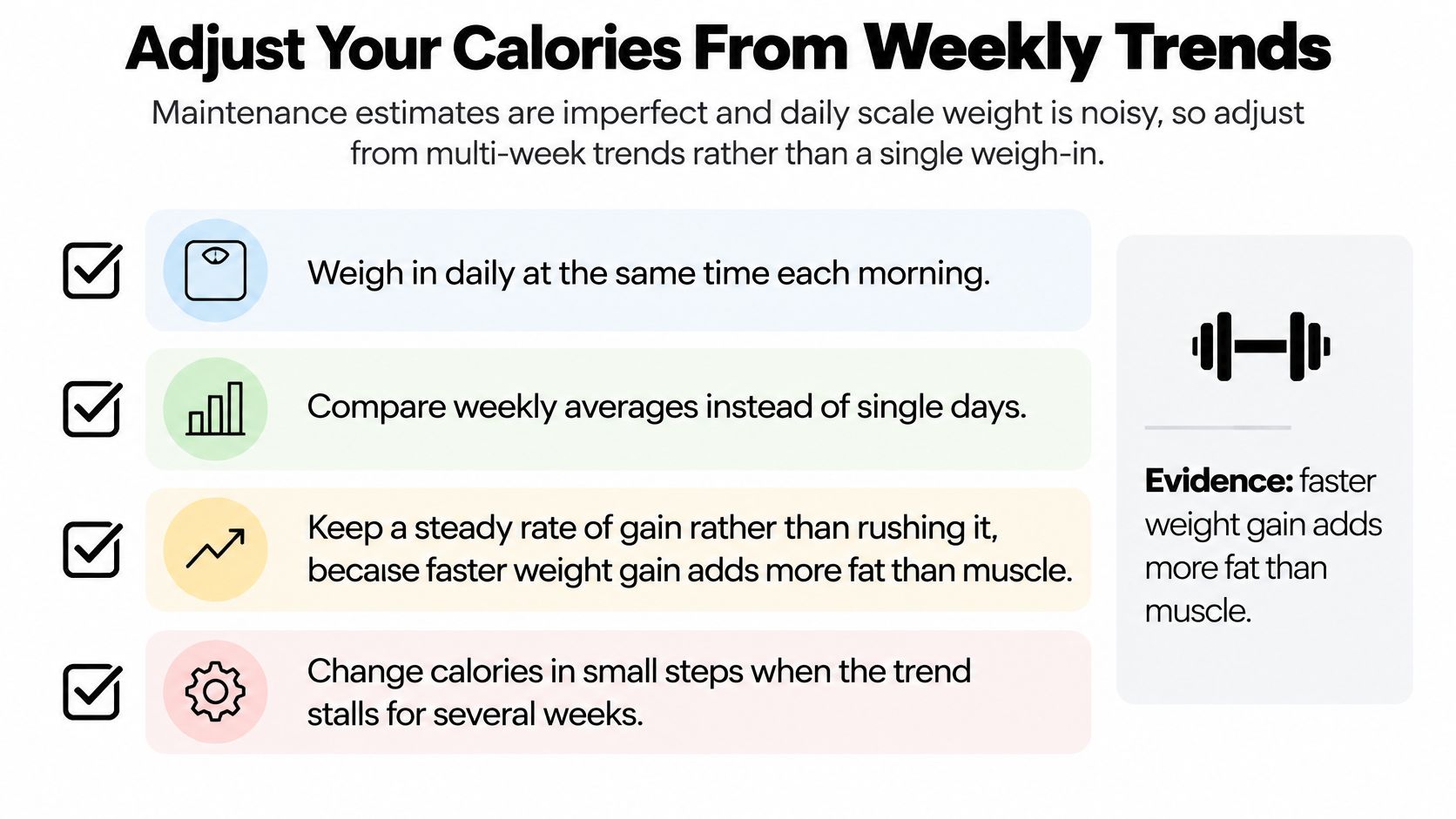
Maintenance is an estimate, and daily scale weight shifts with meals, training, and sleep. A heavier reading can reflect water rather than new tissue, so use weekly averages to guide adjustments instead of reacting to one morning.
A flat average paired with stalled lifts can mean the surplus is too small, but it can also point to training that needs attention. In an eight-week controlled study of resistance-trained participants, researchers compared estimated maintenance with surpluses of about 5% and 15%. The Sports Medicine - Open analysis recommends conservative surpluses of about 5-20% over maintenance, or body-mass increases of roughly 0.25-0.5% per week. More advanced trainees are generally better served by smaller surpluses and slower gain rates. The target is a starting hypothesis, not a fixed rule: change intake in small steps and see how your trend responds.
Women, older lifters, beginners, and people eating varied cuisines may need especially careful adjustments. Energy needs differ, portions can be difficult to estimate, and one universal calorie target cannot capture that variation. Change intake by about 5%, then give the adjustment time to show up in your weekly average.
Use the checklist before changing your target. Weigh-ins are useful when you compare weeks, not isolated mornings.
Read the three-week pattern
A stall means several weeks without a change in the weekly average, not one flat week. Compare the average with your waist measurement and lifting progress. Change one thing at a time, then allow another two to three weeks to assess the result.
| What you see over 3 weeks | Likely meaning | Calorie change |
|---|---|---|
| Weight flat, lifts flat | Surplus too small or training stalled | Raise intake about 5% |
| Weight rising faster than 0.5% per week | Surplus too large, fat gain likely | Lower intake toward 0.25-0.5% per week |
| Waist growing faster than body weight | Fat gain outpacing muscle | Reduce surplus, keep protein and training |
| Lifts rising, weight rising at target rate | On track | Keep current intake |
If both weight and lifts are flat, check your training before changing food. Progress still depends on gradually adding challenge to your lifts. If training is progressing but the weekly average is stuck, a 5% increase is a modest test. If weight rises faster than 0.5% per week, reduce intake toward the 0.25-0.5% range. If your waist grows faster than body weight, reduce the surplus while keeping protein and training steady. When lifts are improving and weight is on pace, keep intake unchanged.
Accurate logging makes these comparisons more useful. A food diary helps you check whether the surplus you intended is the one you ate. Without a record, it is harder to tell whether a trend calls for an adjustment or reflects inconsistent intake.
Start Your Surplus This Week
You don't need a perfect plan to begin. You need one maintenance number, one surplus, and two weeks of honest logs.
- Estimate maintenance with the calculator in the Calorie Genie AI app, which shows how many calories you should eat per day in metric or imperial units, or use the three-step method above. During setup you share your goal, body stats, and activity level, and the app sets a daily calorie and macro target you can change any time in Settings.
- Add 5-20% based on training age and body fat. Newer lifters who are relatively lean go higher. Advanced lifters and anyone with a growing waist go lower.
- Set protein at 1.6-2.2 g per kg and split it across the meals you already eat.
- Log intake and weigh in daily. Review the weekly average after two to three weeks, not after a single heavy morning.
- Move intake by about 5% using the signals table. If you're on pace, leave it.
Calorie estimates are a guide, not medical advice, and they aren't a substitute for a clinician. If you have a medical condition, talk with a doctor or a registered dietitian before you change your diet. Then run the first week as written, and let the three-week average tell you the next edit.
Calorie Genie AI sets a daily calorie and macro target from your goal, body stats, and activity level, then lets you log meals and adjust that target as your weekly trend changes. That's the same loop this guide uses for building muscle: a modest surplus, enough protein, and a number you revise instead of a bulk you guess. Visit Calorie Genie AI and set this week's target before your next training day.