

At 2,000 calories a day, macros for maintenance come out to 45–65% of energy from carbohydrate (about 225–325 grams), 20–35% from fat (44–78 grams) and 10–35% from protein (50–175 grams). Any combination inside those ranges that adds up to 100% can hold your weight steady, which is why the ranges matter more than any single ratio.
So why does a plan that worked six months ago leave you gaining now? Because a maintenance target isn't a number you calculate once and keep. It's an estimate you test, then correct as your training, appetite and daily movement change.
Most guides hand you a ratio and a calorie total, then stop. This one builds in a different order: the energy budget first, then protein, then carbohydrate and fat, then a monthly review against your own weight trend. The arithmetic is shown at every step, along with which parts are estimates and how much weight to give them.
Table of Contents
- Maintenance Macro Ranges at a Glance
- Maintenance Calories Set the Budget First
- How to Set Protein, Carb and Fat Targets
- What Maintainers Actually Eat in Practice
- Recalibrate Macros from Your Weight Trend
- Set Your Maintenance Macros and Review Them Monthly
Maintenance Macro Ranges at a Glance
A 2,000-calorie day is the clearest place to see how shares turn into grams, because every percentage converts into a number you can weigh.
Adult macro ranges at 2,000 kcal per day
| Macronutrient | Share of energy | Calories at 2,000 kcal | Grams per day |
|---|---|---|---|
| Carbohydrate | 45–65% | 900–1,300 | 225–325 g |
| Fat | 20–35% | 400–700 | 44–78 g |
| Protein | 10–35% | 200–700 | 50–175 g |
Read across a row and you get three things at once: the share of your energy from that macronutrient, the calories that share represents, and the grams it works out to. Those ranges are the adult Acceptable Macronutrient Distribution Ranges, published by the US National Academies as part of its Dietary Reference Intakes. They're designed to cover essential nutrient needs and support long-term health across a whole population, not to describe one ideal physique plan.
The conversion rule makes the table usable: carbohydrate and protein supply about 4 calories per gram, fat about 9. That's why the fat row looks small next to carbohydrate at a similar percentage. A 30% fat share is a lighter pile of food than a 30% carbohydrate share, because each fat gram carries more than twice the energy.
Why the ranges are wider than one ratio
Because more than one split works. Take a 60/25/15 pattern at 2,000 calories: 300 g carbohydrate, about 56 g fat and 75 g protein, and every one of those sits inside the adult guardrails. Shift to 45/35/20 and you get 225 g carbohydrate, about 78 g fat and 100 g protein, also inside.
Both are legitimate maintenance patterns. Which one suits you depends on how much you train, how hungry you get, what you like eating, and whether you follow a vegetarian or lower-carb pattern by choice. What can't vary is the total: each pattern spends 100% of the same 2,000 calories.
What to hold on to: the percentages describe how you spend a calorie budget. The budget itself is a separate number, and it comes first.
Maintenance Calories Set the Budget First
Maintenance calories are the average daily intake predicted to hold your body weight where it is. That number shifts with your age, sex, height, current weight and how much you move, so two people of the same height can need quite different amounts. The National Academies calls it the estimated energy requirement, and its Dietary Reference Intakes summary gives 2,275 kcal per day as a worked example for an adult. Treat that as a prediction, not a measurement.
People arrive at a calculator with an approximate weight, a rough sense of activity, and a wish for one clean number. Think of that number as the monthly income in a budget. If the income estimate is off, every macro target built from it drifts too, even when the percentages look sensible.

Three steps to a starting number
- Enter honest inputs. Age, sex, height, current weight, and an activity level that matches a normal week rather than your best week.
- Log everything for two to three weeks. Meals, snacks, drinks and the oil in the pan. In the same period, weigh yourself each morning after the bathroom and before eating.
- Compare where the block ends. If body weight is roughly where it started, the intake you logged is close to maintenance for your current life.
A calculator gives an opening estimate. Your logged intake and weight trend show whether that estimate fits your real routine. That difference matters because maintenance is a moving range, not a one-time output. Training, appetite, travel and food choices all change the practical target, so the first number is a starting point for adjustment.
Once you have that total, the split is a separate decision. The Institute of Medicine published the Acceptable Macronutrient Distribution Range in 2002 within the Dietary Reference Intakes, framing it around meeting daily energy and nutritional needs while reducing chronic-disease risk. It is deliberately a distribution range rather than one fixed ratio, on the reasoning that people can maintain body weight across several macro patterns.
Two common splits show why the total matters more than the split. At 2,000 calories, 40% carbohydrate, 30% protein and 30% fat works out to 200 g carbohydrate, 150 g protein and about 67 g fat. A 55/25/20 split gives 275 g carbohydrate, 125 g protein and about 44 g fat. Both add up to 2,000 calories, and neither is wrong. They are two ways of spending the same income.
Check the arithmetic by handing each macronutrient its share of the budget. At 2,000 calories, 55% carbohydrate is 1,100 calories, then 1,100 divided by 4 gives 275 g. Protein at 25% is 500 calories, then 500 divided by 4 gives 125 g. Fat at 20% is 400 calories, then 400 divided by 9 gives about 44 g. This is why a small-looking fat gram target still carries a large share of the calories.
The arithmetic is easy to check by hand, and a walkthrough helps if you would rather watch it once than read it twice.
Changing calories and changing the split are two separate decisions. When the scale drifts over several weeks, you move the total. When training, hunger or food preference changes, you move the pieces and leave the total alone. Do both at once and you will not know which one worked.
If you do not have a starting total yet, work out how many calories you need a day first, then come back to the split with that number in hand.
How to Set Protein, Carb and Fat Targets
The National Academies' summary of the adult ranges describes these as population-level guardrails for nutrient intake and chronic-disease risk, not individualized performance targets. So the goal is a workable range, not a perfect ratio. Set a floor for protein and fat, then give the rest to carbohydrate in a form you can eat week after week.
Maintenance works best as a moving range. Protein is the anchor, carbohydrate and fat flex around training, hunger and food preference, and the whole line gets reviewed against your weight trend over several weeks. Think of the target as a budget with fixed bills and flexible spending, not a one-time calculator result.
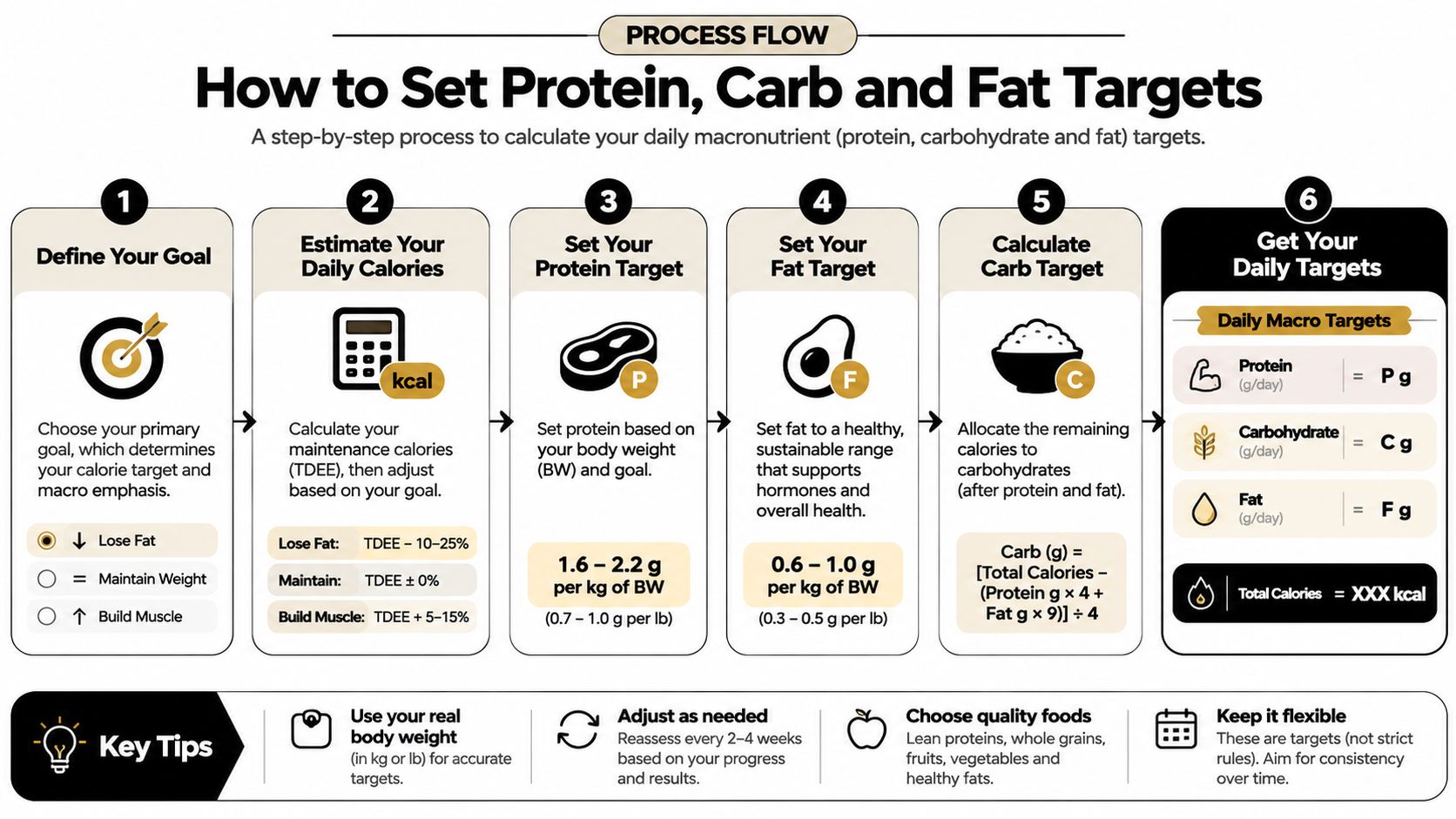
The sequence that holds up
- Fix the calorie total. Every other number scales off it. Change it later and the grams change with it.
- Set protein from body weight, not from a percentage. Protein needs for maintaining or building muscle rise with training, so body weight anchors the estimate better than a share of your budget. For a worked body-weight example, see how to calculate the amount of protein you need.
- Protect a fat floor. Keep fat at no less than 20% of calories, which at 2,000 kcal is at least 44 g. Fat is energy-dense and helps you absorb fat-soluble vitamins, so trimming it hard to make room for carbohydrate is a trade you may feel in hunger and in how satisfying meals taste.
- Give the remainder to carbohydrate. Subtract protein and fat calories from your total and divide by 4. At 2,000 calories with 150 g protein (600 kcal) and 44 g fat (396 kcal), that leaves 1,004 calories, or 251 g carbohydrate, landing at about 50% of energy.
- Check all three shares against the ranges. If protein climbs past 35%, or fat drops under 20%, move calories between carbohydrate and fat instead of pushing protein higher still.
- Spread protein across meals and give the plan two to three weeks. Three or four portions of 30 to 50 g each is easier to hit than one large evening serving. A couple of weeks of logging shows whether the plan is livable before you judge the scale.
Why protein gets its own step
A 2024 systematic review and meta-analysis found that increased protein intake significantly reduced loss of muscle mass in adults with overweight or obesity who were pursuing weight loss, with a standardized mean difference of 0.75 (95% CI 0.41–1.10). That same evidence base includes an umbrella review finding possible evidence that protein amount does not change body weight, fat mass or waist circumference when calories are held constant. Protein is a floor worth protecting, not a dial to max out. The estimate is still an estimate, because body weight, training and food preference all shape what you can repeat.
Here's the sequence as a single visual, from the calorie total at the top to the carbohydrate check at the bottom.
What a finished target line looks like
At 2,000 calories, a protein-first line might read 2,000 kcal, 150 g protein, 44 g fat, 251 g carbohydrate. That's 600 calories from protein, 396 from fat and 1,004 from carbohydrate, with protein at 30% and fat at 20%, both inside the adult ranges. Write your own line down and keep it visible for the next three weeks.
The point is not to defend that line forever. If your weight trend drifts, adjust the total before you start reshuffling every macro. If your weight holds but meals feel hard to repeat, change the split while keeping the total steady. That keeps the calibers clear: calories set the budget, protein protects the anchor, fat protects the floor, and carbohydrate fills the gap.
What Maintainers Actually Eat in Practice
Real maintenance eating rarely matches a tidy ratio, and a large cohort gives a useful benchmark. A 2025 prospective cohort study of 1,518 adults who had first lost at least 5% of their body weight, published in the journal Obesity, recorded average maintenance-phase intake of 20.6% protein, 33.8% fat and 43.1% carbohydrate.
Macro shares in practice and in targets
| Pattern | Protein share | Fat share | Carbohydrate share |
|---|---|---|---|
| Observed maintenance-phase average (1,518 adults) | 20.6% | 33.8% | 43.1% |
| Midpoint of AMDR ranges | 22.5% | 27.5% | 55% |
| Protein-first lifter, 105 g protein at 2,000 kcal | 21% | 20% | 59% |
| Protein-first lifter, 150 g protein at 2,000 kcal | 30% | 20% | 50% |
Reading the differences
The cohort's average sat on more fat than either protein-first example and less protein than the 150 g target produces. That isn't a flaw in how those 1,518 adults ate. It shows that people hold their weight off on a range of patterns, several of which look nothing like a fitness-forum split. The midpoint row is the centre of the adult ranges: protein at 22.5%, fat at 27.5% and carbohydrate at 55%.
Where the lifter rows differ is emphasis. At 105 g protein, the protein share stays close to the cohort's 20.6%, while that example spends considerably less on fat and more on carbohydrate than the cohort did. At 150 g protein, carbohydrate drops to 50% and protein rises to 30%. Someone who trains four days a week may prefer the second; someone who walks a lot, eats mostly plant foods and feels better on more carbohydrate may prefer the first.
Benchmark, not target: the cohort figure tells you what maintenance looked like for a large group. It doesn't prescribe what yours should look like.
The shares only mean something next to a calorie total. A 20.6% protein share is about 103 g at 2,000 calories and about 155 g at 3,000. Same percentage, very different plate. Think of the percentage as the recipe direction and the calorie total as the size of the meal. Change the size, and the same direction yields a different amount on your plate.
Pick the row that matches your training, your appetite and the food you like, then test it for two to three weeks before deciding it's wrong. Nothing in the table says which pattern is better. It shows what each one costs in grams.
Recalibrate Macros from Your Weight Trend
Say you finish a diet at 78 kg, then plug the calorie target from a year ago back into your tracker and eat that way. Three weeks later the 7-day average is creeping up, even though nothing about your meals feels different. That isn't a mistake in the arithmetic or a lack of discipline. The budget moved underneath you.
Why the target stops matching
Energy expenditure can stay suppressed after weight loss even when body weight is stable. A review of adaptive thermogenesis reports estimates of roughly 150–250 fewer kcal burned per day in some individuals in the weight-reduced state, with much of that adaptation appearing to happen through non-resting activity rather than resting metabolism. In plain terms, your planned workouts stay the same while you take fewer steps, stand less and fidget less without noticing.
That's why maintenance is a moving range rather than a precise number. It responds to training volume, sleep, how much you move at work, and how long you spent dieting. The same macro split can also produce different outcomes for two people eating it, or for you in two different months, because daily movement and training change the expenditure side of the equation.
A maintenance target isn't a fact you look up. It's a working estimate you correct with your own trend data, one small adjustment at a time.
The recalibration loop
- Hold the plan steady for two to three weeks. Change nothing and log everything, so the trend has something honest to show.
- Average each week's weigh-ins. Weight moves on water, sodium and glycogen far more than on a day's fat change, so a single morning can mislead you in either direction. Look at seven days, not one.
- Compare the trend with your goal range. A flat line inside the range needs no action, even if a Tuesday morning looked bad.
- Adjust total energy in small steps. Around 100–200 kcal per day is more controllable than a large correction, and it's easy to reverse if you overshoot.
- Take the change from carbohydrate or fat. Protein is anchored to body weight, so it usually stays put while the other two absorb the adjustment.
- Redistribute before you cut. If weight is stable but training feels flat or hunger is high, keep the total the same and move calories around, such as more carbohydrate near hard sessions and more fat within the adult fat range.
The National Academies' guidance on energy requirements treats maintenance as a dynamic estimate rather than a permanent prescription, and NIDDK's Body Weight Planner models maintenance calories against the activity you keep up after reaching a goal, showing that behaviour is part of the calculation alongside body size. The same guidance notes that energy expenditure changes during weight loss, which is why predicted weight change slows over time.
Weight trend and macro adjustment
| Weight trend over 3 weeks | What it usually means | Adjustment |
|---|---|---|
| Flat within your goal range | Maintenance is holding | Keep calories and macros unchanged |
| Rising steadily on 7-day averages | Intake is above maintenance | Reduce carbohydrate or fat by about 100-200 kcal per day |
| Falling below your goal range | Intake is below maintenance | Add about 100-200 kcal per day, mostly from carbohydrate or fat |
| Stable weight but poor training or hunger | Total energy is fine, the split is off | Shift calories between carbohydrate and fat with the same total |
When the scale holds but the week feels bad
Stable weight with flat training and constant hunger is a split problem, not a calorie problem. Move a slice of your fat allowance into carbohydrate and place most of that carbohydrate within a couple of hours of your hardest sessions. Keep a little fat around the meals that need it for satisfaction, because a plan you resent by Friday won't survive the month.
One more check matters before you change anything: is the log accurate? Under-reporting is the most common reason a maintenance plan seems to fail, and the usual culprits are cooking oil, sauces, the handful you ate standing at the counter and the drinks. A consistent food diary makes the weekly comparison possible in the first place, because you can't correct a trend you never measured.
Nothing in this table or in the numbers above is medical advice. If a weight change is unexpected, unexplained or fast, take it to a clinician rather than adjusting macros until it fits.
Set Your Maintenance Macros and Review Them Monthly
One decision carries this whole method. Take the target line you built, hold it unchanged for the first two to three weeks, then run the recalibration loop once a month. Put a recurring date in your calendar so the review happens before you've forgotten what changed.
Each month, check two things and only two: where the 7-day average weight sits against your goal range, and whether training and hunger feel steady. Both fine, change nothing. Weight drifted, move total energy in a small step. Weight steady but you feel flat, move calories between carbohydrate and fat and leave the total where it is.
Calorie Genie's setup asks for your goal, body stats and activity level, then sets a daily calorie and macro target you can adjust at any time in Settings. Logging by photo, or describing a meal in words, keeps the numbers close to real life between reviews. Those results are estimates based on what you enter, so read them as a helpful guide rather than a measurement. Photo and barcode scanning need Calorie Genie Premium, and the app is free to download on iOS and Android.
Log today's meals and let the next three weeks tell you whether the numbers are right.
Calorie Genie AI builds the target line for you: your goal, body stats and activity level become a daily calorie, protein, carb and fat plan you can adjust in Settings whenever your maintenance range shifts. Snap a photo of a meal or type what you ate, and the numbers land in your diary so your monthly review has real data behind it instead of guesswork. Visit Calorie Genie AI to set your maintenance macros and log your first meal today.