
You're logging lunch, checking a protein label, and wondering whether your daily target is sensible or just a number someone at the gym suggested. The useful calculation starts with your body weight and your actual goal, then gets checked against the meals and calories you can realistically eat.
Table of Contents
- Protein Needs Start With Body Weight and Goal
- Daily Protein Targets for Every Weight and Goal
- Which Weight to Multiply When You Are Losing Weight
- How to Calculate Your Own Protein Target in Five Steps
- Turning a Daily Protein Target Into Meals
- Mistakes That Skew the Number and Your Seven-Day Check
Protein Needs Start With Body Weight and Goal
Daily protein in grams = body weight in kilograms × a goal-appropriate protein factor. The multiplication is simple. Choosing the factor takes more judgement because maintaining general health, exercising regularly, and dieting while lifting aren't the same situation.
Consider people of the same body weight: someone eating normally without structured training and someone deliberately losing weight while resistance training. Their daily targets can differ substantially even though their scales show the same number. Training frequency alone doesn't settle the calculation; food intake and the purpose of training matter too.
Before calculating, write down:
- Current body weight: Use a recent measurement rather than an old estimate.
- Resistance training: Record what you're doing, not what you intend to start.
- Dieting status: Decide whether you're deliberately eating less to lose weight.
If protein tracking is new to you, understanding what macros are helps put the number alongside carbohydrates and fat.
These calculations are population estimates for healthy adults, not prescriptions. If you have kidney disease, diabetes, or another medical condition, get individualized guidance before changing your intake. Use the chart to identify a starting point, not to override a clinical nutrition plan.
Daily Protein Targets for Every Weight and Goal
Daily protein targets by goal and body weight
| Goal | Grams per kg per day | 60 kg | 70 kg | 80 kg | 90 kg |
|---|---|---|---|---|---|
| Baseline health for sedentary adults (RDA) | 0.8 | 48 g | 56 g | 64 g | 72 g |
| Weight loss without structured training | 1.2 | 72 g | 84 g | 96 g | 108 g |
| General fitness and endurance training | 1.4 | 84 g | 98 g | 112 g | 126 g |
| Weight loss plus resistance training | 1.6 | 96 g | 112 g | 128 g | 144 g |
| Building muscle with resistance training | 1.6–2.0 | 96–120 g | 112–140 g | 128–160 g | 144–180 g |
| Older adults preserving muscle | 1.2–1.6 | 72–96 g | 84–112 g | 96–128 g | 108–144 g |
The chart's baseline follows the 0.8 g/kg/day adult Recommended Dietary Allowance set by the Institute of Medicine, intended to cover the needs of nearly all healthy adults. Its arithmetic gives 70 × 0.8 = 56 g daily. Every other cell is the same multiplication with a different factor.
For exercising adults, the International Society of Sports Nutrition position stand on protein and exercise recommends approximately 1.4–2.0 g/kg/day. The fitness and muscle-building rows sit inside that range as practical selections, not as separate official requirements for every sport. The weight-loss and older-adult rows are planning references rather than settled minimums: the dieting figures are starting thresholds that depend on the weight you choose to multiply, and the older-adult range should not be treated as an automatic prescription based on a birthday alone.
Choose the situation, not the biggest number
Pick one row that matches your current circumstances. The rows are alternatives, not add-ons, so combining a dieting factor with a muscle-building factor produces a number the chart doesn't define.
A lifter at 80 kg lands between 128 g and 160 g on the muscle-building row. Where you sit within a range depends on training volume, total energy intake, appetite, and food preferences, which is why I treat the lower end as the starting bid and move up only when recovery or hunger says the higher intake is earning its place.
Practical rule: A higher target needs a reason. It should never be the default just because a range permits it.
The baseline row is a general-health reference, not automatically an athletic target. The top of any range works the same way: it describes what heavy training can justify, not what your body requires, and an intake you hit consistently beats a higher number you miss four days a week.
Protein also has to fit the rest of the day's eating. Planning your macros for weight loss keeps a protein target from crowding out the carbohydrate and fat the rest of your meals need.
Which Weight to Multiply When You Are Losing Weight
Current weight is a reasonable starting input for many readers, but it isn't a universal rule during weight loss. If you have obesity or a large gap between current and goal weight, choosing a reference weight with a dietitian is more defensible than assuming either number is automatically correct.
A 2025 clinical review of protein during weight loss recommends at least 1.2 g/kg/day during weight-loss diets without exercise and at least 1.6 g/kg/day when weight loss includes exercise. The purpose is to account for muscle preservation while energy intake falls, not to make the scale move faster.
Why current weight and goal weight can both mislead
Multiplying a high current body weight by a high factor can produce a target that's difficult to fit into meals. That doesn't prove the calculation is harmful or wrong, but it signals that body composition, calorie intake, and the weight basis deserve attention.
Using goal weight has the opposite weakness. A distant goal describes the body you hope to reach, not necessarily your nutritional needs during the current phase of dieting.
Neither extreme should become a shortcut that avoids judgement:
- Current-weight calculation looks impractical: Review the weight basis and calorie deficit before forcing in extra shakes.
- Goal weight is far below current weight: Don't assume that multiplying the smaller number will adequately support your present plan.
- A clinician has set your intake: Keep that individualized recommendation rather than replacing it with a generic calculator.
A workable convention without false precision
For someone without a large current-to-goal weight gap, I would start with current weight and assess whether the resulting food plan is workable. For someone with obesity, I would ask a dietitian to select a reference weight rather than prescribe an arbitrary midpoint.
A reference weight between current and goal weight can be a planning convention. It is not a universally established cutoff or a validated rule that everyone should apply. Writing down which weight you used is important because otherwise later recalculations become inconsistent.
When a protein target seems impossible, inspect the assumptions before deciding you need more discipline.
The size of the calorie deficit, resistance training, age, appetite, and medical history all affect the decision. A larger deficit isn't something to compensate for by endlessly increasing protein. These are educational estimates, and diagnosed conditions call for individualized advice.
How to Calculate Your Own Protein Target in Five Steps
If you're searching for how to calculate amount of protein needed, use a repeatable routine rather than switching formulas whenever you see a different recommendation. Keep the weight, goal, and calculation together in a note or food diary.
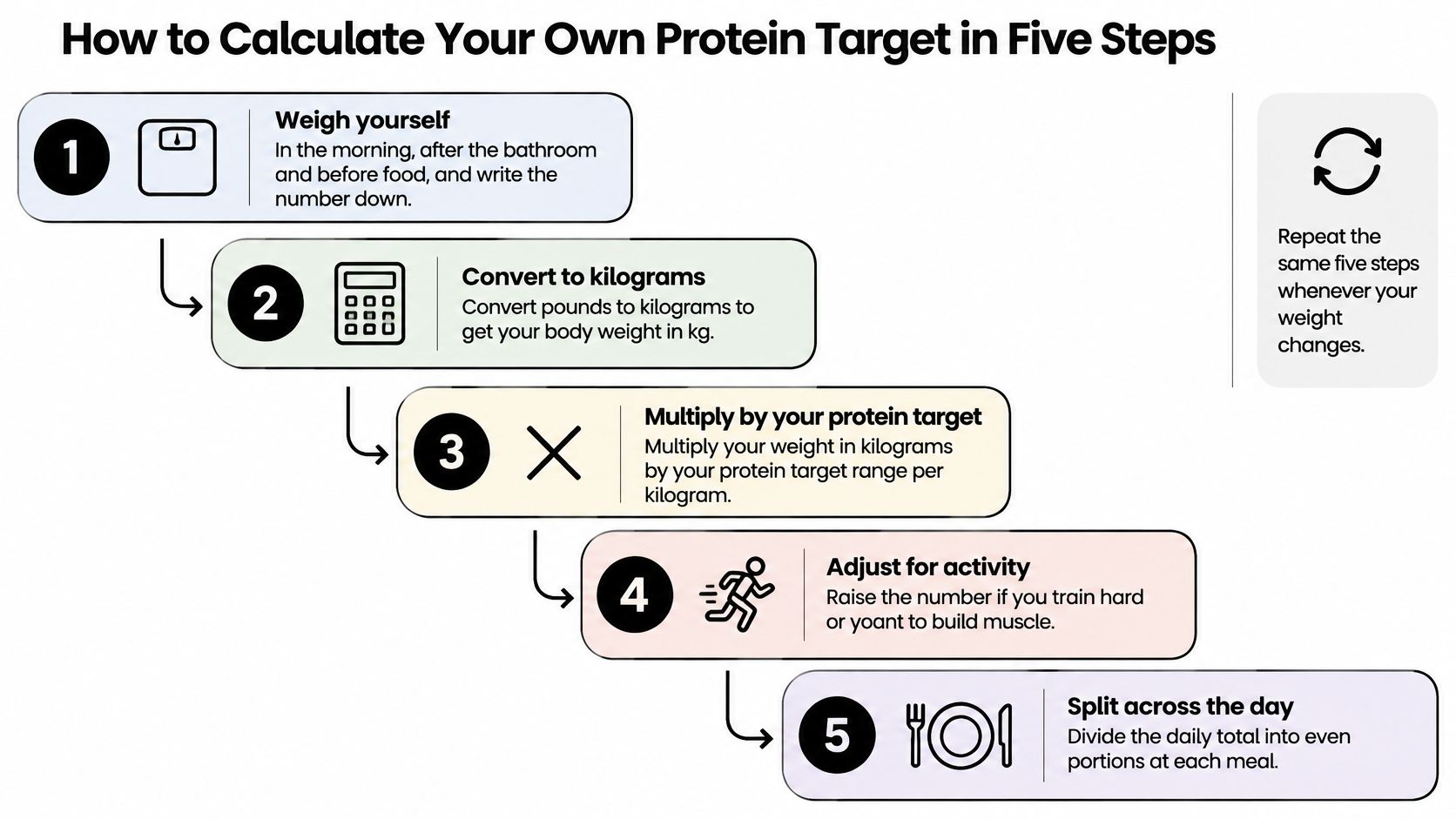
The visual summarizes the workflow from body weight to meals.
Record the inputs before multiplying
Measure your body weight consistently. Weigh yourself in the morning, after using the bathroom and before eating, and record the result. Consistent conditions make the measurement more useful than comparing readings taken under different circumstances.
Put your weight into kilograms. If your scale reports pounds, use a calculator's pounds-to-kilograms conversion and retain the result for your calculation. Don't multiply a pounds reading by a factor intended for kilograms.
Choose your current goal. Select the chart row that matches your eating and training this month. If you're dieting, record whether you're using current weight or a professionally chosen reference weight.
Multiply weight by the selected factor. For example, take the weight-loss-without-training row and multiply your kilogram weight by its factor; for a muscle-building range, calculate both ends. Keep the result readable rather than chasing decimal-place accuracy.
Check the result against your calorie budget. Use your food diary or meal planner to see how much of your daily energy the proposed protein intake occupies. If meeting it leaves little room for other foods, revisit the assumptions rather than treating the calculation as an order.
Test the number with an actual menu
A dieting person who isn't training would use the relevant weight-loss row, then build a normal day of meals around that result. A lifter using the muscle-building row would first choose a manageable point within the range, rather than assuming the upper endpoint is compulsory.
A practical test is whether the number works with food you'll eat. Enter a familiar breakfast, lunch, and dinner, then inspect the gap before buying supplements or replacing meals.
Check both protein and total calories. Adding a protein-rich food without adjusting anything else may improve the protein total while taking the day beyond your intended energy intake.
For a video companion, use the player below.
Keep your calculation as a starting target, not a daily exam. Small differences between planned and logged intake are less important than whether your overall pattern is consistent and appropriate for your goal.
Turning a Daily Protein Target Into Meals
Divide the target across meals you already eat, then decide whether a snack needs to fill the remaining gap. This is a planning strategy, not a requirement to eat on a rigid schedule or force identical portions at every sitting.
Splitting a daily protein target across meals
| Daily target | Breakfast | Lunch | Dinner | Snacks (total) |
|---|---|---|---|---|
| 80 g | 20 g | 25 g | 25 g | 10 g |
| 112 g | 30 g | 30 g | 30 g | 22 g |
| 140 g | 35 g | 40 g | 40 g | 25 g |
| 160 g | 40 g | 40 g | 40 g | 40 g |
These are illustrative allocations, calculated to add up to each daily total. The snacks column represents all snacks combined, not a requirement to eat that amount in a single sitting.
Make breakfast useful without making it compulsory
A 2024 review of protein intake in older adults describes potential benefits from approximately 1.2–1.6 g/kg/day and recommends at least 30 g of high-quality protein at breakfast. It also discusses evidence that balanced intake across meals may improve muscle-protein synthesis compared with concentrating intake in a meal, while acknowledging that the evidence isn't definitive.
That's support for a practical strategy, not proof that everyone needs an identical breakfast. If your first meal contains little protein, strengthening it may be easier than trying to fit most of your target into dinner.
Use foods you enjoy: Greek yogurt, eggs, cottage cheese, tofu, or leftovers from a savory meal. Check the package or food entry to establish portions rather than assuming every yogurt tub or scoop of powder contains the same amount. These protein-rich breakfast ideas offer ways to build a more substantial first meal.
A meal split is useful when it makes eating easier. It isn't useful when you spend the day rearranging food to make every column identical.
Adapt the split to your eating pattern
If you prefer a smaller breakfast, allocate more protein to lunch and an afternoon snack. If you don't snack, distribute that column among your usual meals instead.
Plant-based eaters should count their protein, not dismiss it. Build variety with soy foods, beans, lentils, grains, nuts, and seeds rather than relying on a narrow set of foods.
Protein quality and total intake both deserve attention, but a blanket deduction from every plant-food entry isn't a useful logging method. Use accurate food entries, vary sources, and seek dietetic help if appetite or dietary restrictions make your target difficult to reach.
Mistakes That Skew the Number and Your Seven-Day Check
A correct calculation won't rescue an inconsistent food log. Before raising your target, check whether you're measuring and recording the foods in a way that matches what you ate.
Fix the entry before changing the target
Mixing raw and cooked weights. Match the food entry to the state in which you weighed it. If you weigh chicken after cooking, select a cooked entry; don't attach that weight to a raw-food listing.
Copying a gym rule without checking its purpose. A slogan based on pounds can give a different result from a kilogram-based calculation. Use a consistent method that matches your goal rather than whichever rule produces the largest total.
Adding a shake after you've already met the target. Check your diary first. A supplement is a convenient way to fill a gap, not an automatic addition to a complete day of eating.
Keeping the same target through every phase. Reassess when your weight has changed meaningfully or when you move from losing weight to maintenance or muscle building. Update the goal and the weight basis together.
Meeting protein while overshooting calories. Look at the whole meal, including oils, sauces, drinks, and additions. A high-protein label doesn't establish that a food fits your calorie plan.
Avoid another common logging mistake: treating an estimated portion as a precise measurement. Restaurant dishes, mixed recipes, and photo estimates can all require adjustment when you know more about the ingredients or serving size.
Check the plan against an ordinary week
Run a seven-day check as a practical self-audit. Log your usual meals, aim for your chosen target on most days, and note whether you can do that without disrupting your calorie plan or forcing food when you're comfortably full.
Check three things together: total protein, the energy attached to your food choices, and whether your target still matches your current goal. If the plan is difficult, identify the obstacle before changing the number. A missed lunch needs a different fix from a target calculated using an unsuitable body weight.
Our Calorie Genie setup uses your goal, body stats, and activity level to set daily calorie and macro targets, which you can adjust in Settings. A plate photo lets the app identify foods, estimate portions, and return calories, protein, carbohydrates, and fat, so you can review the meal against your plan.
This short check tests feasibility, not whether you've gained muscle or preserved all lean mass. Those outcomes need longer-term assessment and, where appropriate, professional support.
A usable estimate beats false precision. Choose a defensible starting point, log consistently, and adjust the plan for a clear reason rather than reacting to an isolated day.
Visit Calorie Genie AI to set an adjustable calorie and macro target and use meal photos to estimate your intake. Review the portions before saving, then compare your logged protein with your chosen target during your seven-day check.