
A salad can look light right up until the dressing lands. The greens, cucumber and tomato rarely decide the total. The pour does. That's why estimating calories in salad dressing by style alone isn't enough. You need two numbers, the calories per tablespoon for that style and the number of tablespoons you used, and you need to treat the second number as the one most likely to be wrong.
Table of Contents
- Calories in Common Salad Dressings at a Glance
- Why Oil Makes Some Dressings So Calorie-Dense
- Caesar and Other Dressing Styles Where Labels Decide
- How Much Dressing You Actually Pour
- What Light Labels Hide and When Richer Dressing Wins
- How to Log Dressing Accurately in Your Food Diary
- Confirm the Portion Before You Log the Salad
Calories in Common Salad Dressings at a Glance
Most dressings fall between about 15 and 90 kcal per tablespoon. That's a wide range for the same spoonful, and style predicts most of it. Fat-free dressings sit at the bottom because water and vinegar replace oil. Creamy and oil-based dressings sit much higher because fat carries the flavour and the texture. Mayonnaise-style dressings sit at the top of the common range, since oil makes up most of the recipe.
How to Read the Reference Table
Start with the row that matches what's on your plate. Then multiply the per-tablespoon value by the tablespoons you poured. Two tablespoons is a useful check because many unmeasured pours land near that amount, and every row roughly doubles at that point.
| Dressing style | Serving | Calories per serving | Fat per serving | Calories at 2 tablespoons |
|---|---|---|---|---|
| Oil and vinegar vinaigrette (homemade) | 1 tbsp (15 g) | 70 | 8 g | about 140 |
| Regular ranch | 1 tbsp (15 g) | 60 to 65 | 7 g | about 120 to 130 |
| Mayonnaise-style | 1 tbsp (13.8 g) | 90 | 10 g | about 180 |
| Fat-free | 1 tbsp | 15 | 0 g | about 30 |
| Caesar | 1 tbsp | Use the label value, estimate 60 to 90 if unlabeled | Use the label value, estimate 7 to 10 g if unlabeled | Double the label value, estimate 120 to 180 if unlabeled |
Reading from lightest to heaviest makes the pattern clear. A fat-free tablespoon is a minor addition even if you use two. Ranch is no longer minor once the pour reaches two tablespoons. A homemade oil and vinegar vinaigrette is slightly higher still, which surprises people who assume anything with vinegar in the name must be light. Mayonnaise-style dressing is the heaviest row because there's very little in the spoon that isn't oil or egg based emulsion.
Why the Caesar Row Is Different
Caesar recipes differ enough between brands and restaurants that one fixed value would give false confidence. Treat its row as an estimate range until you can read a bottle or menu panel. That isn't a gap in the table. It's the honest answer for a style built differently by almost every maker.
Find the style first, then count the spoons. A precise per-tablespoon number multiplied by a guessed pour is still a guess.
When a bottle is in front of you, its label beats any chart, including this one. Use the chart for restaurant salads, shared homemade dressings and meals where the packaging is gone. Even then, write the result as an estimate. You'll get closer by naming the style correctly and measuring the amount than by hunting for a perfect database match for a dressing you can't identify.
Why Oil Makes Some Dressings So Calorie-Dense
The arithmetic starts with fat itself. According to the USDA FoodData Central derived entry for homemade vinegar and oil dressing, dietary fat supplies approximately 9 kcal per gram, and that dressing lists 70 kcal and 8 g fat per 1 tablespoon (16 g). Protein and carbohydrate supply about 4 kcal per gram, so gram for gram, oil carries more than twice the energy. Multiply 8 g of fat by 9 kcal and you've already explained nearly all of that tablespoon before counting anything else.
Why Ranch Lands Lower Than Vinaigrette
Ranch feels richer, so people expect it to top the chart. Its recipe works against that expectation. Water, emulsifiers and dairy or other low-calorie components dilute the fat in each spoonful, while a vinaigrette concentrates most of its energy in oil. A tablespoon of ranch still contains plenty of fat, but part of its weight is ingredients that contribute body and tang for far fewer calories.
Homemade dressings follow the same logic. If you whisk oil and vinegar at home, the oil share of your recipe sets the result. Adding mustard, lemon juice, herbs or shallot changes flavour with little effect on the total. Adding more oil changes everything. Greek yogurt swapped in for part of the oil pulls the number down because you're replacing a 9 kcal per gram ingredient with one built mostly on water and protein.
What Three Tablespoons Really Add
One measured spoon rarely ruins a calorie target. Repetition does. Three tablespoons of a 60 to 70 kcal per tablespoon dressing contribute roughly 180 to 210 kcal, comparable to a small snack, while the leafy vegetables underneath contribute relatively little. That's the portion-control trap. The bowl still looks like salad, so your brain files it as a light meal, but the topping alone may match what you'd log carefully if it arrived as a separate item.
The same principle applies to oil used in cooking, which is why a stir fry logged without its cooking oil can drift just as far. If you want to see that effect in another dish, the breakdown of calories in a beef stir fry shows how added fat changes a meal that looks vegetable led.
Logging rule: record the dressing as its own entry, separate from the salad, because it's usually the most energy-dense line in the bowl.
Read ingredient lists with that in mind. The word oil, especially when it appears first, tells you more about the calorie count than the word salad printed in large letters on the front of the bottle.
Caesar and Other Dressing Styles Where Labels Decide
Caesar needs its own rule because no single value fits every bottle. A typical Caesar is built on oil, egg or emulsifier and cheese, so expect it to behave like a creamy, oil-based dressing rather than a light one. Beyond that, don't assume. One brand may use more oil, another more water or yogurt, and a restaurant may make its own version daily with no panel to check.
The Two-Minute Label Check
Find the Nutrition Facts and note the stated serving first, not the calories. For most salad dressings that serving is the 30 g reference amount, expressed as roughly two tablespoons. If you poured one tablespoon, you're logging half the panel values. If you used the whole sachet or ramekin, you may be logging two panel servings without realising it.
Convert grams to spoons with a simple anchor. One tablespoon weighs about 15 g for most pourable dressings, so divide your gram weight by 15 to get tablespoons. Density varies a little by recipe, which is another reason to call the result an estimate rather than an exact figure.
Placing the Other Styles
The styles you'll meet most often include ranch, Caesar, Italian, French, honey mustard, creamy and Thousand Island, and each leans toward a pattern you can use when no label exists.
- Italian and French vinaigrettes: lean toward the oil and vinegar pattern, since oil does most of the work.
- Honey mustard and Thousand Island: carry sugar or sweetener, so the carbohydrate line matters alongside fat.
- Creamy and Caesar styles: lean toward the ranch to mayonnaise-style range, since emulsified oil forms the base.
Sweetened styles deserve a second look at the sugar line. Their fat may be moderate while added sugar lifts the total, and that matters if you're tracking carbohydrates as well as calories.
For an unlabeled Caesar served in a restaurant cup, estimate from the creamy group, say so in your diary note, and revise the entry if you later find the brand or menu figures. An acknowledged estimate you can correct beats a confident number you invented. Until a specific bottle is checked, the Caesar row in any honest chart stays label-dependent.
How Much Dressing You Actually Pour
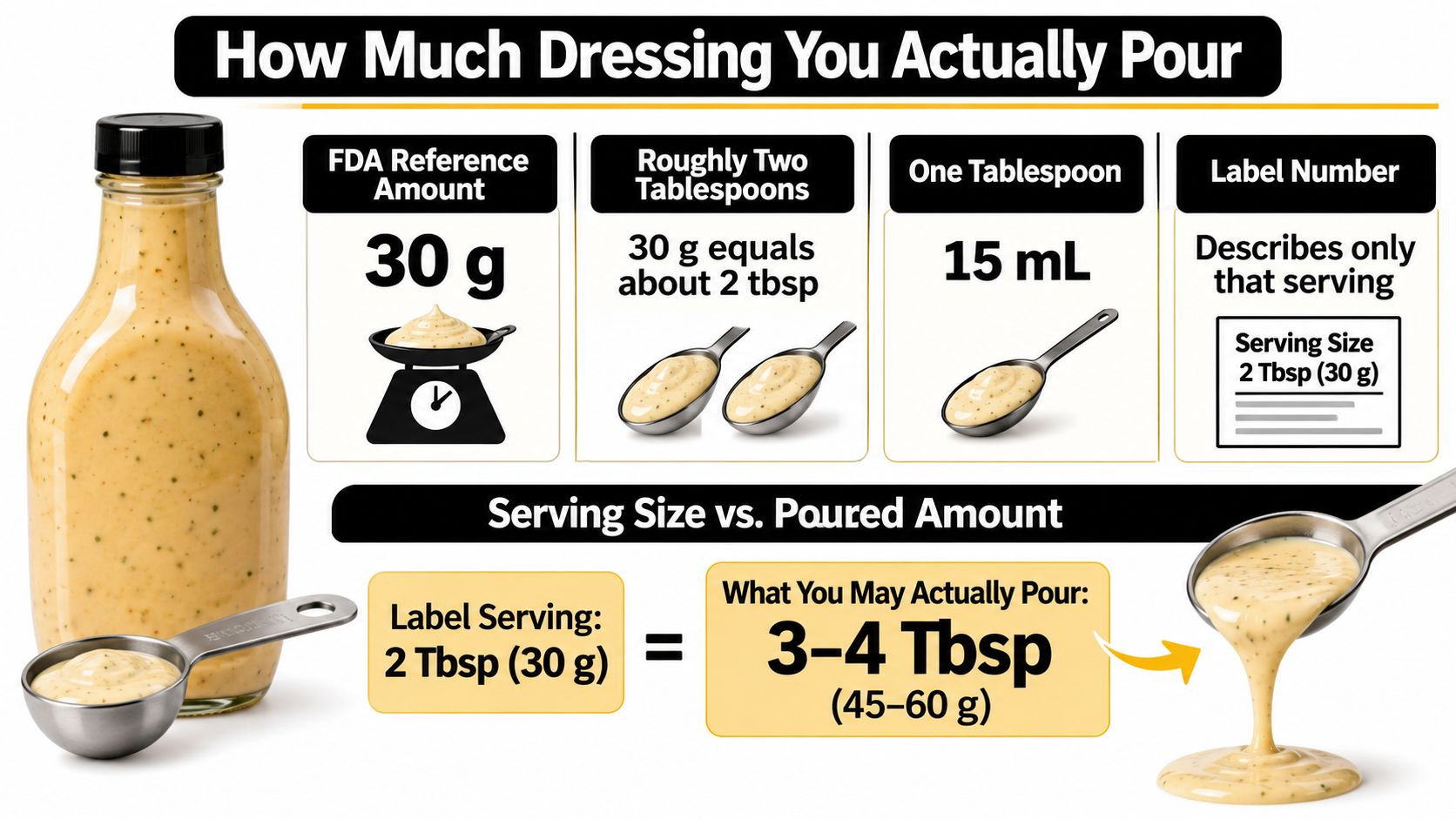
A label serving and a real pour are different things. The FDA labeling guidance for serving sizes defines the reference amount for most salad dressings as 30 g, typically expressed in tablespoons or milliliters, with one tablespoon at 15 mL, and the nutrition values apply only to that stated serving size. So the panel describes roughly two tablespoons, not whatever left your bottle. If you poured freely over a large bowl, you may have used one, two or four labeled servings, and the label can't tell you which.
Five Pours You Will Recognise
Ranch makes a clean worked example because its per-tablespoon value is easy to scale. Every figure below is an estimate for the dressing alone, before the salad is counted.
| Pour scenario | Amount | Estimated calories |
|---|---|---|
| One measured tablespoon | 1 tbsp (15 g) | about 65 |
| Two tablespoons | 2 tbsp | about 130 |
| Small restaurant ramekin | 2 to 4 tbsp | about 130 to 260 |
| Four tablespoons poured | 4 tbsp | about 260 |
| Dipping each forkful | Count the spoons used by the end | about 65 per tablespoon actually consumed |
| Tossed through the whole salad | Measure before tossing | about 65 per tablespoon added to the bowl |
One carefully measured tablespoon looks smaller than expected. It lightly coats a side salad if tossed well, but it won't pool. Two tablespoons is where coverage starts to feel generous, and it's also the amount hidden inside many restaurant ramekins. A full small ramekin can hold two to four tablespoons, so finishing it can mean roughly 130 to 260 kcal of ranch alone. At four tablespoons you're at about 260 kcal before a single leaf is counted.
Dipping each forkful sounds restrained, and it can be. The method works because the fork carries a thin film rather than a puddle. It stops working when you dip too far or top up the ramekin. Count what's left at the end. If half remains, log half.
Tossing dressing through the whole salad is the hardest to judge after the fact, because a well-tossed bowl hides how much went in. It often coats more leaves than pouring over the top, so people add a second squeeze. Measure before tossing, not after.
Other fatty toppings create the same blind spot. The guide to calories in avocado is worth a look if your salads often carry both, since two reasonable additions can stack quickly.
Pour one measured tablespoon into your usual spoon once and look at it. That single calibration does more for your future estimates than any chart can.
What Light Labels Hide and When Richer Dressing Wins
A "light" claim describes one labeled spoon, not the salad you eat. The fat-free salad dressing entry puts fat-free dressing near 15 kcal per tablespoon, with no fat in that entry. A mayonnaise-style dressing in the same spoon is several times richer, because the fat is still in the formula. Category and the panel, not the word on the front, set the estimate.
What Replaces the Fat
Removing oil does not remove the need for texture and flavour. Manufacturers often replace it with water, starches, gums or sweeteners, which is why the first ingredient in fat-free styles is often water or vinegar. Calories stay low. The number that moves is often carbohydrate.
Check total carbohydrate and sugars per serving on the Nutrition Facts panel, especially in fat-free French, honey mustard or Catalina, where sweetness stands in for richness. Fat-free dressing is a different food. Calorie tracking alone makes it the easy win. A goal built around sugar or total carbohydrate needs the panel before you treat it as the regular version with the fat deleted.
Yogurt-based and reduced-fat dressings sit between those poles. Formulas vary too widely for one default, so the label is the number. A yogurt base usually brings more protein and less fat than a mayonnaise base. Added sugar can still show up, and some reduced-fat products cut fat only modestly.
Where Uncertainty Is Highest
Three situations produce the shakiest estimates. Creamy restaurant dressing in a cup hides both recipe and amount. Homemade sauce hides how much oil went into the batch. A bottle with an unclear serving size hides whether the panel means one tablespoon or two. Name the style, estimate tablespoons or grams, use a conservative figure for that style, mark it as an estimate, and revise when a label appears or you realise only part was eaten.
A photo has the same limit. A glossy coat on leaves does not show whether the liquid is vinaigrette or a creamy dressing thinned with water. Treat the first dressing figure as provisional until the style or the portion is known.
When the Richer Dressing Is the Smarter Pick
The FDA page on serving size on the Nutrition Facts label explains that serving information is standardized so products can be compared, while the calorie number still refers only to the labeled serving, not necessarily the amount used in a meal. That split changes the light-versus-regular decision. The lower-calorie choice depends on how much you pour, whether the dressing replaces another high-calorie component, and whether the vegetables are satisfying enough to finish.
Set two plates side by side. One measured tablespoon of an oil-and-vinegar vinaigrette coats a small salad and carries a strong flavour. Four tablespoons of that same fat-free dressing can still come in under one oil-based spoon, yet the thinner texture often leads to a fifth spoon, or to half the greens left behind and a snack later. Measured, the richer dressing can be the plate that stays satisfying at nearly the same calories.
What matters is the pour you will make.
Three checks decide it. The measured amount: one spoon of a rich dressing versus an unmeasured pour of a light one. What it replaces: a flavourful dressing may stand in for cheese, croutons or candied nuts. How complete the meal feels: a salad with protein and a measured two tablespoons of regular dressing may fit the day better than an overpoured light dressing on leaves alone.
A bowl of raw vegetables with no other fat is the clearest case for richness. One measured tablespoon of a fuller dressing makes that bowl taste like a meal, and meals people enjoy tend to get finished. The reverse holds too. Cheese, avocado or an oily protein already on the plate means a fat-free or vinegar-forward dressing can add brightness without another layer of fat.
Judge a dressing by calories per actual portion and calories for the whole assembled salad, never by calories per tablespoon alone.
Oil-based, creamy, sweetened and yogurt-based styles do not share one calorie story. Fat, sugar and protein each move the total, so folding them into a single salad-dressing figure erases the difference the label was written to show.
How to Log Dressing Accurately in Your Food Diary
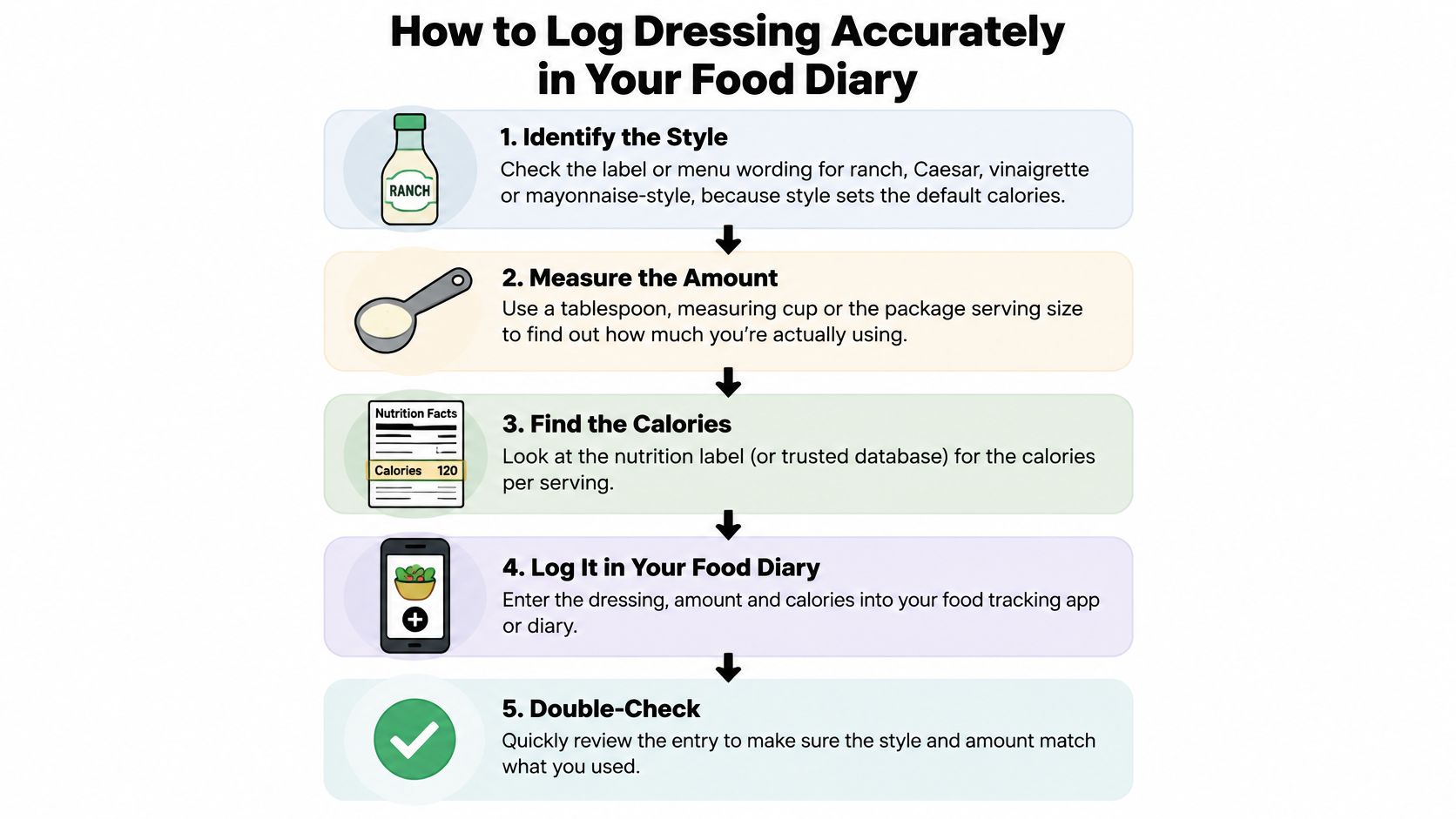
A dressing entry that records style, grams and spoons is already closer to the truth than a generic salad dressing line, even while the calorie figure stays an estimate. The pour is the variable that moves the total. A label only becomes useful once that amount is known.
Repeat the same order at every meal. Each step uses a label, a scale or a spoon count, so the estimate tightens without any special skill.
- Identify the style. Read the label or menu for ranch, Caesar, vinaigrette or mayonnaise-style. Style sets the default calories per tablespoon you will scale. Searching a generic dressing entry and accepting the first hit is the usual slip.
- Measure the pour. Use a tablespoon or a kitchen scale. Tare an empty bowl, add the dressing, record the grams, then divide by 15 g per tablespoon for the spoon count. Scooping from the bottle onto the leaves removes the only chance to know how much left the bottle.
- Log it as its own entry. Give the dressing a separate line from the salad in your food diary app, so the greens do not hide its calories. A single mixed entry makes a later correction almost impossible.
Turning the Label Into Your Number
- Multiply by your actual tablespoons. Take the label's per-serving calories. If that serving is two tablespoons, convert it to a per-tablespoon figure, then multiply by what you measured. Logging the printed serving after pouring double is the most frequent error with packaged dressings.
- Subtract what you left. Note dressing still in the bowl, ramekin or sachet and deduct it. Two tablespoons poured, with half a tablespoon pooling under the last leaves, means about one and a half tablespoons eaten. Eyeballing the leftover is acceptable here because the starting amount was measured.
- Control restaurant meals at the table. Ask for dressing on the side, then spoon it over with a teaspoon or tablespoon from the cutlery so you can count. A salad dressed in the kitchen forces a guess on both style and amount, the two inputs that set the calorie line.
Checking a Photo Estimate
- Review before you save. If a photo tracker reads a creamy dressing as a light coating, correct it. After a scan, Genie returns calories, protein, carbs and fat with a health score, and you can tap any ingredient to change its portion before saving. Set the dressing line to your measured tablespoons instead of keeping the first guess.
Three habits inflate the error in a predictable order. An unmeasured drizzle almost always understates the pour. Logging a full ramekin as one serving understates it further. Picking a fat-free database entry for a regular dressing, only because it appeared first, understates it most of all.
A finished entry should read like a measurement. One clear line works: ranch dressing, 30 g, 2 tablespoons, about 130 kcal, estimate. Style, weight, spoons and calories sit together, so a later correction changes only the amount, and a repeat meal can be copied rather than rebuilt.
Confirm the Portion Before You Log the Salad
A salad's logged calories move with the dressing that lands on the leaves, not with the name on the bottle. Measure that pour before it touches the greens: a tablespoon, or a quick weight in grams. Those seconds decide whether the diary line is a measurement or a guess. Dressing is usually the most energy-dense part of the bowl, so an unchecked spoon throws off the calories, and often the fat, even when the rest of the plate is right.
You do not have to measure every salad after that. A week of counted pours shows what one tablespoon looks like in your usual bowl. Later estimates stay closer because your eye has a reference.
When the amount stays unknown, write estimate beside the entry and correct it once a label, a spoon count, or a gram weight appears. A run of honest estimates, revised when better information shows up, tracks intake more closely than a set of precise-looking guesses.
Confirm the line before you save it. If the reading says a heavy coating and you poured one tablespoon, change the dressing portion to that tablespoon. The leaves can stay as logged. Only the dressing needs to match the pour.
One photo of the finished plate can supply calories, protein, carbs and fat for the whole plate, plus a 1 to 10 health score with a one-line reason. Every ingredient is editable, so the dressing line can be set to the tablespoons or grams you measured. Calorie Genie AI is free to download on the App Store and Google Play. Its calorie estimates are a guide, not medical advice. Snap the salad, match the dressing entry to the pour you counted, and check that total against the rest of your day.