
You've opened a macro calculator, entered your details, and ended up with a set of daily gram targets. Now you're wondering whether those numbers fit your life, especially when dinner is a restaurant meal and your activity changes from week to week.
Learning how to calculate macros means understanding where those targets come from, not just copying the result. Start with an estimated calorie need, divide that energy between protein, fat, and carbohydrate, then use your real-world progress to refine the plan. The maths can be exact even when the inputs aren't.
Table of Contents
- How to Estimate Your Daily Calorie Target
- The Macro Formula and Energy Values
- How to Set Protein, Fat and Carbs in Order
- Worked Macro Targets for Each Goal
- Check Your Split Against Healthy Ranges
- Why Your Macros Drift and How to Adjust
- Start Tracking Your Macros Today
How to Estimate Your Daily Calorie Target
Set calories before splitting macros. Your resting energy needs, daily movement, and goal all affect the amount of food you're planning around.
Estimate resting energy. The adult Mifflin–St Jeor equations described in the National Academies discussion of energy estimation are: for men, 10 × weight in kg + 6.25 × height in cm − 5 × age + 5; for women, 10 × weight in kg + 6.25 × height in cm − 5 × age − 161. For a hypothetical woman aged 30, weighing 70 kg and measuring 170 cm, the calculation is 700 + 1,062.5 − 150 − 161, giving about 1,452 kcal daily at rest.
Account for ordinary activity. Multiply resting metabolic rate, or RMR, by an activity factor to estimate total daily energy expenditure, or TDEE. For this worked example, assume a moderately active multiplier of 1.55: 1,452 × 1.55 gives about 2,251 kcal daily. Choose activity based on your typical week, not a particularly energetic holiday.
Activity factors for estimating daily energy use
The following are illustrative calculator assumptions, not measurements of your personal expenditure. Pick the description closest to your usual routine when working through the example.
| Activity level | Typical week | Multiplier |
|---|---|---|
| Sedentary | Desk job, little or no exercise | 1.2 |
| Lightly active | Exercise 1–3 days a week | 1.375 |
| Moderately active | Exercise 3–5 days a week | 1.55 |
| Very active | Hard exercise 6–7 days a week | 1.725 |
| Extra active | Hard training plus a physical job | 1.9 |
Choose a goal-based target. For maintenance, begin near estimated daily expenditure. For fat loss, choose a modest deficit; for muscle gain, consider a modest surplus alongside appropriate training. There's no need to turn an uncertain expenditure estimate into an aggressively restrictive target.
Treat the result as a trial. Record the starting target and assess how it fits your energy, hunger, training, and progress. A calculator can't establish your exact needs from body measurements alone.
Use this visual to keep the order clear.
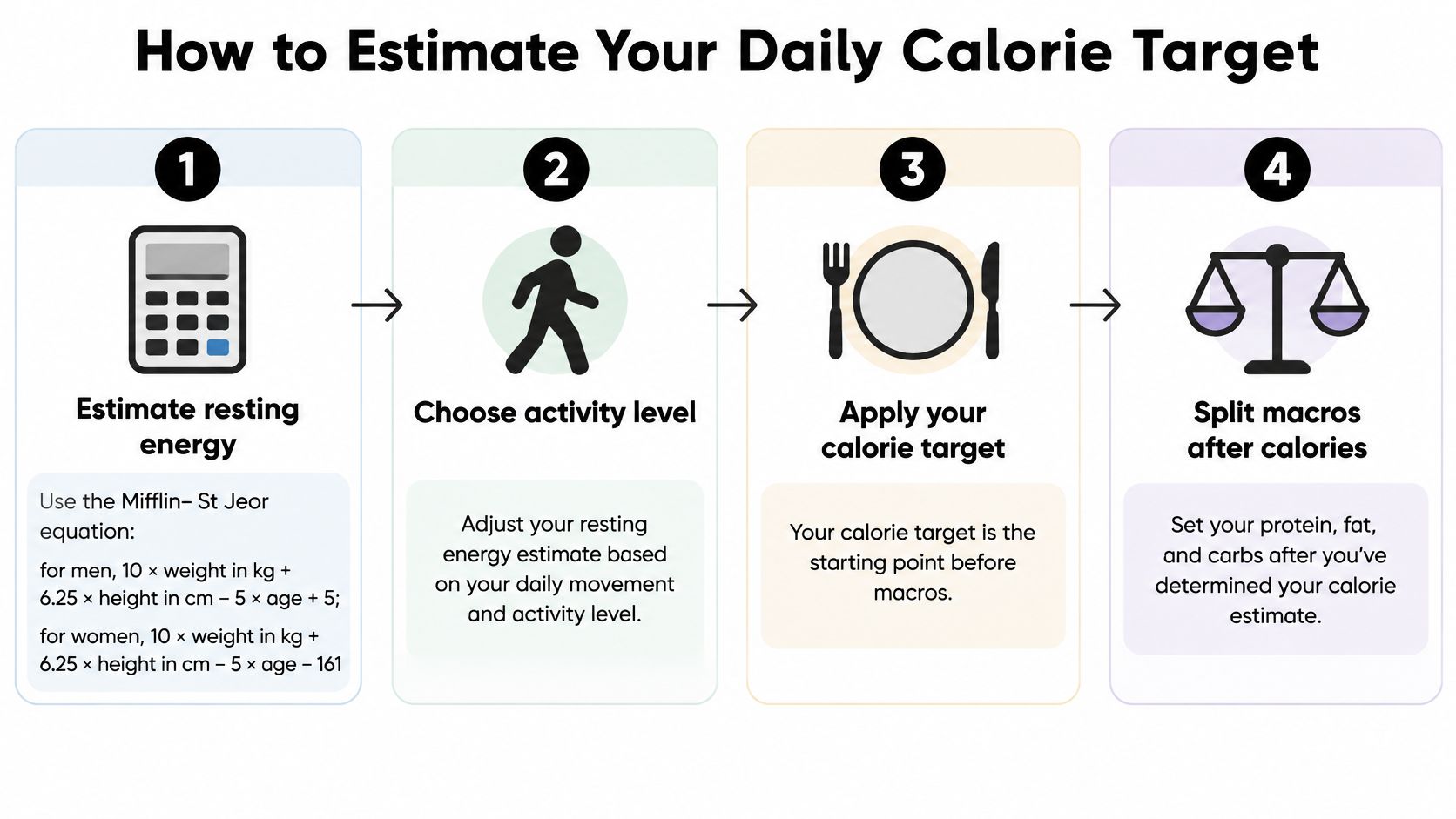
For help choosing the initial intake, use our guide to how many calories you need a day. During our setup, you share your goal, body stats, and activity level, and we set a daily calorie and macro target that you can adjust in Settings.
The Macro Formula and Energy Values
Grams = target calories × share of calories ÷ calories per gram.
The standard energy factors are approximately 4 calories per gram for carbohydrate and protein, and 9 for fat, as explained in the FDA nutrition glossary. Using its worked allocation of a 2,000-calorie day into 50% carbohydrate, 20% protein, and 30% fat, the conversions are:
- Carbohydrate: 2,000 × 0.50 = 1,000 calories; 1,000 ÷ 4 = 250 g.
- Protein: 2,000 × 0.20 = 400 calories; 400 ÷ 4 = 100 g.
- Fat: 2,000 × 0.30 = 600 calories; 600 ÷ 9 = about 67 g.
Enter the share as a decimal when using a calculator. You're allocating a share of calories, not a share of the food's weight or the space on your plate.
Check the serving before counting the grams
A label's serving size isn't necessarily the amount you eat. Nutrition information is generally listed per serving, although some packages also show whole-package values, so multiply each listed macro by the servings consumed.
The calorie total in this example is a general FDA labeling reference, not everyone's personal requirement. Replace it with your own starting calorie target rather than changing your eating to match a label reference.
Maths check: Convert the planned grams back into calories and add them together before using the plan.
Small differences after rounding are expected, particularly when fat grams have been rounded to a whole number. Don't keep adding decimal places to make the result look more authoritative. Labels may round their values, and available energy can differ with food composition.
A correct calculation also doesn't guarantee a nutritionally adequate diet. It tells you how energy has been divided, not whether your food choices meet all your dietary needs.
How to Set Protein, Fat and Carbs in Order
A protein-first approach lets you establish a body-weight-based protein target before distributing the remaining energy. It's especially useful when you exercise regularly and want a plan that supports muscle maintenance or gain.
Keep the allocation order visible while planning meals.
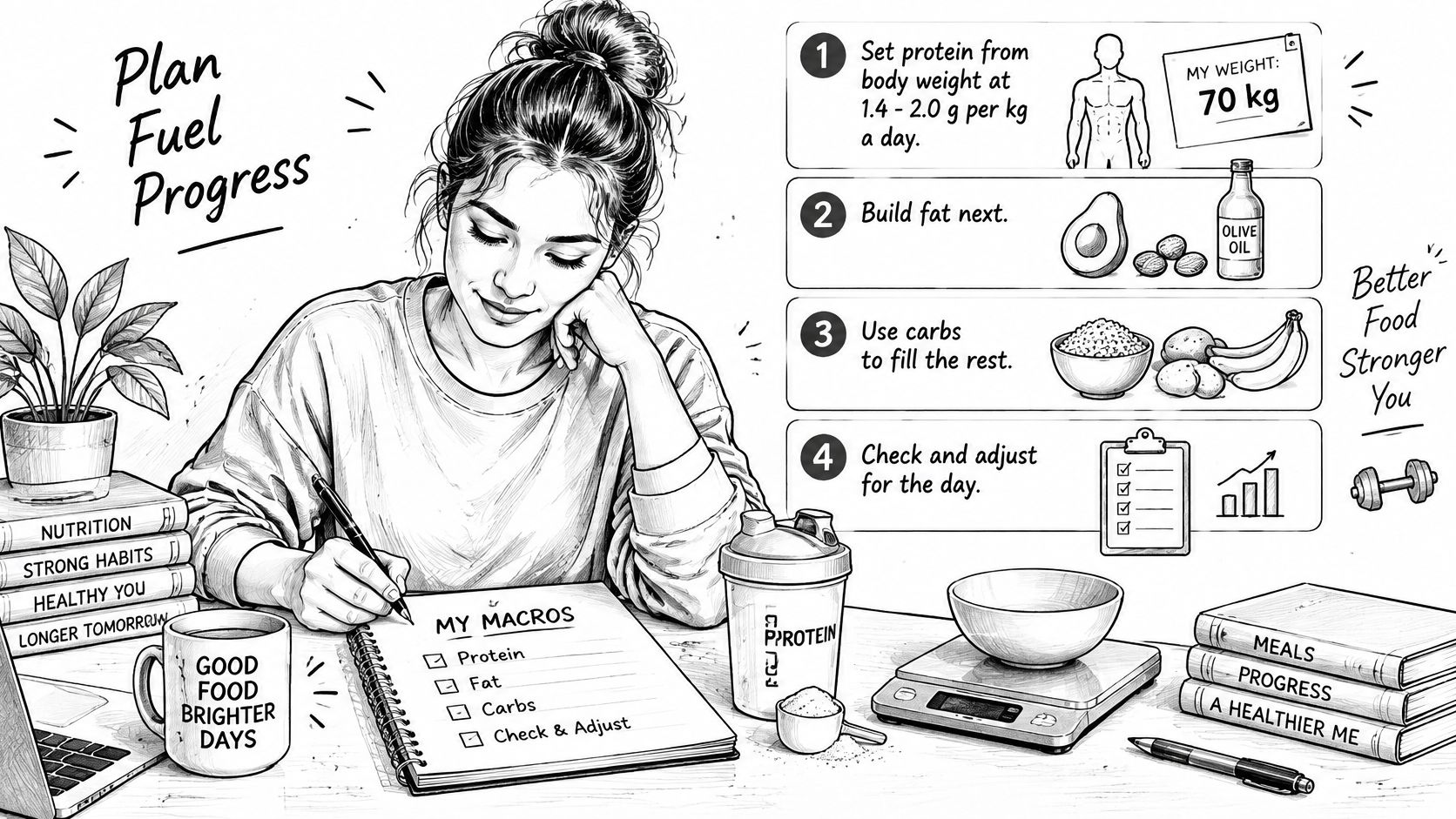
Set protein from body weight. The International Society of Sports Nutrition position stand gives 1.4–2.0 g/kg daily as sufficient for most exercising individuals seeking muscle gain or maintenance. For a hypothetical 75 kg person, 75 × 1.4–2.0 gives [105–150 g protein]. Choosing the upper end for this example gives 150 × 4 [600 kcal].
Reserve energy for fat. For an illustrative 2,400-calorie plan, choose 30% for fat: 2,400 × 0.30 [720 kcal], then 720 ÷ 9 [80 g fat]. This is a planning choice, not a universal minimum everyone must follow.
Give carbohydrate the remaining calories. Subtract protein and fat energy: 2,400 − 600 − 720 [1,080 kcal]. Divide the remainder by carbohydrate's energy factor: 1,080 ÷ 4 [270 g carbohydrate].
Check the finished allocation. Add the energy contributions: 600 + 720 + 1,080 [2,400 kcal]. Write down the gram targets only after confirming that the allocation matches the intended intake.
Make meal distribution flexible
Spread protein across meals in a way you can maintain. If you skip breakfast, plan deliberate protein sources later rather than treating the missed meal as a ruined day.
A 2025 scoping review of breakfast protein identified 15 studies and concluded that the evidence for strength remains unclear. Meal timing is a possible refinement, not a guarantee of better results or a reason to neglect your daily intake.
For a visual companion to meal planning, use the video below.
Avoid these allocation mistakes:
- Starting with an arbitrary protein percentage: Establish the appropriate gram target before working out its calorie share.
- Crowding out other foods: Don't push protein so high that fiber-rich carbohydrate sources disappear.
- Confusing body weight with lean mass: Use the measurement specified by the recommendation you're following.
- Ignoring how the plan feels: Review training, recovery, satiety, and digestion rather than judging success only by the split.
Worked Macro Targets for Each Goal
| Goal | Calories | Fat |
|---|---|---|
| Fat loss | 2,000 kcal | 25% = about 56 g |
| Maintenance | 2,400 kcal | 30% = 80 g |
| Muscle gain | 2,800 kcal | 25% = about 78 g |
These are hypothetical worked targets, not calorie prescriptions. Each row uses the same imagined 75 kg exercising adult, with protein fixed at 1.8 g/kg, giving 135 g protein and 540 protein calories. The calorie totals are chosen to demonstrate the arithmetic, not to predict what someone of that weight needs.
Calculate the carbohydrate remainder
Using unrounded fat calories gives these results:
- Fat loss example: 2,000 − 540 − 500 = 960 carbohydrate calories; dividing by the carbohydrate energy factor gives 240 g carbohydrate.
- Maintenance example: 2,400 − 540 − 720 = 1,140 carbohydrate calories, giving 285 g carbohydrate.
- Muscle gain example: 2,800 − 540 − 700 = 1,560 carbohydrate calories, giving 390 g carbohydrate.
Protein stays fixed in this comparison. Fat changes with the selected allocation, while carbohydrate takes most of the difference between calorie targets. That's why reducing calories can mean smaller portions of carbohydrate foods without requiring you to eliminate them.
The fat-loss row sits about 17% below this hypothetical maintenance intake, calculated from the difference between those rows. That describes this example only. It doesn't establish the right deficit for you, and the muscle-gain row is likewise a starting scenario rather than an optimal surplus.
A goal changes the energy budget. It doesn't automatically require a completely different set of foods.
Choose the row that illustrates your goal, but replace its calories with your own estimated target. Keep the calculation order consistent: establish protein, allocate fat, then work out carbohydrate from the remaining energy.
If you're focusing on fat loss, our guide to macros for weight loss can help you consider food choices and consistency alongside the calculation. A plan you can follow through ordinary workdays, social meals, and training sessions is more useful than an impressive-looking ratio you repeatedly abandon.
Check Your Split Against Healthy Ranges
| Macro | Share of calories | Calories on 2,000 kcal | Grams per day |
|---|---|---|---|
| Carbohydrate | 45–65% | 900–1,300 kcal | 225–325 g |
| Protein | 10–35% | 200–700 kcal | 50–175 g |
| Fat | 20–35% | 400–700 kcal | About 44–78 g |
These adult Acceptable Macronutrient Distribution Ranges, or AMDR, appear in the Dietary Guidelines for Americans; the same guidance gives an adult protein Recommended Dietary Allowance of 0.8 g/kg daily. The table translates those calorie shares into grams for the stated reference intake.
The ranges are population guardrails, not a set of ratios every person must hit exactly. They help you notice an unusually restrictive allocation, but they don't replace consideration of medical conditions, training demands, food preferences, or overall intake.
Separate calorie share from protein adequacy
A percentage tells you how much of your energy comes from protein. A weight-based recommendation asks a different question: how much protein is being provided relative to body size?
For example, applying the adult baseline gives approximately 56 g daily for a 70 kg adult and 72 g for a 90 kg adult. In the hypothetical goal comparison, the protein allocation clears that baseline, but its suitability still depends on the individual rather than the calculation alone.
Don't mistake the RDA for an optimal sports target, and don't assume that a high protein percentage necessarily means a large amount of protein. A percentage only becomes meaningful when you know the calorie total behind it.
Before accepting a split: Check total energy, actual protein grams, and the balance of the remaining foods.
Use this review to identify questions, not to grade your diet:
- Energy check: Does the intake fit your estimated needs and intended goal?
- Protein check: Is the gram target appropriate for your body size and activity?
- Balance check: Can you include varied carbohydrate and fat sources without squeezing out foods you need or enjoy?
- Personal-needs check: Does a medical condition or prescribed diet require individualized advice?
Passing the arithmetic checks is useful. Building a varied, workable eating pattern still requires choosing foods, not just meeting totals.
Why Your Macros Drift and How to Adjust
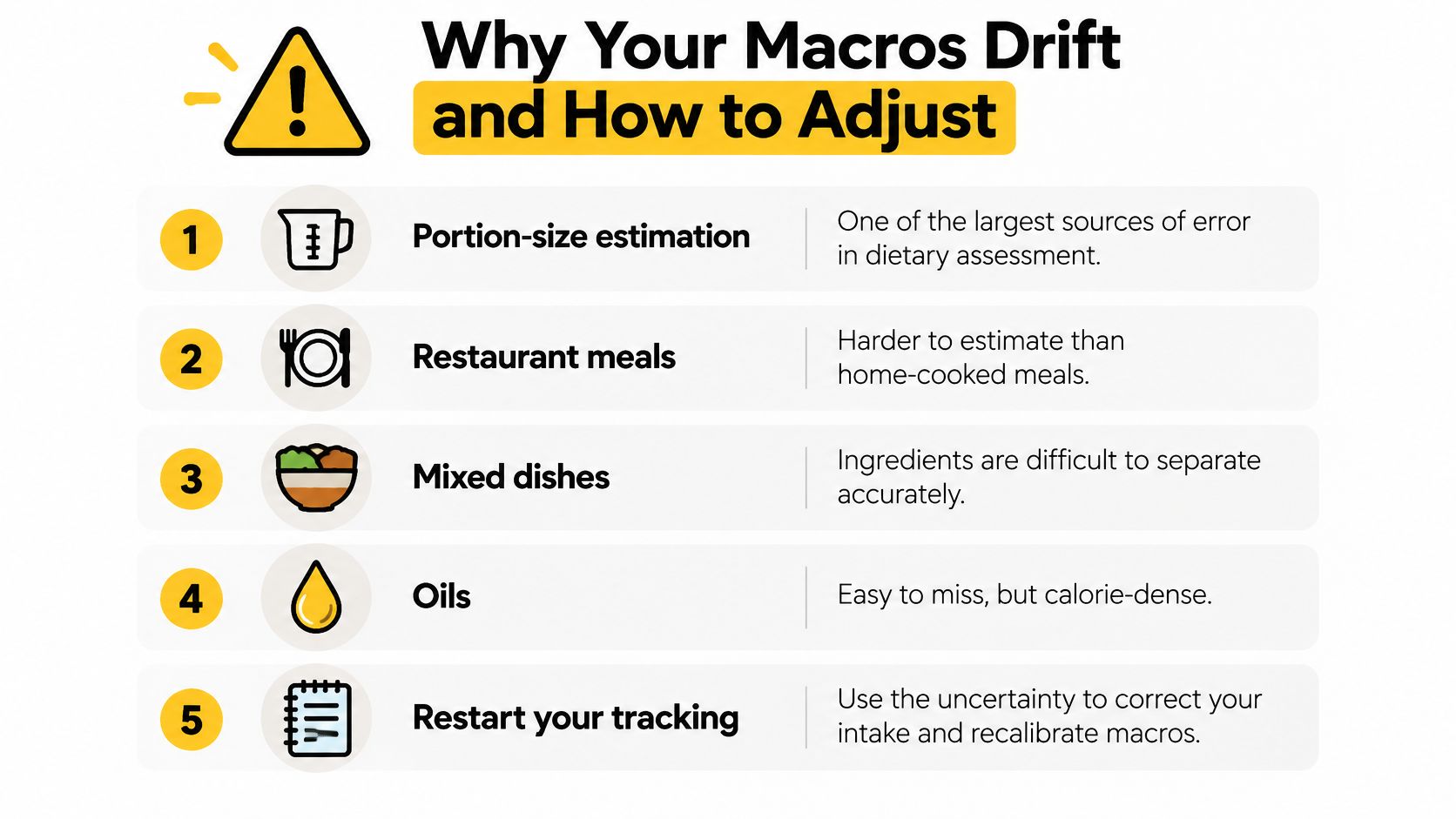
The formula hides uncertainty in the food you record. The Nutritional Assessment overview of dietary errors identifies portion-size estimation as a major source of error, alongside forgotten foods, incomplete ingredient knowledge, and systematic reporting bias.
Restaurant meals and mixed dishes are especially difficult to reconstruct. You may recognize the main ingredients without knowing how much oil, butter, sauce, or spread went into the serving.
Watch for these common sources of drift:
- Unlogged cooking fats: Include oil and butter used during preparation, not just what's visible on the plate.
- Missing drinks: Record milky coffees, juices, alcohol, and other drinks alongside meals.
- Raw and cooked mismatches: Match the food entry to the state in which you measured it.
- Package-serving confusion: Check whether the listed information describes your portion or only part of the pack.
- Double-counted exercise: Don't add workout calories again when your activity estimate already includes that exercise.
Use the checklist to identify what needs checking, rather than assuming you lack willpower.
Adjust from patterns, not isolated weigh-ins
- Keep a consistent record. Use the same approach to portions and entries so comparisons are meaningful.
- Review average trends. Compare body-weight patterns with waist measurements, hunger, training performance, and how consistently you followed the plan.
- Investigate before cutting. Check missing ingredients and serving sizes before deciding the calorie target is wrong.
- Change gradually. Make a small adjustment when the overall pattern differs from your goal, then observe again.
Calculation error and difficulty following the plan aren't the same thing. A correct split can still produce misleading records if the portions entered don't match what you ate. Our daily calorie and macro targets can be adjusted at any time in Settings.
Photo logging also needs confirmation. A summary of a 2025 food-image estimation study reports that testing 52 foods across three large language models produced macronutrient estimation errors of 42%–110%, with protein errors exceeding 60% for every model tested.
Those findings don't measure every food-tracking app, but they're a reason not to treat an image estimate as a measured value. Confirm cooking fats, ingredients, and portion size before saving.
Start Tracking Your Macros Today
Your numbers are a working estimate, so treat the first version as a starting dose rather than a permanent prescription. Write down your calorie target, then your protein, fat and carbohydrate targets underneath it. Check that the split suits your goal, passes the basic adequacy checks, and leaves room for meals you enjoy. A plan you can follow beats a precise split you abandon.
Choose a logging routine you'll use
A food diary app lets you point the camera at a meal, drink, barcode or restaurant menu instead of searching entries or weighing portions. Before saving a photo-scanned meal, tap any ingredient to adjust its portion, paying particular attention to cooking oil and serving size, since those two account for much of the gap between an estimate and what you ate.
Your meal photos are used only to estimate nutrition for you. Keep reviewing the entries rather than assuming the camera captured everything.
Then wait. Set a review date and judge the trend across the whole period, since day-to-day readings bounce around even when the plan is working. If tracking becomes stressful or encourages restrictive eating, step back and seek support.
These estimates are a guide, not medical advice. A registered dietitian can help you tailor intake to medical conditions, specific dietary needs, or a demanding training schedule.
Calorie Genie AI offers photo-based calorie and macro estimates with editable ingredients, helping you turn daily targets into a practical food record. Visit Calorie Genie AI to download the app free on iOS or Android, then log your first meal and see the breakdown for yourself.