
Why does adding protein to oatmeal so often mean dumping in powder and hoping it doesn't turn into paste? If your plain bowl keeps you satisfied for an hour but leaves you hungry again by mid-morning, you don't necessarily need more oats. You may need a more deliberate balance of ingredients.
Oatmeal supplies carbohydrate, fiber, and some protein, but it isn't a concentrated protein source. A nutrition record attributed to USDA FoodData Central lists about 2.5 grams of protein per 100 grams of cooked oatmeal, according to Foodatron's cooked-oatmeal entry. That makes the ingredient you stir in especially useful when you're tracking a daily protein target.
Oats aren't the problem, either. A randomized crossover trial published in 2015 found greater fullness and lower hunger after instant oatmeal than after a ready-to-eat oat-based cereal, but it didn't establish added protein as the cause.
The fix can be a strategic add-in, not a complete breakfast overhaul. Greek yogurt, cottage cheese, powders, seeds, egg whites, and peanut butter all work differently. Choose for your protein needs, then manage the heat, liquid, and timing so breakfast stays creamy rather than clumpy.
Table of Contents
- 1. Greek Yogurt
- 2. Cottage Cheese
- 3. Whey Protein Powder
- 4. Pea Protein Powder
- 5. Hemp Hearts
- 6. Chia Seeds
- 7. Egg Whites
- 8. Peanut Butter
- 8 High-Protein Oatmeal Add-Ins at a Glance
- Build Your Bowl, Then Keep the Streak Going
1. Greek Yogurt
Greek yogurt is the easiest route to creamy protein oatmeal without powder. Its thick consistency blends especially well with rolled oats, and its tang balances sweet toppings such as banana, berries, or honey. Plain yogurt also gives you more control over sweetness than a flavored version.
For a sense of its potential contribution, The Big Man's World's protein-oatmeal recipe lists Greek yogurt as providing 18 grams of protein per half-cup. That's an ingredient value from that recipe, not a guarantee for every yogurt, so check your tub before logging it.
Add it after cooking
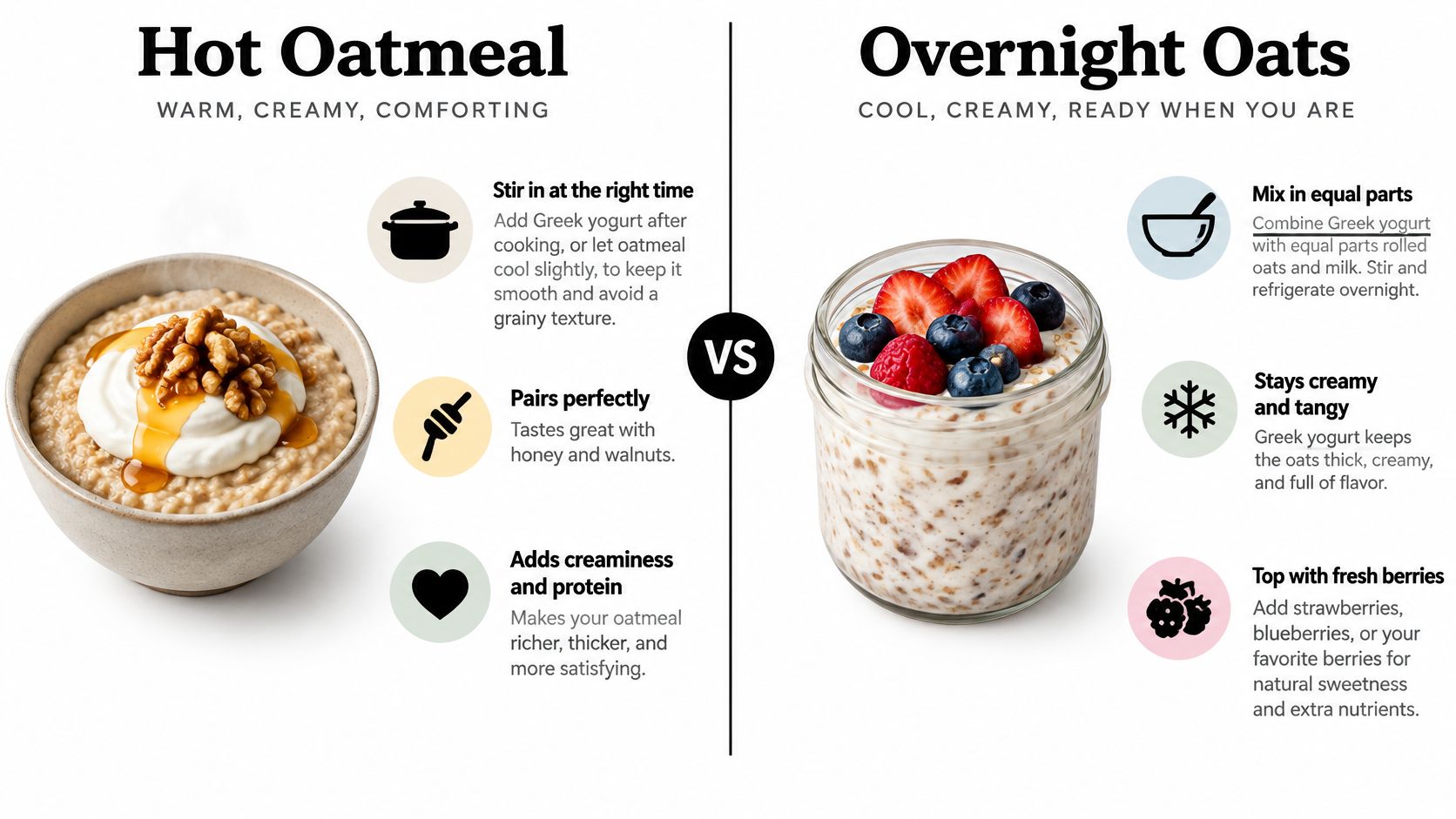
Take the pan off the heat and let the bubbling stop before stirring in yogurt. Start with a generous spoonful, fold it through, and add more until the bowl reaches the creaminess you like. Boiling it aggressively can leave a less smooth result.
For overnight oats, mix yogurt with milk before adding the oats. Keep the mixture looser than your intended finished texture because the oats will absorb liquid in the refrigerator.
- Warm bowl: Finish cooked oats with yogurt, honey, and chopped walnuts.
- Cold bowl: Combine oats, milk, and yogurt, then refrigerate and top with berries.
- Best stack: Use yogurt as the main protein addition and hemp hearts as a soft topping.
Compare labels rather than assuming every strained yogurt contributes the same amount. Our guide to the highest-protein Greek yogurt can help you choose, but your actual product and portion should determine the entry in your food diary.
2. Cottage Cheese
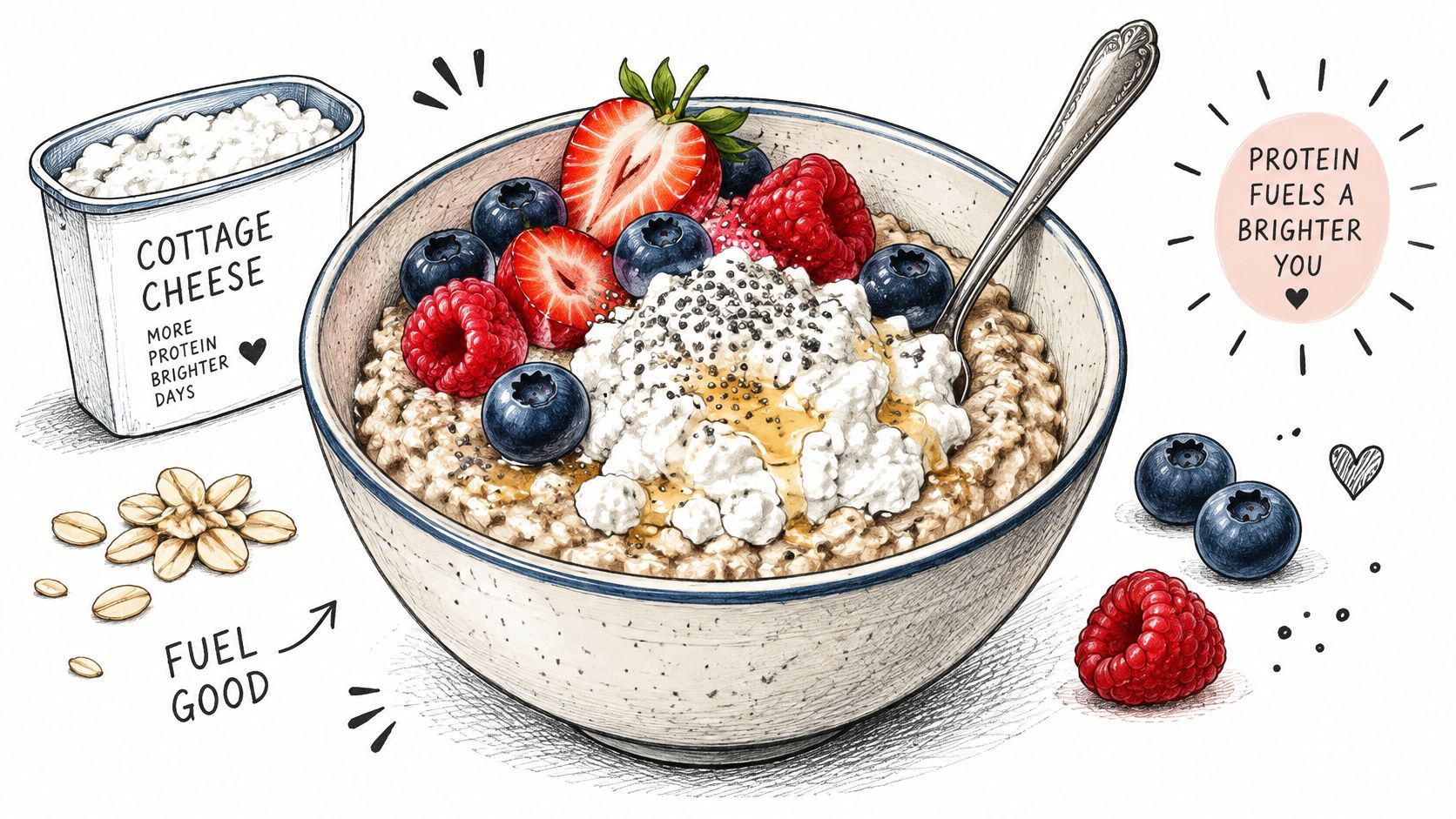
Cottage cheese works beautifully if you like a mild, slightly salty breakfast. The main decision isn't sweet versus savory. It's curds versus completely smooth.
Stir it straight from the tub if you enjoy soft curds scattered through your oats. If that texture bothers you, blend it with a splash of milk using an immersion blender or small food processor before it goes anywhere near the pan.
Blend first for a creamy finish
Cook the oats until tender, remove them from the heat, and gently fold in the cottage cheese. Avoid repeatedly boiling and reheating the mixture, which can make the dairy separate and the curds more noticeable. If the bowl becomes too thick, loosen it with warm milk rather than stirring harder.
For a sweet version, combine blended cottage cheese with cocoa and mashed banana. Taste before adding sweetener, since banana can soften the tang without making the bowl taste like dessert.
A savory version is just as useful: cook oats without sweetener, fold in cottage cheese, and finish with black pepper, sautéed spinach, and chili flakes. Add a cooked egg if it fits your meal plan.
Texture shortcut: Blend cottage cheese separately. Trying to crush the curds against cooked oats usually makes the oats pasty before the cheese becomes smooth.
Cottage cheese can contribute noticeable salt, so compare sodium on the labels if that matters to you. When stacking it with seeds or nut butter, keep those additions modest until you've tasted the finished bowl.
3. Whey Protein Powder
Dumping dry whey into bubbling oatmeal is a reliable way to get little protein dumplings. Make a smooth slurry first, and you'll have much more control over the result.
Whey is useful when you want a concentrated protein addition without building breakfast around a large volume of yogurt or cottage cheese. Its main drawback is that flavor, sweetness, and heat behavior vary between products.
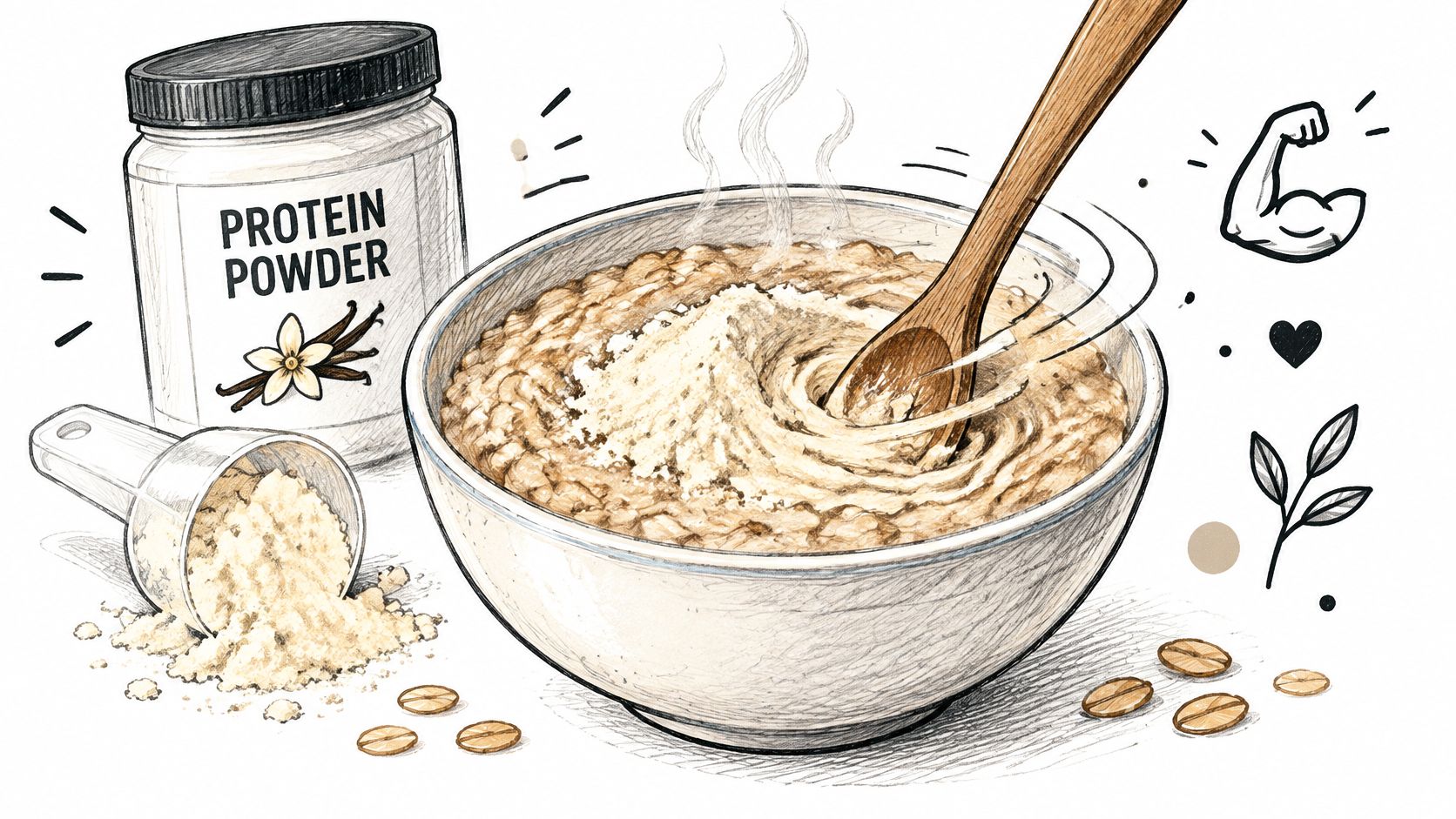
- Mix separately: Whisk your measured powder with cool water or milk until smooth and pourable.
- Remove the heat: Let the cooked oats stop bubbling before folding in the mixture.
- Adjust gradually: Add more liquid if needed, then taste before adding honey or syrup.
Vanilla whey works with cinnamon and cooked apple. Chocolate whey pairs well with banana and a small peanut-butter swirl, but an already sweet powder rarely needs every sweet topping in the cupboard.
Don't cook the oats to their final thickness before adding whey. Leave room for the powder to absorb liquid.
Use the label's serving weight rather than assuming every scoop is equivalent. If your breakfast already contains milk and yogurt, a smaller powder portion may fit better than a full serving.
For weight management, judge the whole bowl's calories and macros, not just its protein total. The same approach underpins our guide to macros for weight loss: choose an amount that fits your day rather than treating more powder as automatically better.
4. Pea Protein Powder
For a dairy-free bowl, pea protein can do the heavy lifting, but it needs more attention to liquid and flavor. Compared with whey, many pea powders make oatmeal thicker and leave a more noticeable earthy or chalky finish.
That doesn't mean you need to cover the taste with extra sweetener. Cocoa, cinnamon, mashed banana, and cooked apple give the bowl a stronger flavor foundation without relying on sweetness alone.
Give it enough liquid
Whisk pea protein with cool plant milk before adding it to cooked oats off the heat. Make the mixture pourable rather than paste-like, and keep extra liquid nearby. If the oats look right immediately but stiffen while you're adding toppings, loosen them again before serving.
For a practical breakfast, combine chocolate pea protein with oats, banana, and cocoa. Alternatively, try vanilla pea protein with cinnamon, apple, and pumpkin purée, remembering that the pumpkin also changes the bowl's thickness.
- Choose for your diet: Check that the complete product is dairy-free if that's essential.
- Compare the serving: Read protein and calories for the actual labeled portion, not merely the scoop size.
- Start gradually: Try the powder without chia first so you can judge how much thickening comes from the powder itself.
Protein quality isn't a reason to dismiss plant-based options. A review in Current Nutrition Reports distinguishes amino-acid-based quality measures from broader health outcomes, supporting a more practical choice based on diet, tolerance, and total intake.
Use your daily target to choose the portion. Our macro calculator for weight loss guide explains how to approach that planning without making every breakfast a maximum-protein challenge.
5. Hemp Hearts
Hemp hearts are for people who want a topping, not another mixing job. These soft, shelled seeds add a mild nutty flavor and a delicate bite without turning oatmeal crunchy or forming a gel.
Sprinkle them over finished hot oats, where they'll stay more distinct, or stir them into overnight oats for a softer texture. They're particularly useful when a bowl of yogurt-enriched oats feels uniformly smooth and needs a little contrast.
Use them as a supporting ingredient
Hemp hearts contribute protein, but don't treat them as interchangeable with a concentrated powder. They also contribute fat and calories, so the right portion depends on what else is already in your bowl. A generous scattering can be appropriate, but it should be intentional rather than invisible to your food log.
Try warm oats with Greek yogurt, sliced strawberries, and hemp hearts. The yogurt provides the main creamy protein addition, while the seeds supply texture without requiring extra cooking.
For a dairy-free version, use soy milk in the oats and finish with hemp hearts and cinnamon. If you also want peanut butter, start with a small swirl rather than piling both toppings on heavily.
- Keep them fresh: Store opened hemp hearts tightly sealed in the refrigerator or freezer.
- Taste before using: Discard seeds that smell or taste rancid.
- Measure your usual topping: Establish a repeatable portion instead of pouring directly from the bag.
Hemp hearts are forgiving when you're stacking ingredients because they don't absorb liquid like chia. They're a good finishing choice when the bowl is already thick enough and you don't want to change its consistency further.
6. Chia Seeds
Chia changes oatmeal's structure more than its flavor. As the seeds absorb liquid, they form a gel that can turn loose overnight oats into a spoonable breakfast, or turn already-thick oats into something uncomfortably dense.
Use chia for texture and fiber, with its protein contribution as a bonus. If increasing protein is your main aim, pair it with yogurt, milk, or a measured powder rather than expecting chia alone to do the job.
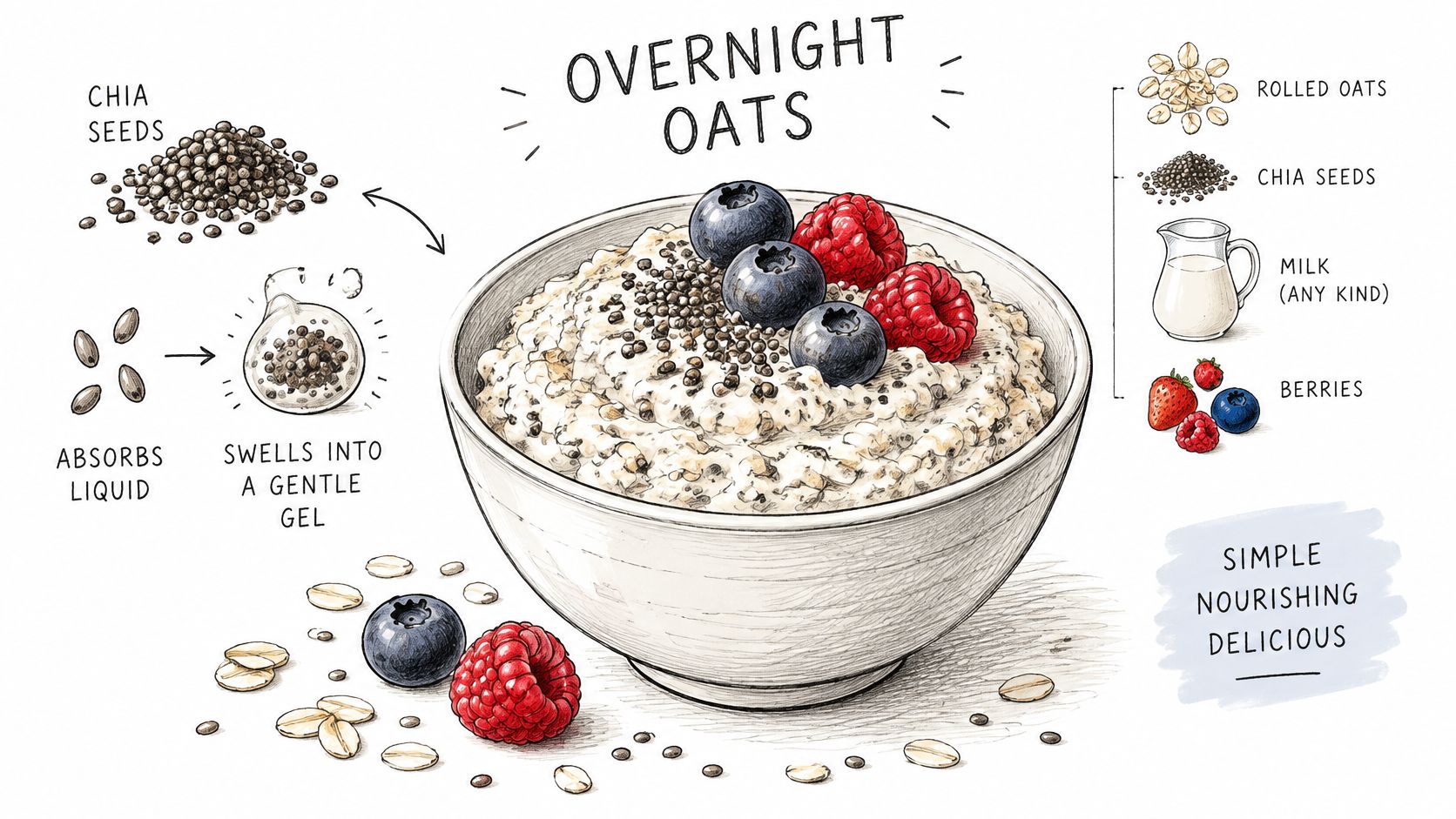
For overnight oats, whisk chia into the milk and yogurt mixture, then stir in the oats. Give everything another thorough stir after it starts thickening, especially around the bottom and corners of the container. That second stir helps prevent dense pockets of hydrated seeds.
For hot oatmeal, stir chia through while the oats are still loose, then let the bowl stand briefly. Add more liquid after it thickens rather than assuming the first consistency is the final one.
Stacking rule: When chia and protein powder share a bowl, both need liquid. Start looser than usual and adjust after they've hydrated.
A useful combination is overnight oats with plain Greek yogurt, milk, chia, and berries. If you dislike the visible seeds, ground chia can reduce the seedy bite, although it will still thicken the mixture.
Begin with a small addition if you're not accustomed to a fiber-heavy breakfast. Increasing chia, oats, seeds, and fruit all at once makes it harder to identify what feels comfortable for your digestion.
7. Egg Whites
Egg whites can make oatmeal fluffy and lightly custardy without introducing a strong flavor. The catch is timing: unlike yogurt or powder, egg whites need to cook, not disappear into a finished bowl.
Use a saucepan and a whisk or flexible spatula for the most control. Carton egg whites make portioning convenient, while separated whites work too.
Keep stirring over gentle heat
Cook the oats until they're almost ready, leaving them slightly loose. Reduce the heat, then pour in the whites gradually while stirring continuously. Keep cooking and stirring until the whites are fully cooked throughout.
Don't dump cold whites into a vigorously boiling pan and leave them alone. They can set into visible strands or chunks, giving you scrambled egg pieces surrounded by oatmeal rather than a cohesive bowl.
- Sweet version: Finish with cinnamon, vanilla, and berries once the whites have cooked.
- Savory version: Fold in cooked spinach and season with black pepper and a little salt.
- Useful stack: Add peanut butter after cooking, or a yogurt topping after the bowl has cooled slightly.
This video offers a visual reference for the mixing technique.
Don't use appearance alone as a reason to stop cooking early. Follow the egg product's cooking directions, and don't serve whites merely warmed through.
For tracking, record the egg-white portion separately from the oats and cooking liquid. That matters especially when you alternate between carton whites and separated eggs, since eyeballing a pour makes your usual breakfast less repeatable.
8. Peanut Butter
Peanut butter makes oatmeal taste richer almost immediately. Stirred into warm oats, it softens and spreads through the bowl; spooned onto cold oats, it stays more like a distinct ribbon.
It adds protein, but it's better treated as a flavor fat than your main protein source. If you keep adding peanut butter solely to raise protein, you may add more calories than you intended before reaching your target.
That distinction matters because oatmeal already has appetite-supporting properties. A review of oatmeal and satiety discusses the role of oat beta-glucan and viscosity, which is a useful reminder that breakfast doesn't need an unlimited collection of rich toppings to be worthwhile.
Melt it rather than fighting it
Stir peanut butter into warm, cooked oats while there's still enough moisture for it to disperse. If you're using a stiff natural peanut butter, mix it with a little warm milk in a separate cup before adding it.
For overnight oats, whisk peanut butter into the milk before combining it with the oats. This distributes the flavor more evenly than trying to stir a cold lump through a chilled, thick mixture.
- Classic bowl: Pair peanut butter with banana and cinnamon.
- Chocolate bowl: Add cocoa to the oats, then finish with peanut butter and milk.
- Protein-focused stack: Use yogurt or powder for the main protein addition and peanut butter for flavor.
Check the ingredient list for added sugar, salt, and oils according to your preferences. Stir separated natural peanut butter thoroughly before portioning so you don't log a spoonful that's mostly oil.
Taste before adding another topping. Peanut butter, hemp hearts, and walnuts can be delicious together, but you don't need all of them for the bowl to feel complete.
8 High-Protein Oatmeal Add-Ins at a Glance
| Add-In | Typical Protein per Serving | Best For | Watch Out For |
|---|---|---|---|
| Greek Yogurt | 15–18 g per 170 g (6 oz) | Creamy oats, hot or overnight | Dairy; tart flavor; can split in very hot oats |
| Cottage Cheese | 12–14 g per ½ cup | Creamy or savory high-protein bowls | Sodium; curdy texture |
| Whey Protein Powder | 20–25 g per scoop | Convenient, concentrated protein | Can clump or turn gritty; dairy ingredients |
| Pea Protein Powder | 20–25 g per scoop | Vegan and dairy-free protein | Earthy or gritty texture; may thicken oats |
| Hemp Hearts | 9–10 g per 3 tablespoons (30 g) | Whole-food protein with healthy fats | Calorie-dense; store cool to prevent rancidity |
| Chia Seeds | 4–5 g per 2 tablespoons (28 g) | Adding fiber and thickening oats | Modest protein; can become gel-like |
| Egg Whites | 3.5–4 g per large egg white | Lean protein with little fat | Cook thoroughly; can turn rubbery if overcooked |
| Peanut Butter | 7–8 g per 2 tablespoons | Rich flavor and a more filling bowl | Calorie-dense; peanut allergy risk |
Build Your Bowl, Then Keep the Streak Going
A balanced bowl needs a clear plan: choose one main protein source, then add only what improves its texture or flavor. Greek yogurt, cottage cheese, protein powder, or cooked egg whites can anchor the bowl. Chia thickens it, hemp hearts add a soft bite, and peanut butter brings richness. Too many additions can leave the oats overly thick, sweet, or filling.
Stack for texture, then check the total
Cook the oats a little looser than you want them to finish. If using egg whites, stir them in while the oats cook. Take the pan off the heat before adding a powder slurry or dairy. Add seeds with care, since they thicken as they hydrate, and finish with nut butter if you want a richer bowl.
For a lighter breakfast, use a measured protein source and keep toppings selective. For a plant-based bowl, choose a suitable plant protein and add enough liquid to offset its thickening effect. Seeds and nut butter make a more substantial bowl, but they also change the meal's overall nutrition.
A higher-protein bowl can still have a smooth texture. Real Life Nutritionist's protein-oatmeal recipe provides 32 grams of protein per serving. Your total will differ if you change the yogurt, milk, powder, or portion.
Protein alone doesn't guarantee a particular glucose response or weight-loss result. A controlled oatmeal glycemic-response study adjusted energy and macronutrients across test meals, underscoring the importance of the whole meal.
Once you settle on a combination you enjoy, make it repeatable. Photograph your bowl in Calorie Genie AI to get estimated calories, protein, carbs, and fat, plus a health score. You can tap any ingredient to change its portion before saving, then compare the meal with your daily protein target. Add powder or other ingredients yourself if they aren't identified correctly, and use nutrition estimates as a guide rather than medical advice.
Visit Calorie Genie AI to download the app on iOS or Android and photograph your next bowl.