
A typical single chicken taco has about 200 to 250 calories. A medium reference taco weighing 120 grams has about 252 calories before heavy toppings or a second taco.
That range is a starting point, not a fixed value. A taco's total depends on how much it weighs and what goes into it, especially the tortilla, cheese, cooking fat, and sauces. For a useful estimate, match the taco's build and size to a reference, then adjust for what's on your plate.
Table of Contents
- Chicken Taco Calories for Common Servings
- What Moves Chicken Taco Calories
- Scale and Log Each Taco
- Restaurant Labels as a Baseline
- Why Database Entries Disagree
- Log the Plate in Front of You
Chicken Taco Calories for Common Servings
A 120-gram medium chicken taco provides 252 calories, or about 210 calories per 100 grams. Its listed macros are 19.2 grams of protein, 20.4 grams of carbohydrates, and 10.4 grams of fat. These figures offer a general reference for comparing a similar taco.
| Taco | Serving | Calories | Protein | Fat | Carbs |
|---|---|---|---|---|---|
| Medium chicken taco | 120 g | 252 | 19.2 g | 10.4 g | 20.4 g |
| Grilled chicken taco | 104 g | 210 | Not listed | Not listed | Not listed |
| Chicken taco with cheddar | 120 g | 234 | 16.2 g | 11.8 g | 20.6 g |
| Soft chicken taco, lettuce and cheese | 100 g | 189 | 13.3 g | 6.3 g | 19.7 g |
| Corn tortilla chicken taco with cheese | 100 g | 211 | Not listed | Not listed | Not listed |
| Flour tortilla chicken taco with cheese | Per taco | 220 | Not listed | Not listed | Not listed |
| Chicken taco with beans and cheese | 100 g | 193 | Not listed | Not listed | Not listed |
| Chicken taco with beans and cheese | 105 g | 203 | 11.6 g | Not listed | Not listed |
| Large corn chicken-and-cheese taco | 160 g | 338 | Not listed | Not listed | Not listed |
Serving units matter. The flour-tortilla example is listed per taco, while several other entries are given per 100 grams. Comparing those figures directly is like comparing a whole loaf with a slice: the serving size needs to match first.
For example, a 104-gram grilled chicken taco has 210 calories, or about 202 calories per 100 grams. A 120-gram cheddar taco has 234 calories, or about 195 calories per 100 grams. Different fillings and amounts explain why tacos of similar weight can have different totals.
Larger portions add up quickly. A 105-gram beans-and-cheese taco has 203 calories, while a 160-gram corn chicken-and-cheese taco has 338.
A practical match: Choose the row closest to your taco's ingredients and weight. If your taco has extra cheese, sour cream, guacamole, or another tortilla, account for those additions separately. For one typical taco, about 200 to 250 calories is a reasonable starting estimate. A larger taco or more generous toppings can put it above that range.
What Moves Chicken Taco Calories
A taco's calorie total follows its ingredients and portions more than its tortilla color. In the listed examples, a corn-tortilla chicken taco with cheese has 211 calories per 100 grams, while the flour-tortilla version is listed at 220 calories per taco. Since those figures use different serving bases, they are not a precise shell-to-shell comparison. They do show why the listed taco nutrition examples need to be read alongside portion size and toppings.
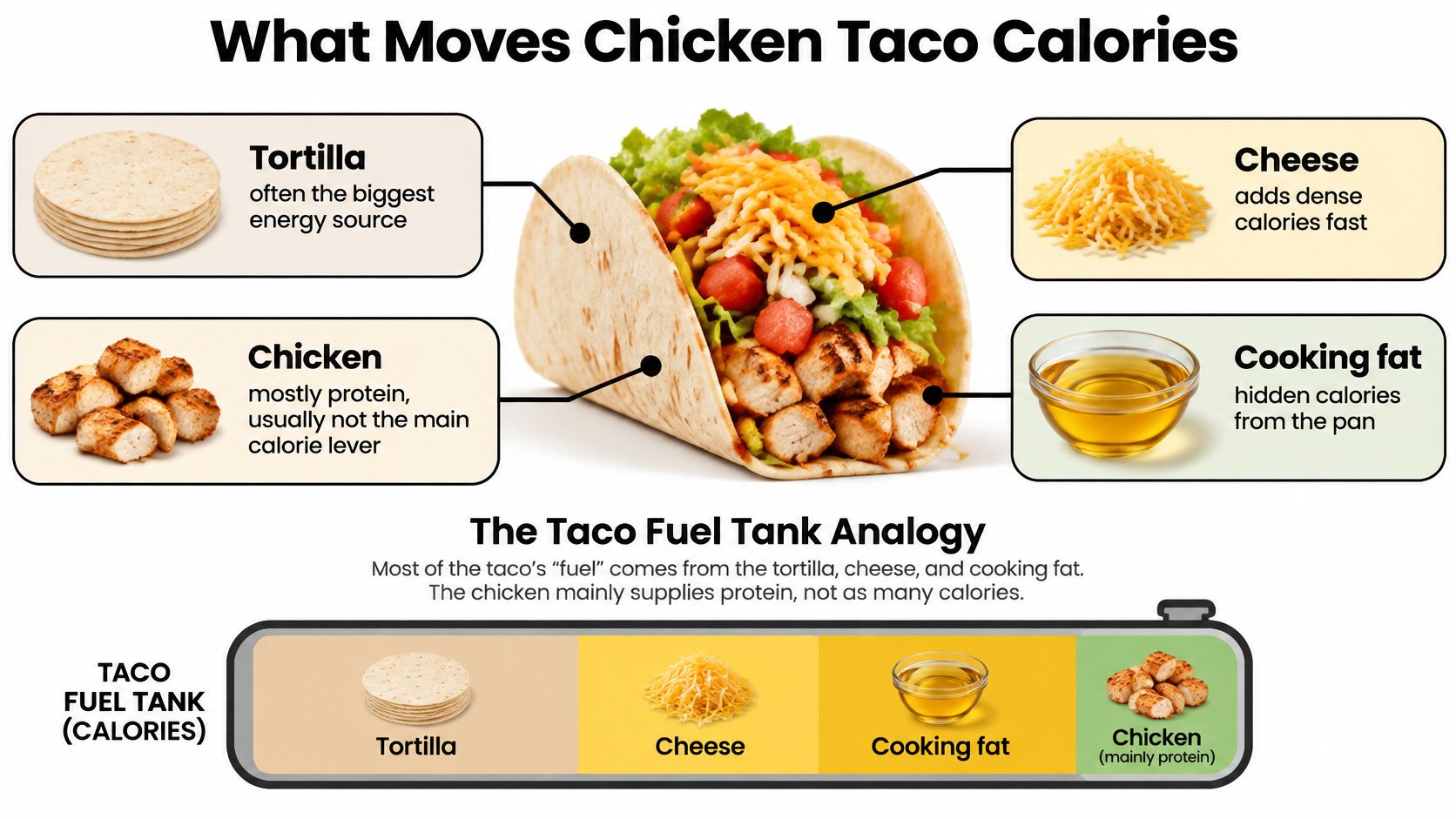
A taco is built in layers: the tortilla, chicken, cheese, and cooking fat each contribute to the total. Chicken also supplies protein, while cheese and added fat can shift calories noticeably. That is why two tacos with similar amounts of chicken can still differ.
The examples make the contrast concrete. A soft taco with lettuce and cheese is listed at 189 calories per 100 grams, a corn-tortilla taco with cheese at 211, and a chicken taco with beans and cheese at 193. The cheddar example has 11.8 grams of fat in a 120-gram serving, compared with 6.3 grams per 100 grams in the soft lettuce-and-cheese taco. Across the listed examples, protein ranges from 11.6 to 19.2 grams per serving, so calories are only part of the nutrition picture.
Build the estimate layer by layer
Start with the shell, then consider the chicken portion and any cooking fat. Add cheese and beans, followed by avocado, sour cream, or creamy sauce. Salsa, lettuce, onion, and cilantro add bulk and flavor, while richer toppings can change the calorie estimate more.
Avocado can stay in the build. Log it as an ingredient and use this guide to calories in avocado to estimate the topping.
Change one layer at a time to compare tacos. Corn versus flour may make a small difference in these examples; cheese, cooking fat, and the grams of each ingredient can move the total more. A useful estimate describes the taco's ingredients and portions, not just its chicken.
Scale and Log Each Taco
Use this formula when you know the reference value per 100 grams:
Estimated calories = reference calories per 100 grams × portion grams ÷ 100.
For example, a taco with a reference density of 195 calories per 100 grams and an estimated weight of 150 grams comes to about 293 calories. That's a practical way to adapt a reference to a larger or smaller taco rather than treating one database serving as a universal size.
| What you ate | Basis | Estimated calories |
|---|---|---|
| One beans-and-cheese taco | 105 g at the listed serving | 203 |
| One medium reference taco | 120 g | 252 |
| One taco scaled from cheddar density | 150 g at 195 kcal per 100 g | 293 |
| One large corn chicken-and-cheese taco | 160 g | 338 |
| Two beans-and-cheese tacos | 2 × 10⁵ g | 406 |
| Two large corn tacos before sides | 2 × 160 g | 676 |
The portion examples show why counting tacos alone can mislead. A 105-gram beans-and-cheese taco is listed at 203 calories, with 11.6 grams of protein, 3.4 grams of fiber, and 419 milligrams of sodium. A large 160-gram corn chicken-and-cheese taco is listed at 338 calories, or about 211 calories per 100 grams. The corn tortilla chicken-and-cheese serving reference supports weighing or estimating each taco rather than multiplying a generic entry.
Two tacos at the smaller reference serving total about 406 calories. Two large tacos reach about 676 calories before sides, sauces, or drinks. For a meal with chicken as the main filling, you can also compare the portion with a guide to chicken thigh calories, then account for the shell and toppings separately.
A repeatable logging routine
Count and size the tacos. Record how many you ate and whether each was small, medium, or large. Two tacos don't necessarily equal twice the same generic entry if their weights differ.
Estimate edible grams. Weigh the taco if practical. Otherwise, choose the closest reference serving, such as 105, 120, or 160 grams, and be consistent about whether you're estimating one taco or the whole plate.
Scale the reference. If the entry is per 100 grams, multiply its calories per 100 grams by your estimated portion weight, then divide by 100. Use a per-taco entry only when your taco closely matches that serving.
Add substantial extras separately. Include additional cheese, cooking oil, sour cream, guacamole, or creamy sauce as their own ingredients. This keeps the estimate adjustable if you remember a topping later.
Log fresh toppings sensibly. Salsa, lettuce, onion, and cilantro contribute texture and flavor. Include them if your tracking method allows, but don't let them distract from the larger uncertainties, such as oil or a heavy pour of sauce.
Use restaurant numbers as a starting point. If a chain lists a standard taco, begin there. Adjust the log if your taco looks larger or carries more sauce or cheese than the standard build.
Subtract what you leave. If you don't finish the taco or sides, account for leftovers instead of logging the full serving you were served.
Keep the macros with the calories. Protein, carbohydrate, and fat make the log more informative. The cited taco examples span about 11 to 17.5 grams of protein per taco, so two similar-looking builds may not provide the same amount.
Correct the ingredients, not the search result. If the total looks off, edit the grams or the amount of cheese, oil, or sauce. A better-matched build is usually more useful than switching to another entry with “chicken taco” in its name.
Restaurant Labels as a Baseline
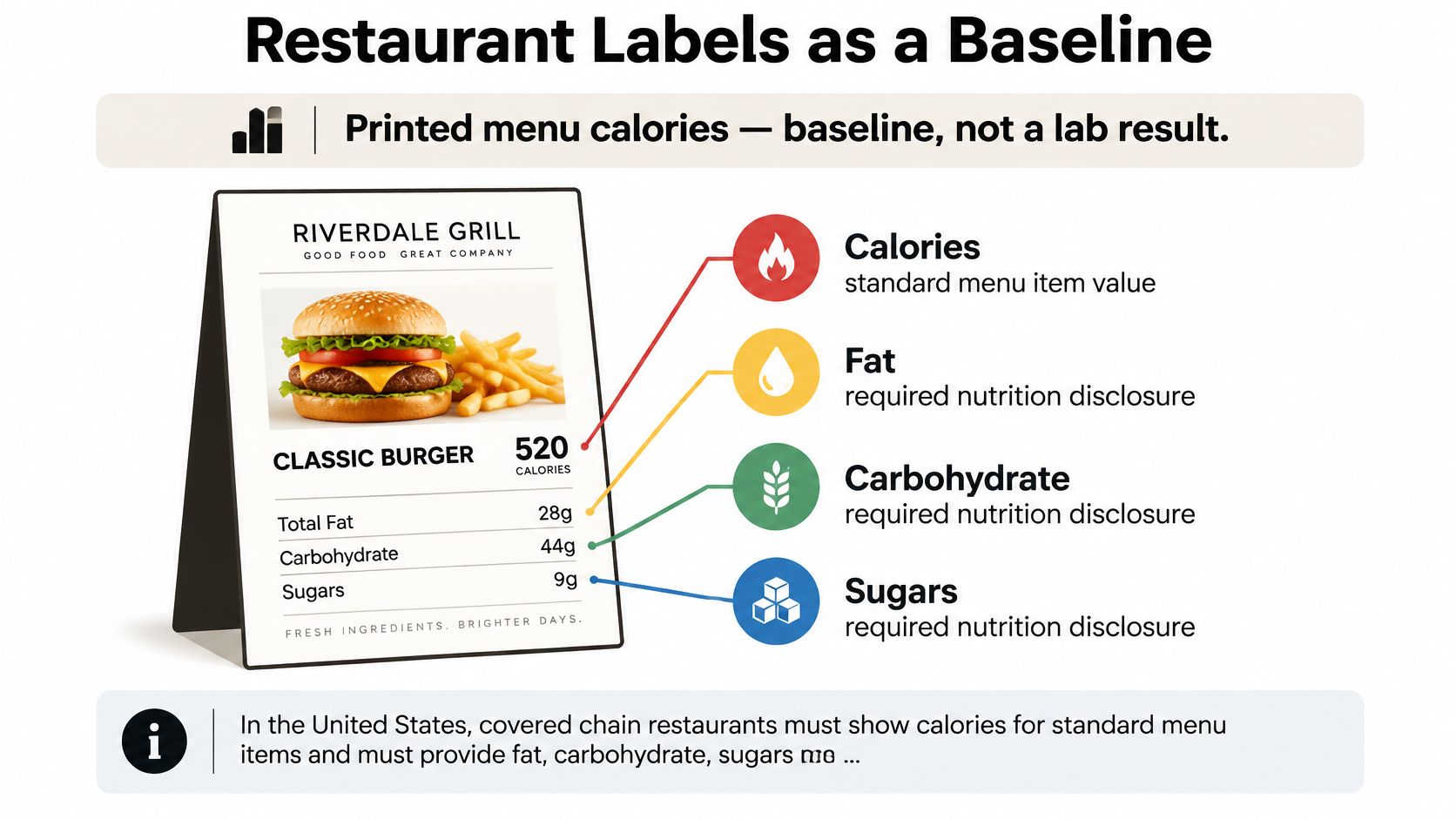
A restaurant menu calorie count is a useful starting point, not a measurement of the taco on your plate. In the United States, covered chain restaurants must list calories for standard menu items and provide additional nutrition information on request. The listed value describes a set build; the taco you receive can differ in chicken, cheese, sauce, cooking oil, or assembly. The FDA's restaurant nutrition labeling information explains these labeling requirements.
| Situation | What the number means | How to log it |
|---|---|---|
| Chain with 20 or more U.S. locations | Calories for the standard menu item | Use the menu figure as a baseline |
| Extra nutrition on request | Information such as fat, carbs, sugars, fiber, protein, and sodium | Add the macros you track |
| Restaurant meal differs from its label | The served portion or ingredients may not match the standard build | Adjust for visible differences |
| Independent taqueria or custom toppings | There may be no comparable standard label | Estimate the taco's ingredients and portions |
Restaurant calorie counts can differ from the calories in the food served. A label is like a recipe template: useful for orientation, but it cannot account for every variation in portion size or preparation.
For a Taco Bell Cantina Crispy Chicken Taco with Avocado Ranch listed at 270 calories, or a University of Maryland Mexican corn chicken street taco listed at 306 calories, start with the named item if it matches your order. Then account for clear differences, such as extra cheese, a second tortilla, a larger chicken portion, or more creamy sauce. Independent restaurants and customized orders may not have a comparable standard label, so estimate the taco's ingredients and portions instead.
Why Database Entries Disagree
A “chicken taco” database entry describes a particular build, not a fixed recipe. One may include cheese; another may include beans, a different tortilla, or salad ingredients instead. Those differences change the calories per 100 grams, so the entry's name alone may not tell you whether it matches your meal.
Choose the build before the number
First match the construction: taco or salad, beans or no beans, cheese or no cheese. Then check the serving size. A value for 100 grams cannot be compared directly with a whole-taco entry until you know the taco's weight.
Choose the construction first, then the grams. An entry that matches the ingredients and serving size is more useful than a prominent number for a different build.
Database entries disagree because each describes its own combination of ingredients and portions. Corn versus flour usually moves the total less than cheese, cooking fat, or the amount of each ingredient. Match the build, then use the weight to make the comparison more meaningful. The same approach helps with pork chop calorie estimates.
Log the Plate in Front of You
For a typical single chicken taco, about 200 to 250 calories is a useful starting range. The estimate gets more personal when you account for the taco's weight and its cheese, cooking fat, and sauce. You don't need to remove toppings you enjoy; you need a log that reflects the portion you ate.

If weighing each ingredient feels like too much work, Calorie Genie can scan a meal photo and return calories, protein, carbs, and fat for the plate, along with a health score and a one-line reason. Every ingredient is editable, so you can change a portion or swap an item before saving. Calorie estimates are a guide, not medical advice.
Visit Calorie Genie AI to scan and log the tacos in front of you, then adjust the cheese, sauce, or portion if the estimate doesn't match your plate. Save the meal once the ingredients and serving size look right.