
The most popular advice about macros for weight loss often starts in the wrong place: find the perfect ratio, then expect the scale to follow. A more useful starting point is your calorie budget. From there, you can organize meals around protein, carbohydrates, and fat without turning every bite into a math test.
You don't need a flawless split. You need a workable plan, a way to check your progress, and permission to refine estimates when real meals don't match neat calculator results. Macro numbers are estimates, not medical prescriptions.
Table of Contents
- Why Macros Matter After Calories Are Set
- Standard Macro Ranges for Adults Explained
- How Much Protein You Need for Weight Loss
- Adjusting Carbs and Fat Without Overcorrecting
- Sample Macro Meal Templates for a Full Day
- Choosing a Tracking Approach That Fits Your Routine
- Your Next Step Toward a Macro Plan That Works
Why Macros Matter After Calories Are Set
Two adults can eat identical calories and have opposite afternoons. One stays full through dinner. The other is hunting for snacks by three.
The difference usually sits in how the budget is divided. That division is the job of macros.
Weight loss still rests on energy intake below expenditure. Macro choices organize what happens inside that limit: food quality, fullness, training support, and how easy the plan is to keep. The National Academies' dietary reference framework treats the macro ranges as nutritional guardrails, not proof that one precise split guarantees better results.
Calories work like the total money in a monthly budget. Macros are how you divide it across rent, groceries, and savings. Rearranging the categories never adds money, so hitting your targets only counts if they fit inside the allowance.
Each number has its own job. Calories describe the amount of dietary energy. Macro targets describe how you plan to spend it. Before picking a split, work out how many calories you need a day and treat the result as a starting estimate you can test, not a fixed entitlement.
Then ask four things of the plan: can you buy, cook, and enjoy the foods; does it support the activity you do; could you follow it during a busy week; and can family meals or restaurant food fit without starting over.
Practical rule: Set the spending limit before rearranging the spending categories.
Expect your portion estimates to be off sometimes. A "tablespoon" of oil or a "medium" potato rarely matches the logged number, so judge the plan by weekly trends in weight, hunger, and energy rather than single days. When a trend stalls, adjust one part of the budget at a time instead of rewriting the whole ratio each week.
None of these figures is a prescription. Start by learning your usual eating pattern, since a plan built around familiar foods is easier to repeat than a new menu you won't cook twice.
Standard Macro Ranges for Adults Explained
Macro calculators can make a suggested ratio look more authoritative than it is. The standard reference is broader: the Acceptable Macronutrient Distribution Range, usually shortened to AMDR.
For healthy adults, the ranges and their approximate gram equivalents below follow the dietary reference intake framework summarized by the National Academies. At 2,000 calories, carbohydrates account for 45–65%, fat for 20–35%, and protein for 10–35%, corresponding to the amounts shown.
Adult Macro Ranges at 2,000 Calories
| Macronutrient | Share of Calories | Approximate Grams at 2,000 kcal |
|---|---|---|
| Carbohydrates | 45–65% | 225–325 g |
| Fat | 20–35% | 44–78 g |
| Protein | 10–35% | 50–175 g |
These are population-level health ranges, not a ready-made weight-loss prescription. The calorie level in the table is an illustration, not a recommendation for your body.
Read the Table as a Set of Boundaries
Each row shows room for variation. It doesn't tell you to choose the top of every range, and the endpoints aren't meant to become a single combined menu.
Instead, choose a combination that fits your total energy allowance. If you allocate more of that allowance to one macro, less remains for the others.
The wide protein span is especially useful for understanding why a universal ratio falls short. A sedentary adult and someone dieting while resistance training may need different practical targets, even when their calorie budgets happen to match.
There's another distinction worth keeping clear: a percentage and a gram target answer different questions. A percentage describes a share of your energy intake. A gram target describes an amount of a nutrient.
When calorie intake changes, an unchanged protein percentage produces a different amount of protein. That's why checking the actual grams matters, rather than assuming that a respectable-looking percentage always provides an appropriate intake.
Use the table this way:
- Check the overall pattern: Compare your planned split with the adult reference ranges.
- Inspect the amounts: Look at grams, particularly for protein, rather than percentages alone.
- Keep context attached: Your activity, preferences, and health circumstances still matter.
- Avoid false certainty: A calculator result isn't proof that your body needs that exact split.
The aim isn't to squeeze your eating into a perfect pie chart. It's to understand what the chart represents so you can make informed adjustments.
How Much Protein You Need for Weight Loss
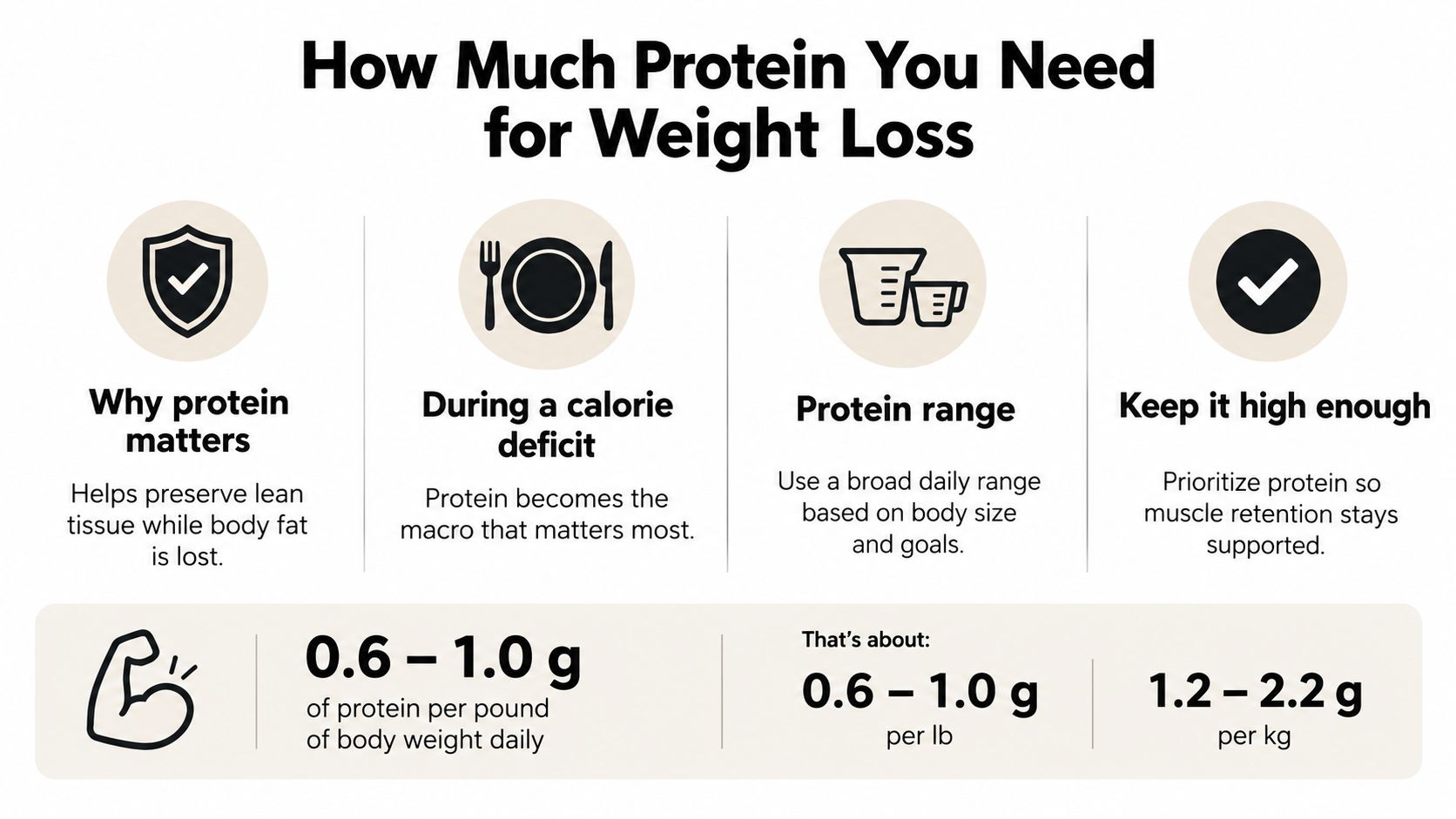
Protein gets planned early because while weight is coming down, enough of it can help protect lean tissue. Treat it like the first line item in a food budget: decide the amount, then let carbs and fat fill the remaining room instead of changing the whole ratio every week.
For exercising adults who diet while staying active, a practical range is 1.2–1.6 g of protein per kilogram of body weight daily; for an 80 kg adult, that equals 96–128 g daily, or 384–512 calories, and spreading it across three or four meals gives roughly 25–40 g per meal, as outlined in this review of protein intake during weight management. Treat those figures as estimates, not medical prescriptions.
Set a Gram Target From Body Weight
Start with body weight in kilograms, then choose a point in the range that matches your situation. The lower end may be more practical for lighter activity. The upper end becomes more relevant with resistance training, greater leanness, or a larger calorie deficit. Those are reasons to personalize, not reasons for everyone to chase the highest intake.
Next, compare that gram target with your actual meals. Portion estimates are imperfect: labels differ, recipes vary, and restaurant servings are easy to misjudge. Use a simple log for a week or two, watch the trend, and change the meal that is falling short before redesigning the whole plan.
If breakfast is the weak spot, compare higher-protein Greek yogurt options and check the serving information on the product you buy. The useful question is whether it helps your daily total and fits your calorie budget.
Keep the Target Steady Long Enough to Judge It
A protein target works like a shopping list: it tells you what to put in the cart before you decide on extras. Meals do not need to look identical, and a large evening serving can be moved toward lunch or breakfast if that is easier to repeat.
Hold the target steady while you check scale trend, hunger, and training quality. If progress stalls, adjust portions or food choices before recalculating every ratio. More protein still uses calories, and people with kidney disease or other medical conditions should get individualized advice before using a higher-protein target.
Adjusting Carbs and Fat Without Overcorrecting
Once you've chosen a protein target, carbohydrate and fat choices become a question of fit. Which foods do you enjoy? What supports your training? Which meals are easiest to repeat?
Consider this worked example: at 2,000 kcal, a plan with 30% protein, 40% carbohydrate, and 30% fat provides 150 g protein, 200 g carbohydrate, and approximately 67 g fat, using 4 kcal per gram for protein and carbohydrate and 9 kcal per gram for fat. This calculation illustrates an adjustable split, while the Canadian dietary reference tables provide the standard AMDR guardrails.
Notice that the example's carbohydrate share falls below the standard adult range discussed earlier. It's a mathematical example, not a universal recommendation, and its protein amount shouldn't replace the body-weight calculation just because the ratio looks tidy.
Change Food Choices for a Reason
A lower-carbohydrate pattern may suit someone who prefers more protein and fat. But don't remove carbohydrate automatically when progress slows.
Carbohydrates support training intensity, and carbohydrate-containing foods can help you include dietary fiber. Fat also needs deliberate space because it supplies essential fatty acids and supports absorption of fat-soluble vitamins.
Rather than treating either macro as the problem, ask what isn't working:
- Meals feel hard to repeat: Rework the food selection before making the split more restrictive.
- Training feels poorly supported: Review carbohydrate availability instead of cutting it by default.
- Fat keeps getting squeezed out: Check the plan against the reference range rather than aiming as low as possible.
- The menu fits your routine: Keep it stable long enough to evaluate it.
Respond to Trends, Not a Frustrating Weigh-In
Watch your weight trend over several weeks alongside your food records. Before changing the plan, check whether logged portions resemble what you ate.
If progress has stalled despite a reasonably consistent routine, adjust the calorie allowance or portions. Don't assume that moving calories from carbohydrate to fat will solve an unchanged energy-budget problem.
A useful adjustment answers a specific problem. It isn't simply a different ratio.
Change something you can identify clearly, then observe the result. Keeping the rest of the plan recognizable makes it easier to understand whether that adjustment helped.
Sample Macro Meal Templates for a Full Day
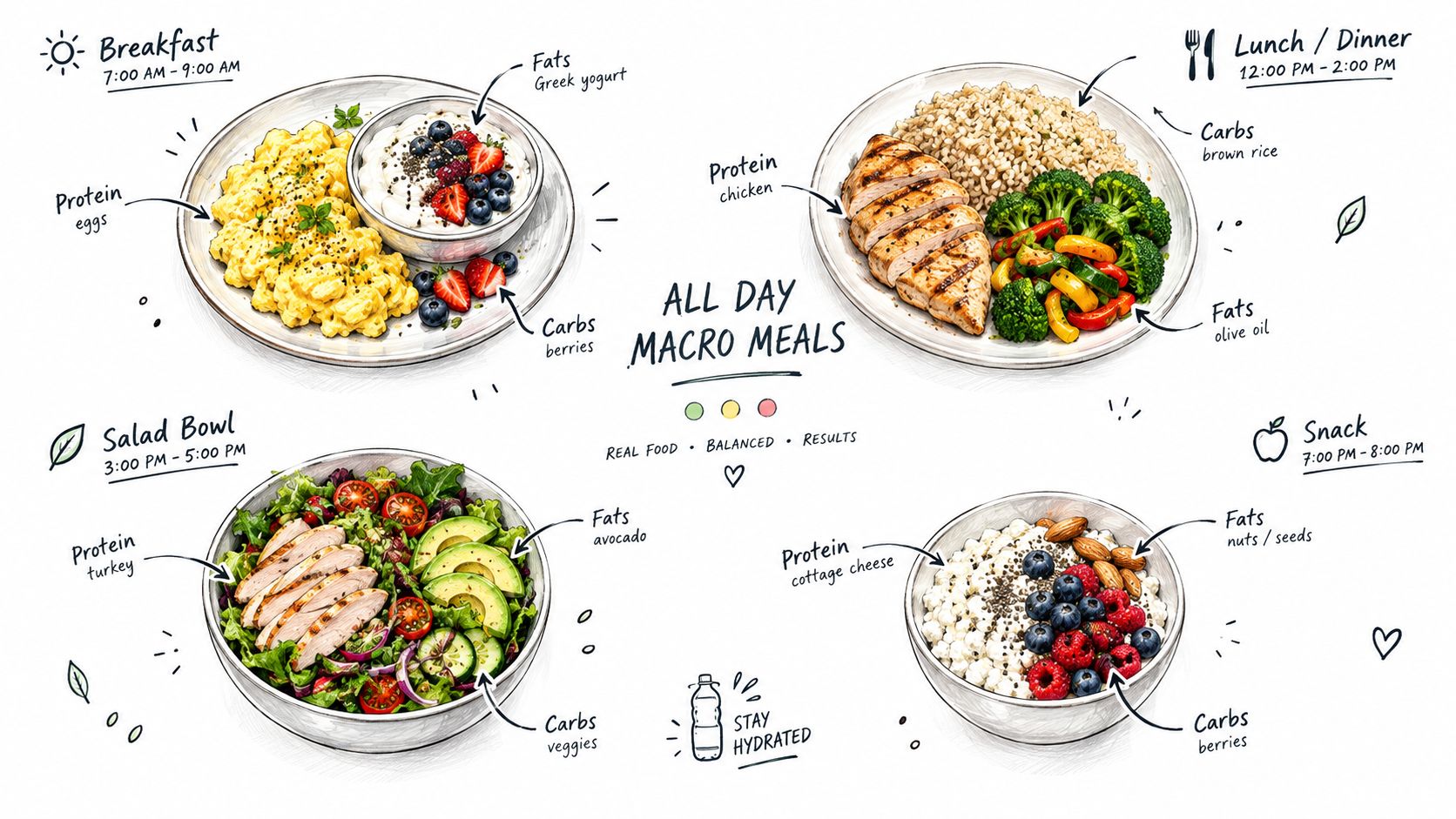
A meal template is a shopping guide, not a nutrition label. The ingredients suggest a balance, but the actual macros depend on your portions, preparation, and product choices.
Use this visual as meal inspiration rather than a set of fixed serving prescriptions.
Build a Day Around Familiar Plates
Breakfast could be eggs with Greek yogurt and fruit. Let the yogurt and eggs form the protein anchor, then choose fruit or toast according to your appetite and carbohydrate plan. Check the yogurt label and include any cooking fat rather than assigning the meal a generic macro total.
At lunch, try chicken with rice and vegetables. Adjust the chicken portion to your remaining protein needs and the rice portion to your carbohydrate plan. Log dressing or sauce separately when you know what was added.
A bean-and-fish bowl offers another lunch or dinner template. Treat it as a mixed dish with ingredients you can adjust, rather than assuming every bowl has the same balance. The bean, fish, grain, and dressing portions determine how it fits your day.
For dinner, lean beef with potatoes and vegetables gives you another recognizable starting point. Choose the preparation you enjoy, then account for additions such as oil, butter, or sauce. You can also repeat a lunch template if that makes shopping easier.
The embedded video offers another format for considering meal planning.
Let Meal Timing Serve Your Routine
Perfectly even protein timing isn't a pass-or-fail requirement. In a randomized feeding study of women with overweight or obesity, different protein distributions did not appear to influence body-composition changes during weight loss when total protein was fixed, according to the USDA research publication summary.
That finding supports flexibility, but it doesn't establish that timing never matters for athletes, older adults, or people pursuing muscle gain.
If breakfast is low in protein, review lunch, dinner, and any snack you already planned. You don't need to label the day a failure or force an uncomfortable breakfast tomorrow.
- For irregular schedules: Attach meals to your waking routine rather than conventional clock times.
- For limited food budgets: Build around affordable foods you already buy and check their actual portions.
- For shared family meals: Adjust your serving instead of requiring everyone to follow your targets.
Use the daily protein target established earlier as your guide. Meal templates help you reach it; they don't need to impose a rigid timetable.
Choosing a Tracking Approach That Fits Your Routine
A food log works like a bank statement: a rough record you keep reviewing beats a perfect one you abandon. Detailed entries do nothing if you stop logging after a week, and fast entries do nothing if you never correct obvious mistakes. Pick the method that fits how you eat.
| Approach | Where It Fits | What to Check |
|---|---|---|
| Manual database entry with a scale | Repeat recipes and meals you prepare | Food match, preparation state, and measured portion |
| Barcode scanning | Packaged products with labels | Serving size and the amount consumed |
| Photo-based logging | Quick records of meals, including eating out | Ingredients, hidden additions, and portion estimates |
Manual logging gives you control over each entry but asks for the most input. Barcode scanning removes the search step for packaged foods. Photo logging cuts entry time, although mixed dishes tend to need more correction afterward.
Understand What the App Estimates
Calorie Genie is a photo-first option that also includes manual database and barcode workflows. It estimates calories, protein, carbohydrates, fat, and fiber from meal photos, then lets you correct the result in plain words or edit ingredients and portions yourself.
An onboarding quiz sets your calorie and macro targets. The app also scans barcodes and restaurant menus, and it displays weight and calorie charts over 7, 30, or 90 days, as described on its website. AI scanning requires Premium, and every photo-based nutrition figure is an approximation rather than a measurement. Treat those numbers as estimates to review, not medical prescriptions.

Spend Your Attention on Uncertain Entries
Photo estimates are not equally dependable across foods. A 2025 portion-estimation study reported cooked-rice accuracy of 74.4% from a 45° image and 85.4% with multiple angles combined, while soup had lower accuracy and more overestimation; these are findings from the food-photo portion-estimation study, not accuracy claims for Calorie Genie.
So spend your checking effort where the guesswork is highest:
- Labeled foods: Check the serving against what you ate.
- Visible ingredients: Correct an obvious portion mismatch.
- Mixed dishes and soups: Add recipe context when you know it.
- Oils and sauces: Record additions a photograph may not reveal.
- Leftovers: Update the entry to reflect what you consumed.
Good enough for logging means a reasonable, repeatable estimate you refine when better information appears. It does not mean laboratory precision.
A food diary app keeps those records in one place so trends stay visible. Your calorie budget is still the foundation, and your macros organize what sits inside it. Review weight trends and recurring patterns over several weeks, then make one deliberate adjustment. That approach beats chasing an exact figure for every restaurant meal or switching ratios each time a day looks off.
Your Next Step Toward a Macro Plan That Works
A macro target can look precise on paper and still fail in the kitchen. Treat calories as the budget and macros as the categories on the shopping list: they help you spend that budget with intention, while the calorie total still does the heavy lifting.
Start where uncertainty is lowest. Set the calorie allowance first, use the adult ranges as guardrails, turn the protein guidance into a daily amount you can hit, then let carbs and fat flex around preference, training, and hunger. When the scale trend stalls, review portions and consistency before changing the ratio. One careful adjustment beats five nervous ones.
Start With a Meal You Already Eat
You do not need a new shopping list to begin. Pick a familiar meal and name its protein anchor, carbohydrate foods, fats, and additions. Compare the estimate with what you know about the ingredients, then correct the obvious gaps.
That small review builds the skill that matters across photo logging, labels, and measured recipes. Expect estimates to be useful before they are perfect. This guide supports education; medical conditions may require individualized guidance, and macro numbers are estimates to test and refine.
Calorie Genie AI offers photo-based calorie and macro estimates with editable ingredients and conversational corrections. To try the workflow, download Calorie Genie from the App Store or Google Play. Answer the onboarding quiz, review your starting plan, and log one familiar meal to practice correcting its estimate.