
Your water bottle is on the desk, but you can't remember whether you've refilled it. You've had coffee, lunch and a workout, and your phone still says you're behind on water. Should you drink more, change the target or keep a better record?
Learning how to track water intake starts with separating what you drank from what your body might need. A useful system combines a measured container, an easy log and a few contextual checks. It shouldn't turn the evening into a race to finish a bottle.
Table of Contents
- Daily Water Targets and What Counts Toward Them
- Choose a Method and Log Step by Step
- Cross-Check Your Log With Urine Color and Symptoms
- Adjusting Your Target for Heat, Exercise and Health
- Start Logging Water Today
Daily Water Targets and What Counts Toward Them
The U.S. National Academies' water intake guidance gives adequate-intake references of approximately 3.7 liters (125 fluid ounces) daily for adult men and 2.7 liters (91 fluid ounces) for adult women, including water from beverages and food. These are reference values for healthy, generally sedentary adults in temperate conditions, not instructions to drink that much plain water.
Adult total water reference values, using those National Academies benchmarks:
| Group | Reference total water per day | What to note |
|---|---|---|
| Adult men | About 3.7 L (125 fl oz) | Total from beverages and food, not plain water alone |
| Adult women | About 2.7 L (91 fl oz) | Same total basis; needs rise with activity and heat |
| Very active people in continuous hot weather | 6 L or more | A high-demand example, not a default target |
| Adults with fluid restrictions or kidney or heart conditions | Clinician-prescribed amount | Follow clinician-specific guidance, not a generic app target |
Match the target to what you record
Tea, milk, coffee, soup and fruit all contribute water. If you're also logging nutrition, keep beverage volume separate from its calorie entry. Our black coffee nutrition guide addresses the nutrition side; your water record answers a different question.
Say you drink coffee with breakfast and eat a large salad at lunch. You've taken in water even if you haven't touched your bottle. Treating the headline reference as an additional plain-water requirement would overlook those contributions.
The old eight-glass rule also leaves important questions unanswered. How big is the glass? Are you working outdoors or sitting in an air-conditioned office? A fixed count can't account for different bodies, diets and working conditions.
Practical rule: Compare like with like. A plain-water log isn't a complete total-water record.
Choose the reference closest to your situation as a starting benchmark, then label your log clearly: plain water, all beverages, or beverages plus estimated food water. I'd start with all beverages and note water-rich meals separately rather than assigning precise water amounts to every ingredient. If you need a specific drinking target, account for food rather than copying the total-water figure into an app.
Choose a Method and Log Step by Step
| Method | Best for | Main weak point | Effort |
|---|---|---|---|
| Marked reusable bottle | Steady drinkers who use one container | Forgetting to log refills | Low |
| Paper tally or notes app | Trying a habit for one week | Skipped on busy days | Medium |
| Phone reminders at set times | People who forget to drink | Reminders don't record amounts | Low |
| One-tap in-app logging | Quick entries throughout the day | Works only if every drink is logged | Low |
| Smart bottle with automatic volume | Hands-off readings | Estimates need manual correction | Low once set up |
The best method is the one you'll use during a busy afternoon, not just while setting it up. A marked bottle is inexpensive and easy to inspect. An app is more convenient when you switch between mugs, bottles and drinks bought outside the house.
Reminders and records do different jobs. In a 2024 World Nutrition Journal smartphone-reminder study, total-fluid-intake adequacy after four weeks was 90.2% in the reminder group versus 63.0% in the control group, among 87 completers. That supports testing reminders, but an alert still doesn't tell you how much you drank.
Build a measured routine
Choose a container with a known capacity. Use a bottle with volume markings or measure your usual mug with a kitchen measuring jug. Record its capacity once so you don't keep guessing.
Attach checkpoints to existing activities. Check your log when you wake, start work, eat lunch, take an afternoon break and finish dinner. These are opportunities to review, not compulsory drinking appointments.
Record consumption and refills separately. A refill means water entered the bottle, not your body. Either log drinking events as they happen or tally completed bottles, but don't use both methods for the same water.
Compare the running total with your plan. If your record looks unexpectedly low, first check for forgotten entries. If you haven't had much to drink, make the next ordinary opportunity easier by putting your bottle within reach.
Subtract what remains. Ice, unfinished tea and water left in the bottom of a bottle aren't consumed volume. Don't mark a container finished just because you're putting it away.
Review the friction at night. Did you forget refills, leave the bottle at home or dismiss every reminder? Change that specific obstacle instead of adding more alerts everywhere.
For example, you could use a 750 ml bottle marked in 250 ml increments, with reminders at 10:00, 13:00 and 16:00. Those are example settings, not hydration prescriptions. If you prefer an evening entry, keep a visible tally during the day so the final total isn't a memory test.
Decide whether automation is worth it
A Scientific Reports smart-bottle validation study reported total daily intake accuracy within 3%. That's useful measurement performance, but it doesn't establish that buying a smart bottle will improve your hydration.
Automation is most helpful when manual entry is the obstacle. It's less helpful if you regularly drink from other containers or ignore the readings. Keep manual correction available and check unexpected totals against what's left in the bottle.
If you already record meals, putting the beverage habit beside your food diary routine can reduce the number of separate tasks you need to remember. It doesn't require logging every sip; a consistent container-based method is often easier.
Choose the simplest setup that captures your real drinking pattern, not the device with the most features.
Test your chosen method for a week before switching. Judge it by missing entries, ease of use and whether you understand the total, not by how polished the dashboard looks.
Cross-Check Your Log With Urine Color and Symptoms
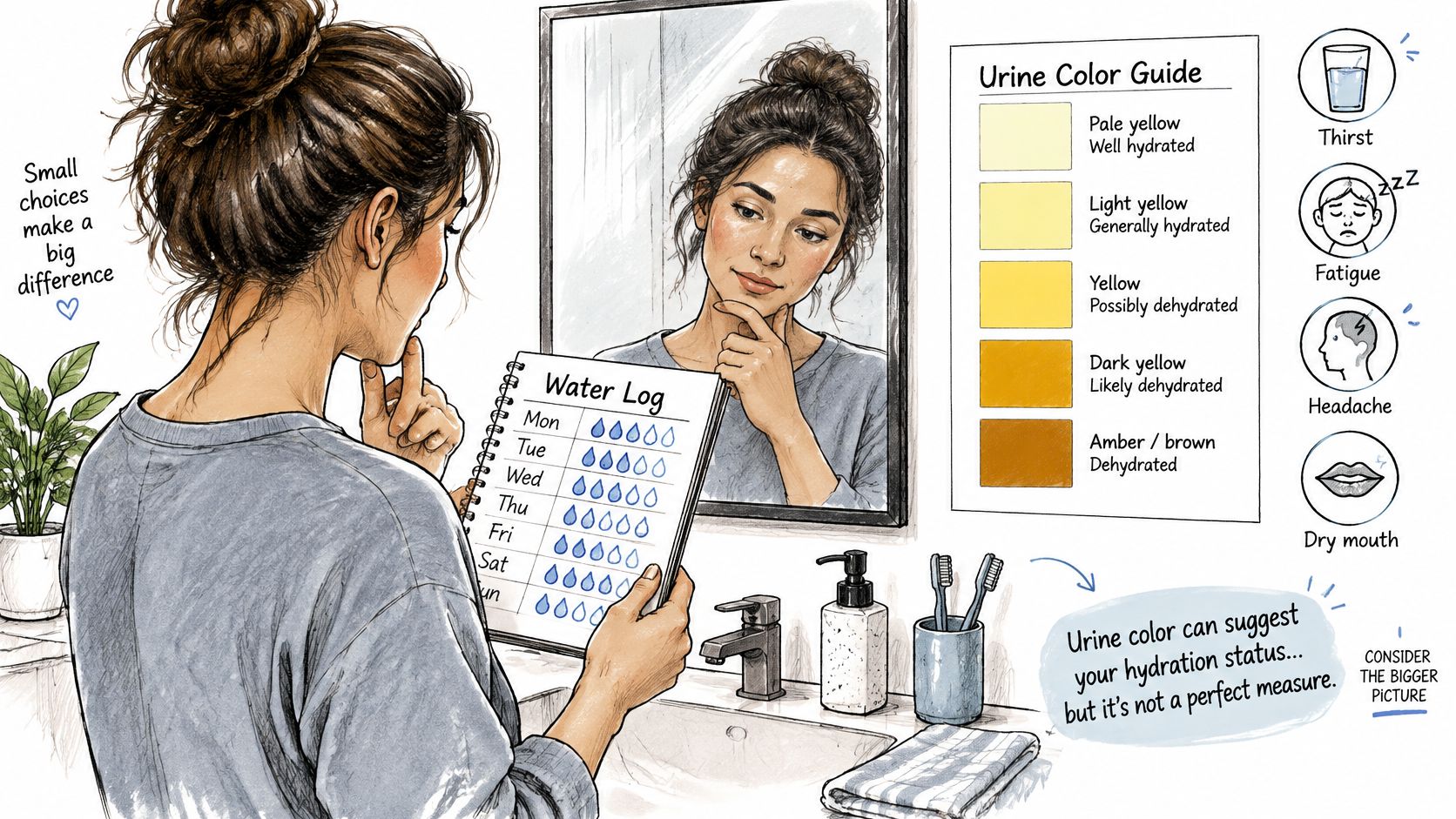
Urine color is feedback, not a hydration meter. The National Academies' dietary reference chapter on water explains that urine generally darkens as output falls and dissolved substances become more concentrated, but there's no precise one-to-one relationship between its color and hydration level.
Use the bathroom check as a brief observation alongside your record, rather than another target to chase.
Look for a pattern, not a perfect shade
Check under similar lighting and describe the color as pale yellow, medium or dark. Don't assign yourself a precise hydration percentage.
- Add context. Note whether you've been sweating, feeling ill or drinking less than usual.
- Notice output. Repeated dark urine alongside unusually little urination deserves more attention than an isolated color change.
- Check other explanations. Foods, supplements, medications and lighting can alter what you see.
- Avoid chasing clear urine. Pale yellow can be a broad behavioral signal, but a color change isn't an instruction to drink aggressively.
A study published in the European Journal of Clinical Nutrition found that urinary measures were associated with fluid intake and that afternoon urine concentration more closely reflected the daily value than some other sampling times. An afternoon check can therefore be a useful consistent reference, without treating that observation as a diagnosis.
Know what your log can't explain
Suppose your intake record looks normal but your urine remains unusually dark and you feel unwell. Adding more entries won't explain the cause. Equally, a low recorded total may reflect missed logging rather than low intake.
Safety boundary: Never use urine color alone to diagnose dehydration.
Persistent symptoms or a continuing change in urination call for a conversation with a clinician. Water logging supports awareness and consistency, not medical diagnosis. Calorie estimates are likewise a guide, not medical advice.
Adjusting Your Target for Heat, Exercise and Health
More water isn't automatically better tracking. A useful record shows what changed during your day and helps you respond proportionately, rather than treating every missed target as a reason to force fluids.
Record the situation before changing the amount
| Situation | Logging adjustment | Watch for |
|---|---|---|
| Hot weather or heavy sweating | Log additional drinks and note the heat | Dizziness or dark urine despite drinking |
| Endurance exercise | Weigh before and after; plan replacement around estimated loss | Drinking far beyond thirst during long sessions |
| Shift work, driving or limited restroom access | Plan smaller servings and flexible reminders | Skipped drinks followed by a late catch-up |
| Illness or fever | Note intake and symptoms rather than chasing a fixed target | Little urination or persistent vomiting |
| Fluid restriction or kidney or heart condition | Follow clinician-specific limits | Any conflicting target from a generic app |
The Calculatorian overview of water needs and exercise replacement summarizes guidance to replace roughly 1.5 times the fluid lost after activity, adjusted for duration, intensity and environmental conditions. Treat that as recovery guidance requiring context, not an instruction to consume a large amount immediately.
For a practical exercise record, weigh yourself before and after the session on the same scale, wearing similarly dry clothing. Record what you drank during exercise and whether you urinated, because the scale change alone doesn't capture every fluid movement. Use the result as an estimate to discuss with a sports clinician or dietitian if you train for long events or sweat heavily.
Water, electrolyte-containing drinks and food can all contribute during recovery. Don't count only the plain water and then add unnecessary drinks because the log looks incomplete.
Plan around access and avoid forced drinking
Drivers, shift workers and travelers may have limited access to safe drinking water or toilets. That's a scheduling constraint, not a lack of motivation. Put drinking opportunities beside realistic breaks, use smaller planned servings and snooze reminders when stopping isn't possible.
Excessive water intake can dilute blood sodium, causing hyponatremia. Severe cases can involve confusion, seizures or coma, so forcing fluids during prolonged exercise is a genuine safety concern.
Don't respond to an unfinished goal by rapidly drinking the remaining amount. If you feel unwell after drinking a lot, stop forcing fluids and seek medical help. Confusion or seizures require emergency care. The aim is to avoid both dehydration and unnecessary drinking, not to finish every day with a perfect progress bar.
Start Logging Water Today
Choose a method you can use immediately, write down an appropriate starting target and record your next drink. You don't need a new bottle, a wearable or a perfectly reconstructed morning to begin.
Keep the setup visible and simple enough to repeat.
Make today's record useful
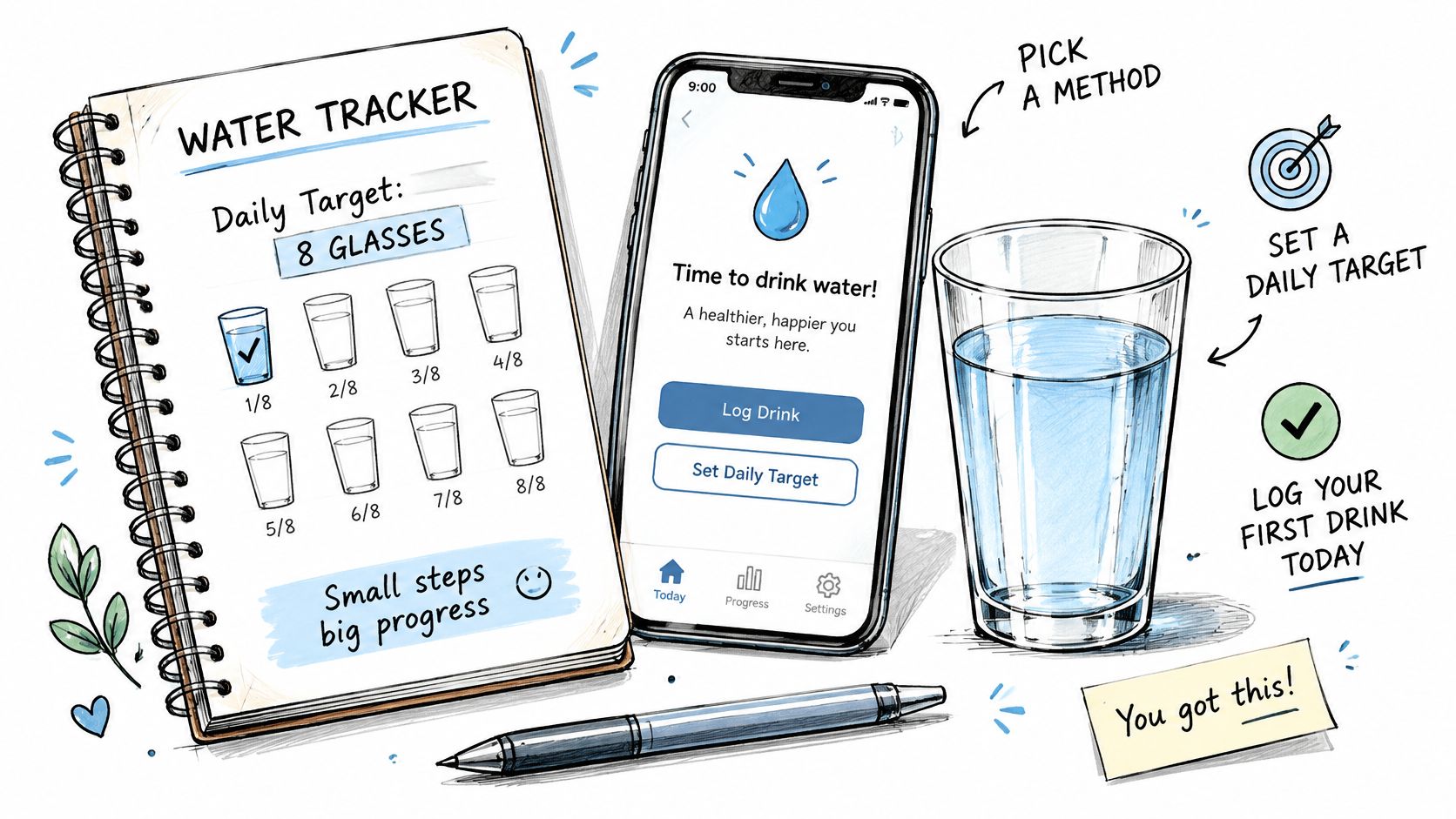
- Set the target. Label whether it covers plain water or a broader intake record.
- Choose the method. Keep the bottle, notebook or phone shortcut where you'll use it.
- Check at natural breaks. Review your entries around meals or work transitions.
- Review tonight. Identify missing drinks and the part of your routine that needs attention.
- Adjust for the day you had. Record unusual heat, hard exercise or illness instead of assuming every day should look identical.
If a day slips, enter the amount you reasonably remember and mark it as incomplete. Don't invent precision, and don't drink extra to compensate for a missing record. A gap in the log is an information problem, not proof of a fluid deficit.
Keep related habits together
Our Calorie Genie water log adds 250 ml with one press, lets you set a daily water goal and records weigh-ins. Water and weigh-ins appear alongside meals in your history over 7, 30 or 90 days, so you can compare ordinary workdays, weekends and training days without keeping separate records.
If you're choosing a combined nutrition and hydration routine, our guide to choosing a calorie-counting app can help you consider the wider workflow. Treat the figures as estimates and a helpful guide, not medical advice.
For a closer look at the app, watch the walkthrough.
Calorie Genie AI brings water logging, meals and weigh-ins into the same daily routine, with a water goal you can set and review. Visit Calorie Genie AI, download the app from the App Store or Google Play, and log your first 250 ml today.