

Two people, same food, same twelve weeks, and the only difference is whose choice the diary format was. In that study, food-recording adherence was 64.2% for participants using their preferred format, against 43.4% for those assigned a less-preferred one (published in PMC). Nothing about their discipline changed. Their tool did.
That gap is the whole argument here. A food diary isn't a laboratory instrument, and keeping one isn't a test of willpower. It's a pattern-finding habit, and a habit survives only when the method is easy enough to repeat on the days you'd rather not bother. Most advice gets this backwards, pushing for every ingredient, every gram and every crumb, then acting surprised when the log dies in week three.
I'd rather you finish four months with a rough, honest record than three weeks with a perfect one. What follows covers how to keep a food diary in a way that holds together: what to write down, how to log a meal in under a minute, what to do with stews and restaurant plates, how to step down to less detail as your patterns become obvious, and how to review a week without letting one missed day end the whole thing.
Table of Contents
- Why Most Food Diaries Fade and What to Aim For
- What to Record for Every Eating Occasion
- How to Log Each Meal in Five Steps
- Logging Mixed, Homemade and Restaurant Meals
- Choose a Tracking Level You Can Sustain
- Review Your Week and Recover From Missed Days
- Log Your First Meal Today
Why Most Food Diaries Fade and What to Aim For
In 2023, average adherence to dietary self-monitoring was 49.34% in phase II of a digital self-monitoring study published by JMIR mHealth and uHealth (the phase II analysis). Read that as a practical fact rather than a failure of character: in a study where recording was the entire point, roughly half the expected entries never happened.
So what separates the people who get something out of a diary from the ones who abandon it? Volume of detail isn't it. A systematic review found that participants completing at least 80% of expected dietary self-monitoring episodes lost about 3.5 kg more than those below that threshold, though the effects varied and weren't necessarily sustained at 12 months (the review in PMC). The variable you control is how often you show up, not how precisely you measure.
The target: a log with enough entries to show the shape of your week. Not every gram. Not every bite. Enough to see when, where and why you eat.
Think about what a week of entries reveals. Say you log Monday to Thursday beautifully, then go quiet from Friday dinner to Sunday night. The blanks aren't a moral failure, they're the finding. Your weekday pattern is stable and your weekend pattern is invisible, which means your weekend is exactly where the diary has something to teach you. A diary that captured every weekday calorie and no weekend context would tell you less than a scrappy one that caught three Friday nights.
The purpose of the whole exercise is that shape: the 4 pm snack that isn't hunger, the second glass of wine that follows a hard meeting, the portions that creep up when you cook for other people. Calories and macros are a useful by-product, not the point.
Your next step is small and specific. Pick the one method you could still use on a bad day, whether that's a paper notebook in your bag, a notes app, or your phone camera, and set a daily target of three entries. Three is enough to establish the habit and low enough that a chaotic Tuesday doesn't wipe it out.
What to Record for Every Eating Occasion
The core rule is every eating occasion, not every meal. The handful of nuts at the counter, the spoon you licked while cooking, the milk in your second coffee: those are entries. They're also the ones that usually go missing, and they're frequently the reason a log looks tidy but the scale doesn't move.
The National Institute of Diabetes and Digestive and Kidney Diseases recommends recording what, when, where, why and how much you eat (NIDDK's healthy eating guidance), which is a good spine for a template. Here's how I'd lay that out so every entry has the same eight fields:
| Element | What to record | Example |
|---|---|---|
| What you ate | Each food and drink by name | Greek yogurt with honey |
| Amount | Weight or serving count | 150 g raw chicken breast, weighed before cooking |
| Cooking fat | Oil or butter used in cooking | 1 tsp olive oil in the pan |
| Sauces and dressings | Every addition, including on the side | 2 tbsp ranch on a salad |
| Preparation | Raw or cooked, and the method | Baked, weighed raw |
| Timing and place | Clock time and where you ate | 7:30 pm, at the desk |
| Reason | Hunger, stress, habit or social | Snacked while working late |
| Leftovers | Amount left on the plate | About a third of the bowl |
Where Entries Usually Go Wrong
Preparation is the field people skip and then misread. A 150 g raw chicken breast baked in a teaspoon of oil weighs less once cooked and carries the oil on top of its own calories. Log it as two lines, the chicken weighed raw and the oil separately, and you've captured something a single "baked chicken" entry would have hidden.
Weighing is worth the trouble for a short list of calorie-dense items: oils, dressings, nuts, cheese and dry grains. A small digital scale with a tare button costs little and answers the question a hundred times. It's easier to see why when you look at what a spoonful carries: this breakdown of calories in a tablespoon of olive oil makes the point better than I can.
For packaged food: use the serving size printed on the label and count how many servings you actually ate. Half a bag of crisps is 1.7 servings, not one.
Leftovers and tasted bites count too. They're small individually and consistent collectively, which is precisely why they matter.
Copy those eight fields into a notes app or a paper template today. Once the structure is fixed, filling it in takes seconds, and you stop reinventing the format every time you sit down to eat.
How to Log Each Meal in Five Steps
Speed is the difference between a diary that lasts and one that becomes another chore. The routine below gets a meal logged in well under a minute once you've done it a few times.
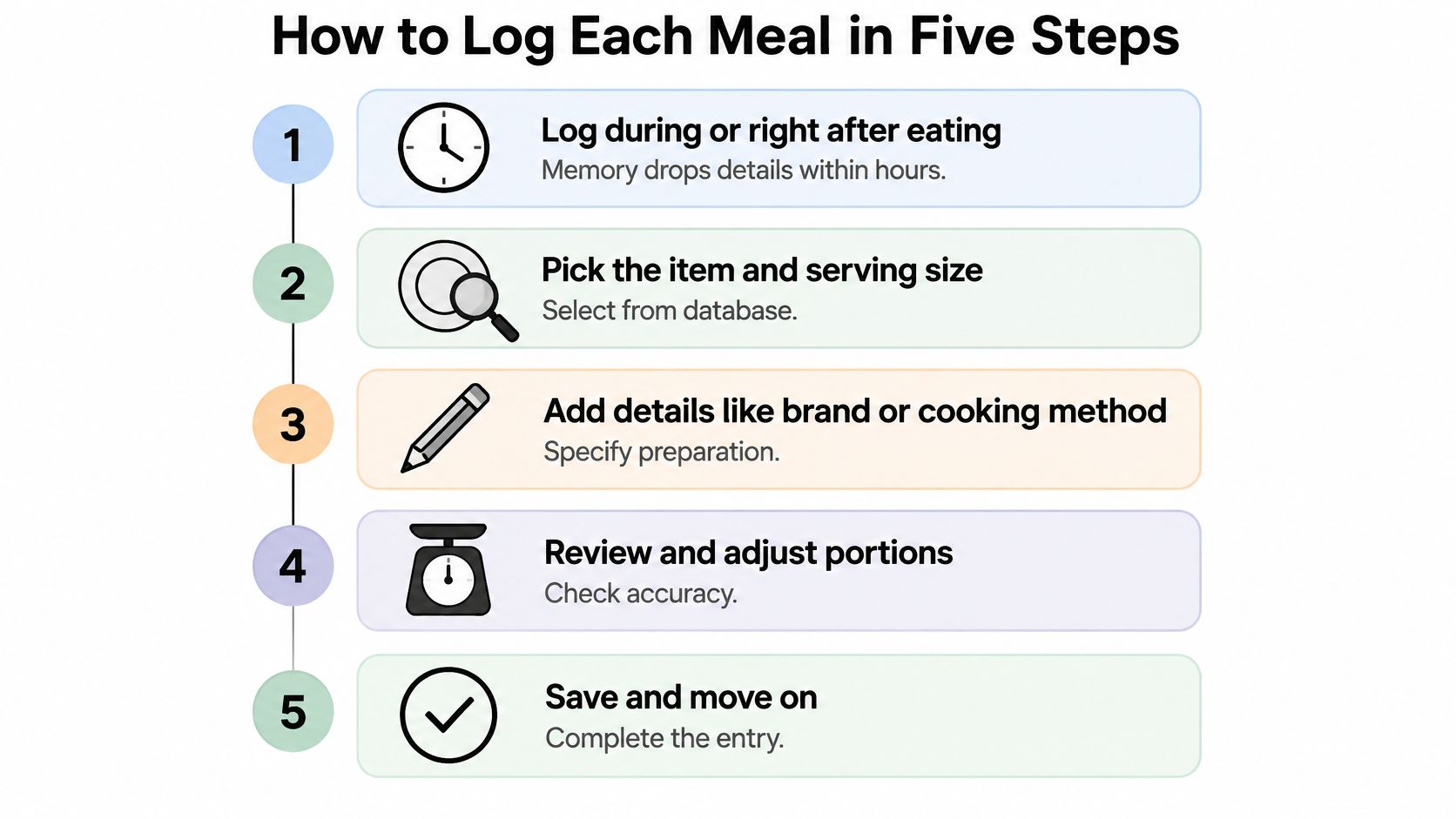
- Log during the meal or minutes after it. Memory holds the food and loses the detail first: the oil, the second helping, the drink. The common slip is saving the entire day at 11 pm, by which point dinner is a guess and lunch is a rumour.
- Pick the item and the serving size from the package, or photograph the plate. If you're using a photo-based tracker, one shot of the plate before you start eating is enough. The slip here is logging the menu description rather than what arrived, dressing and all.
- Add what you couldn't see going in. Cooking oil, butter, sauce, dressing, the sugar in your coffee, the bites taken while plating. This single step closes most of the gap between a plausible log and a useful one.
- Check the total and fix the obvious error. A single serving logged as a whole pack, a 20 g handful typed as 200 g, milk added three times. Correct what's clearly wrong and move on. The entry needs to be sensible, not audited.
- Mark a missed occasion as missing. Don't rebuild lunch from memory at midnight. A visible gap is honest data. An invented entry becomes a false record you'll treat as real later.
If you'd rather watch the routine before trying it, this walkthrough covers the same sequence in real time.
What a Complete Logged Day Looks Like
| Occasion | Entry | Time and place |
|---|---|---|
| Breakfast | Porridge, 40 g dry oats with 150 ml semi-skimmed milk | 7:15 am, kitchen counter |
| Morning drink | Black coffee with 1 tsp sugar | 8:05 am, on the way out |
| Lunch | Turkey sandwich with 1 tsp mayo; about a third of the chips left | 12:30 pm, desk |
| Afternoon snack | Apple, 1 medium | 3:30 pm, desk |
| Dinner | Baked salmon, 140 g, with 1 tsp olive oil; 1 cup broccoli | 6:45 pm, kitchen table |
| Evening snack | Handful of nuts, 30 g, snacked while working late | 9:30 pm, sofa |
Six occasions, three of them not meals, and the reason field doing real work on the last row. That's the pattern to aim for. Not a longer list, a complete one.
Logging Mixed, Homemade and Restaurant Meals
Stews, curries, casseroles, shared platters, a recipe you invented on Tuesday and the plate set down in front of you at a restaurant. These are the meals that break neat logging, and they're also most of what people eat.
The trouble is always the same two things. Visible ingredients are easy: you can see the chicken, the potato, the spinach. The oil that went into the pan, the butter under the crust, the coconut milk in the sauce are not visible, and they carry real calories. Restaurant plates add a second problem, which is that you didn't cook the food, so you can't know what went in, and a shared platter gives you no clear portion to claim.
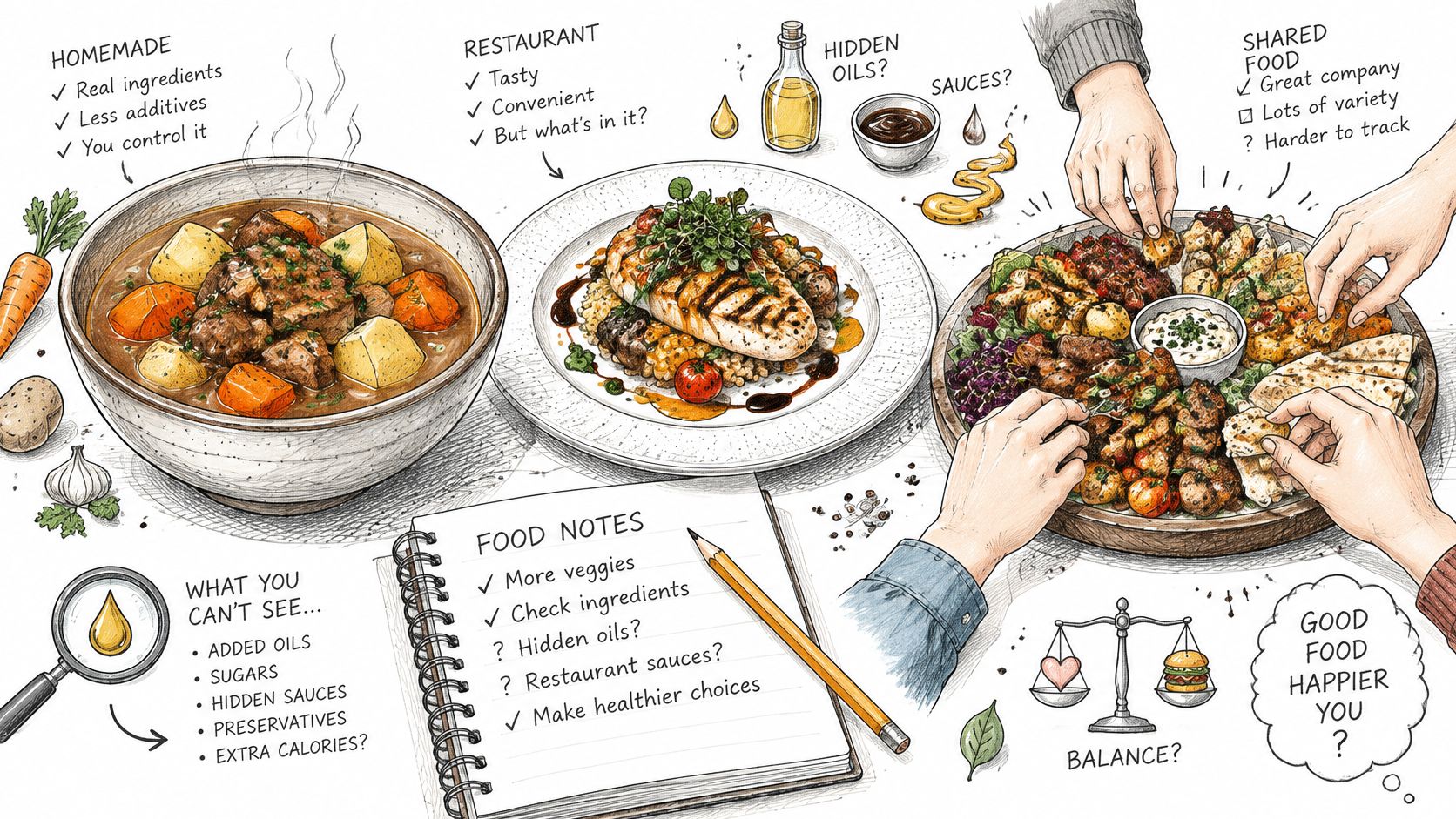
Here's the four-part protocol I'd apply on the spot:
- Log what you can see, by name. "Chicken and vegetable curry" beats "curry". "Chicken thigh, potato, spinach, coconut milk" beats both.
- State the fat and the sauce, even as a guess. "1 tbsp oil, 2 tbsp coconut milk" is a guess worth making. Leave it out and you've told the tracker the dish was steamed.
- Use a range when you can't know. 350 to 450 kcal is a more honest entry than 412, and it stops a guess from masquerading as a measurement.
- Save the recipe once, then reuse it. For a dish you cook weekly, enter the ingredients and the total yield once, divide by the number of portions, and log a portion next time in one tap.
Tooling doesn't remove this uncertainty, it just makes it visible. A 2025 systematic review reported food-recognition results ranging from 61.8% for meal recognition to 54.5% for serving-size estimation in one investigation (Cambridge review of AI dietary assessment). Identifying a dish is easier than measuring it, which matches what anyone who has eyeballed a bowl of rice already knows.
Expect under-counting as well. The U.S. National Cancer Institute's dietary-assessment guidance reports that food records underestimate true energy and protein intake by approximately 4% to 37%, depending on the population and study design (NCI dietary assessment primer). So round up for oils and restaurant portions rather than splitting hairs over a yoghurt.
At a restaurant, ask for dressing on the side, assume more oil than the dish suggests, and log the bread while you're still eating it. If you're choosing from a menu, this guide to the healthiest food at Mexican restaurants shows how to pick before you order rather than reconstruct afterwards. And when you can see what you left on the plate, correct the entry afterwards. That correction is worth more than any pre-meal estimate.
Choose a Tracking Level You Can Sustain
Full detail is a phase, not a lifestyle. Start there for two to four weeks to learn your patterns, then step down to something you can hold for months. The table below is how I'd map the choice.
| Level | What you log | Effort | Best when |
|---|---|---|---|
| Full detail | Every item, with weighed fats, sauces and drinks | Highest | Learning your patterns for two to four weeks |
| Standard | Every meal and drink, with estimated portions | Moderate | Your everyday routine |
| Light | Main meals plus high-calorie extras such as oil, sauce and alcohol | Low | Busy weeks or travel |
| Photo-only | One plate photo per eating occasion, reviewed once a day | Lowest | Eating out often or cooking for others |
Two things push people towards the wrong level. The first is ambition, which lands them in full detail for six weeks and out of the habit entirely by week eight. The second is expecting the technology to do the work. In 2024, only 12.8% of 894 logged food and drink items were scanned in the DitEetIk! smartphone food-record study published by JMIR mHealth and uHealth (the DitEetIk! study). Most entries came from somewhere other than a barcode, which means describing food stays part of the job whatever tool you open.
The honest answer to "how much should I track?" is still being argued. A systematic review of 59 behavioral weight-loss studies found inconsistent definitions of adherence across the field and noted that self-monitoring tends to wane over time, which limits how precisely anyone can say what dose of tracking is enough (review in Obesity). So you answer it for yourself with a question: what's the minimum tracking I can sustain while still seeing the pattern that matters to me, whether that's the 4 pm snacks or the Thursday drinks?
Move down a level when logging has felt like a chore for two weeks. Not after one missed day. Two weeks of dread is a signal about the method, not about you. If you're comparing tools, this roundup of the best counting calories apps is a sensible place to check what each one records.
Review Your Week and Recover From Missed Days
A diary you never read is just admin. Ten minutes once a week, ideally the same evening each time, turns a list of entries into a decision or two. Here's the checklist I'd run:
- Days logged. Count them. Four out of seven is a working diary. Two is a prompt to step down a level.
- Where entries went missing. Is it always dinner, always the commute home, always Friday?
- One trigger. Name the single situation that produced the most gaps or the most unplanned eating.
- Weekday against weekend. Compare the two side by side. The difference is usually where the extras live.
- Repeat offenders. Dressings, sweetened drinks, alcohol, the standing snack at the counter. Find the item that appears four times and never gets measured.
- One or two changes. Not five. Pre-log the restaurant meal before you leave the house, or measure cooking oil for one week.
On missed days: don't reconstruct them from memory. Mark the gap, then pick up at the next eating occasion. The diary can afford a hole; it can't afford fiction.
Three failure modes account for most abandoned logs. The first is quitting after an unplanned meal, as though a single unchecked takeaway invalidates the previous ten days. The second is only logging the meals you're proud of, which turns the diary into a performance rather than a record. The third is the generic entry: "chicken salad" logged identically for months while the bowl doubles in size.
For a brutal week, drop to the light level rather than stopping. Log your protein sources and your drinks and leave the rest. A thin week that continues the habit beats a perfect week that ends it.
A missed day is information about your life that week, not a verdict on your character. The diary guides decisions. It doesn't promise a result, and it shouldn't be read as medical advice.
Log Your First Meal Today
Here's the smallest version of a start. Choose your level, and for the first week take standard: every meal and drink, portions estimated. Set a phone reminder for the meal you most reliably forget, which is often either lunch on a working day or the evening snack. Then log that meal with the eight fields from earlier, including the oil and the sauce.
Put the first weekly review in your calendar now, seven days out, and use the checklist above when it arrives. That's the whole system: log, review, adjust one thing.
If you'd rather not type everything, Calorie Genie is a photo-based AI calorie tracker built for exactly this. You point the camera at a meal, a drink, a barcode or a whole restaurant menu, then adjust any ingredient or portion before saving the entry. AI photo scanning needs a Premium subscription, so check the store terms before you build it into your routine. It runs on iOS and Android, and the estimates are a guide, not medical advice, so verify the oils, portions and mixed dishes yourself.
A complete diary isn't the goal. A diary you still open in March is. Calorie Genie AI lets you photograph a meal, a drink, a barcode or a restaurant menu and edit any ingredient before saving, so the entry takes seconds and the habit survives a bad week. If you want a faster way to log than typing every item, visit Calorie Genie AI and snap your first meal today.