
A level US tablespoon of olive oil (13.5 g) has about 119 calories, almost all from fat. A 14 g tablespoon in some database records sits nearer 126 to 130 calories.
That spread is the spoon and the record, not a special kind of oil. Extra-virgin, regular, and light olive oil are all nearly pure fat, so they land in the same calorie neighborhood per gram. What moves the total is whether the spoon was level, heaped, or a free pour from the bottle.
If you log meals, the useful habit is to pick one measure and stick with it. A tidy "one tablespoon" entry that doesn't match the pour in the pan will drift from what you ate. Grams beat spoon names when you want the diary to stay honest.
Table of Contents
- Calories and Macros in One Tablespoon of Olive Oil
- Why Olive Oil Calorie Values Disagree
- Everyday Cooking Uses That Add Up
- Where One Tablespoon Fits Your Daily Budget
- How to Log Olive Oil Accurately
- Confirm Your Measure and Take the Next Step
Calories and Macros in One Tablespoon of Olive Oil
Start with the reference people need for 1 tablespoon olive oil calories. A level US tablespoon is 13.5 g and about 119 kcal. That weight is fat. Protein, carbohydrate, and fiber are 0 g, so the calories aren't split across other macros.
If you track what macros are, oil is the simplest case. The gram column and the fat column match, because there's nothing else in the spoon.
| Measure | Grams | Calories (kcal) | Fat (g) | Carbs and protein |
|---|---|---|---|---|
| Level tablespoon (standard reference) | 13.5 g | 119 | 13.5 | 0 g |
| Heaped tablespoon (estimate) | about 16 g | about 141 | about 16 | 0 g |
| Level teaspoon | 4.5 g | about 40 | 4.5 | 0 g |
| 14 g tablespoon (some database records) | 14 g | 126-130 | 14 | 0 g |
Why the gram column wins
A spoon name hides the fill. "Tablespoon" can mean a flat measuring spoon or a mound that never got leveled. The scale doesn't care which word you used. It shows the grams, and the calories follow the grams.
A heaped spoon in the table is only an estimate, about 16 g, so you can see how fast a mound climbs past the level reference. A level teaspoon is the small unit, about 40 kcal, which is what a short finishing pour often is. The 14 g row is there so a different app total doesn't look like a different oil.
Working rule: If you own a scale, log the grams. If you don't, log 119 kcal for a level tablespoon, then add a separate line for any heap or extra pour.
Why Olive Oil Calorie Values Disagree
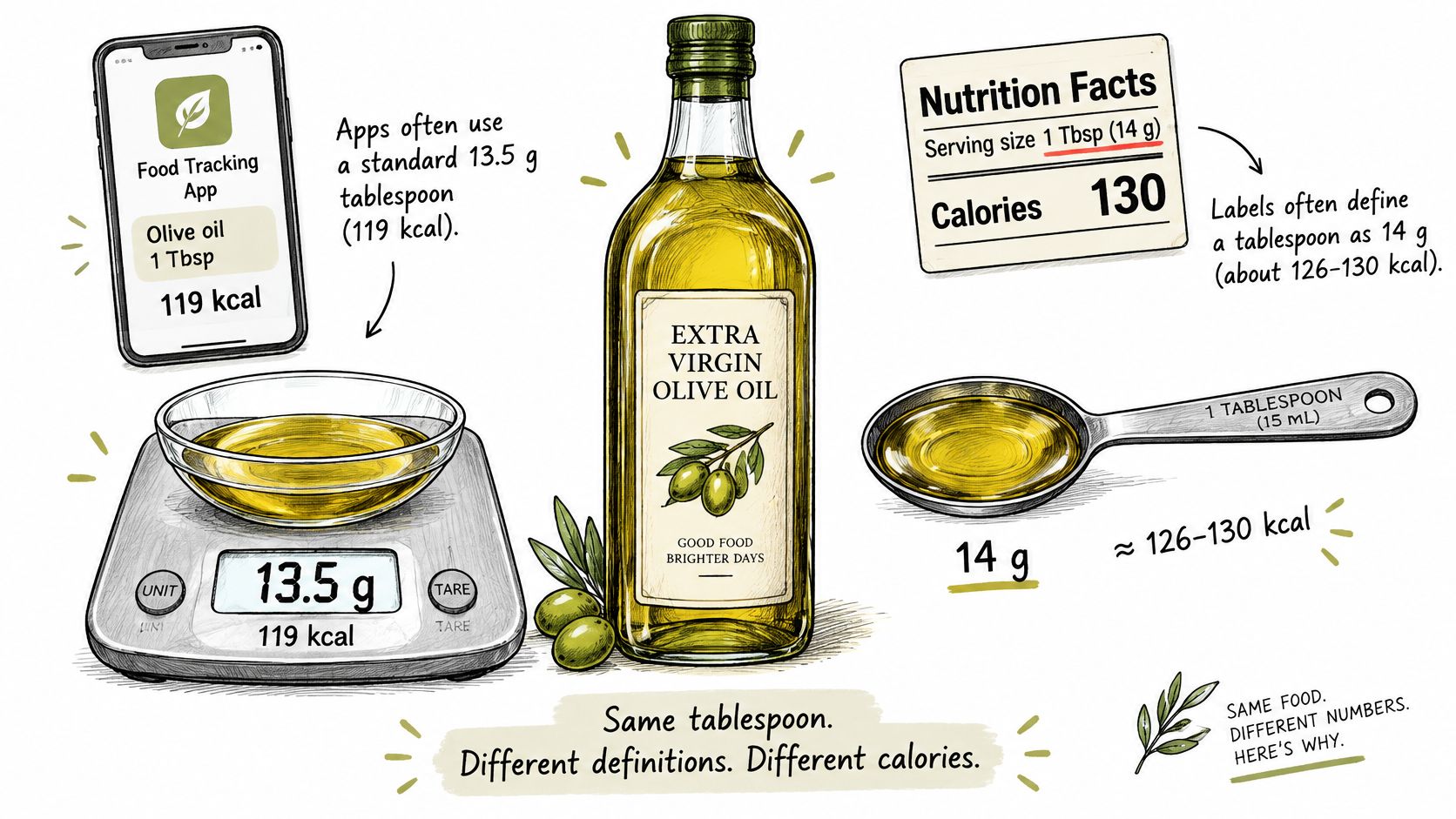
Apps and labels don't share one spoon. FoodDataHub's olive oil record shows the usual split. USDA-derived records use both a 13.5 g tablespoon at 119 kcal and a 14 g tablespoon at about 126 to 130 kcal. That's a measurement and database-definition issue, not a meaningful gap between extra-virgin, regular, and "light" olive oil.
Small grams, real calories
Oil is almost entirely fat, so a tiny weight change shows up. At the commonly cited 884 kcal per 100 g, 0.5 g is roughly 4.4 kcal. Half a gram is easy to miss on a spoon and easy to see on a scale. A 14 g entry can also print as roughly 124 to 130 kcal once the food-composition record and rounding are applied. None of that means one bottle is "lighter."
Light on a label refers to flavour and colour, not a lower-fat tablespoon. Household spoons and labelling conventions also differ across markets, so the same word can mean a different fill in another kitchen.
Three things people call a tablespoon
- Level measuring spoon: Filled, then scraped flat. This is the 119 kcal reference.
- Heaped spoon: A mound above the rim. The extra grams are real calories.
- Free-poured amount: Oil straight from the bottle. Nobody measured it, so the diary is a guess.
Pick the closest of those three, note whether it was level or heaped, and treat the number as a guide. A tracker that wants a better entry can ask a plain question. Was that a level tablespoon, a heaped spoon, or a drizzle?
The short clip below walks through how a pour in the pan relates to the number you save.
Everyday Cooking Uses That Add Up
The calories slip in during ordinary cooking, not during a special "oil day." Sautéing vegetables or eggs often starts as one tablespoon in the pan, and the bottle keeps tilting after that first glug. You don't see the second pour on the plate.
| Cooking use | Typical amount | Estimated calories |
|---|---|---|
| Sautéing vegetables or eggs | 1 tablespoon | about 119 |
| Pan-frying an egg | 1 teaspoon | about 40 |
| Finishing a bowl with a drizzle | 1 teaspoon or more | about 40 or more |
| Roasting potatoes for four | 2 tablespoons | about 238 |
| Salad dressing base | 1-2 tablespoons | about 119-238 |
| Dipping bread at a restaurant | 2-3 tablespoons | about 238-357 |
Match the habit to your kitchen
A drizzle is usually a teaspoon or more, not a few drops off the lip of the bottle. Roasting potatoes for four often takes two tablespoons tossed through the tray, and you eat your share of that coating. Bread at a restaurant can sit in two or three tablespoons in the dish, with no spoon in sight.
Salad dressing is the quiet one. The oil is mixed in a jar or poured over leaves, and the recipe line is easy to skip. The same pattern shows up in a beef stir fry, where the pan fat is part of the meal even when the photo looks like meat and vegetables.
- Measure the pour once: Fill a level spoon, watch that amount hit the pan, and use that picture next time.
- Use a pour spout or a spray for pan work: A slower stream is harder to overshoot than an open neck.
- Log restaurant oil on its own line: Bread dip and dressed salad don't live inside the bread or the greens entry.
Most home cooks already do at least one of these. The sauté pour and the unmeasured dressing are the two that add up on a normal weeknight.
Where One Tablespoon Fits Your Daily Budget
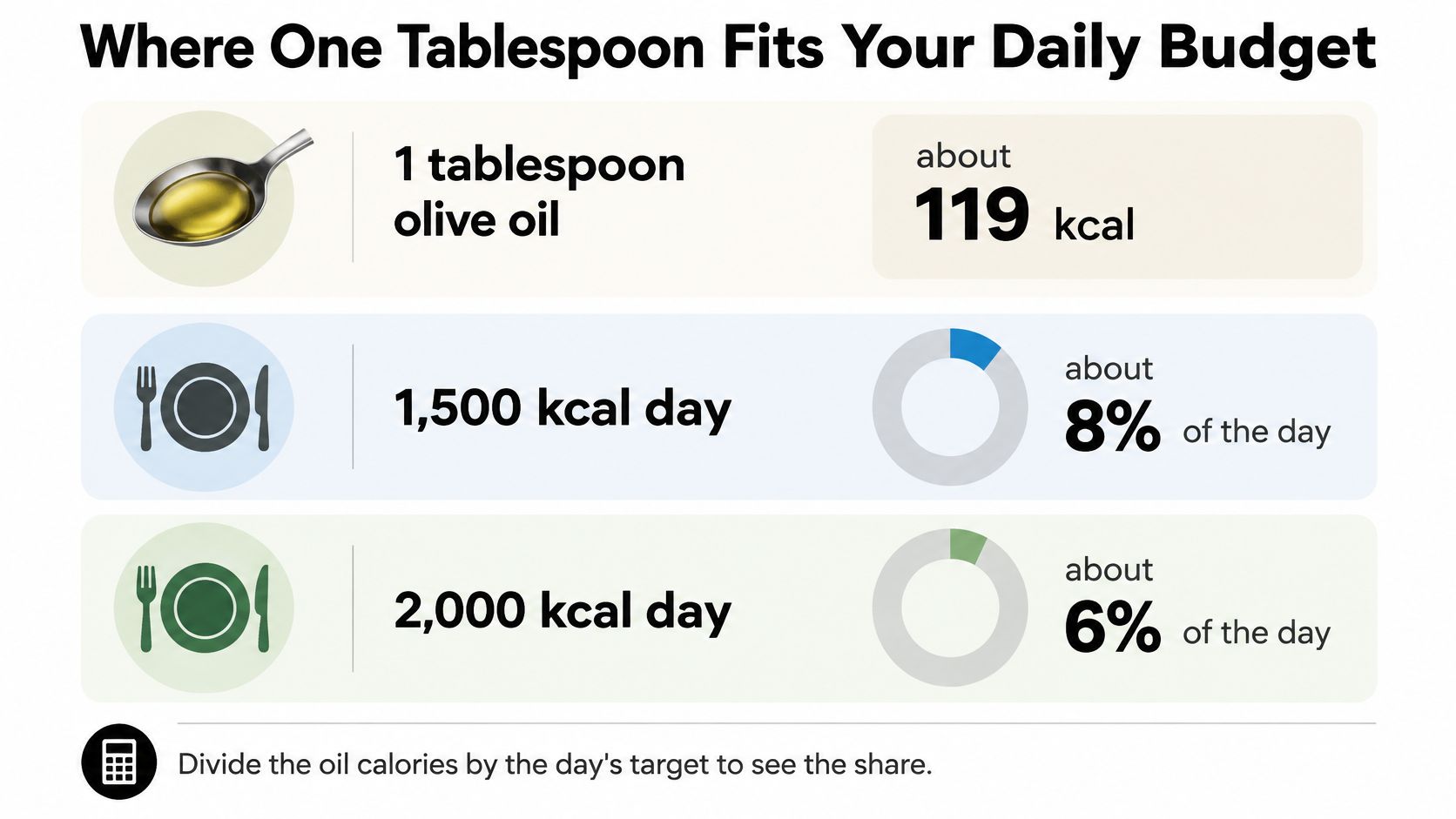
Divide the oil calories by the day's target and you get the share. On a 2,000 kcal day, one level tablespoon is about 6 percent of the day. Three level tablespoons, 357 kcal, take close to a fifth.
| Daily target | 1 tablespoon (119 kcal) | 2 tablespoons (238 kcal) | 3 tablespoons (357 kcal) |
|---|---|---|---|
| 1,600 kcal | about 7% | about 15% | about 22% |
| 2,000 kcal | about 6% | about 12% | about 18% |
| 2,500 kcal | about 5% | about 10% | about 14% |
How the share moves
The same spoon is a larger slice when the target is lower. Around 1,600 kcal, one tablespoon is about 7 percent, and three tablespoons are about 22 percent. At 2,500 kcal the same three spoons are about 14 percent. Oil is energy-dense and it is also your fat grams, so a macro log should watch fat beside calories, not calories alone.
If the oil is part of a meal you enjoy, keep it and log it. If you want room for other foods, pour a smaller measured amount instead of dropping the food group.
These shares are arithmetic, not a prescription. Your target can be changed in Settings whenever the plan no longer fits the week.
How to Log Olive Oil Accurately
A correct oil line has a known measure behind it. Guessing "a tablespoon" after the bottle is back in the cupboard is how the diary doubles.
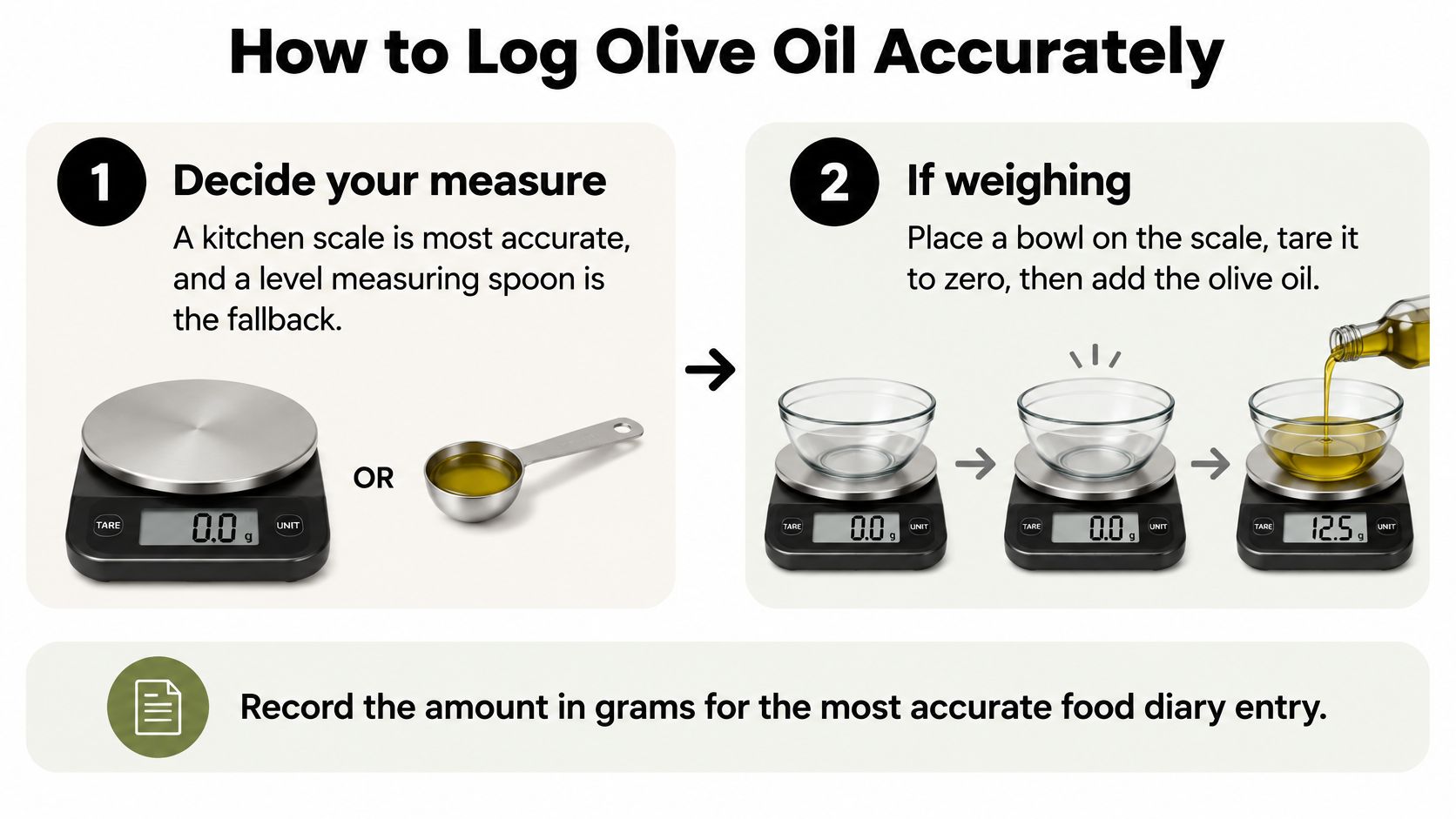
- Decide the measure before you pour. A kitchen scale is the accurate choice. A level measuring spoon is the fallback when the scale is in a drawer.
- If you weigh, tare the bowl. Set the bowl on the scale, zero it, and pour until the display reads 13.5 g for one level tablespoon. The tare stops the bowl's weight from joining the oil.
- If you use a spoon, level it. Fill a measuring tablespoon and scrape it flat with a knife or the edge of a spatula. Don't tip a heaped spoon over the pan and still call it level.
- Log one entry for that amount. Use 119 kcal for the level tablespoon, or the grams you weighed. One line keeps the pour from hiding inside "sautéed vegetables."
- Add every extra as its own line. A second glug, a finishing drizzle, or a heap gets a new row. Dressing is the same idea, which is why a salad dressing calorie entry works better as oil plus the other ingredients than as one vague "dressing" guess.
- Check the day, then adjust next time. Look at the oil lines against the day's total. If the pan always needs more than one spoon, change the planned amount instead of hoping the extra was small.
The slip that doubles the pan
Pouring straight from the bottle, with no spoon and no scale, is the common miss. A second tilt feels like the same pour and can match another full tablespoon. You won't see it on the finished eggs.
A clean log is boring in a good way. One line per pour, the measure written out, and the calories stated. "Olive oil, level tablespoon, 13.5 g, 119 kcal" is enough. "Olive oil, extra pour, 1 teaspoon" sits under it when you added more.
Confirm Your Measure and Take the Next Step
Before you save today's oil, choose the basis and write it in the diary note. Scale, level spoon, or estimate. The number is only as solid as that choice.
If you already weigh the bottle or the bowl, keep doing that. If you cook by eye, leave a level measuring spoon next to the stove so the fallback is in your hand, not across the kitchen.
When the oil is inside a whole meal, you can point the camera at the plate, a drink, a barcode, or a restaurant menu and log without searching or weighing. After the photo, tell Genie in plain words that the vegetables were cooked in a level tablespoon of olive oil, or edit the oil portion yourself. Calorie figures are a guide, not medical advice.
The next step is small. Pick the measure, log today's oil with that note, and look at the day's total once the last meal is in.
Calorie Genie AI turns a photo of the plate into calories and macros, then lets you correct the olive oil in plain words when the pour was a level tablespoon, a heap, or a restaurant drizzle. That keeps 1 tablespoon olive oil calories tied to the measure you used, instead of a generic spoon the app invented. Visit Calorie Genie AI and log today's oil with the measure written in the note.