
A grilled boneless ribeye with the lean meat and the separable fat included is about 247 calories in a 3-ounce (85-gram) cooked portion, which works out to roughly 291 calories per 100 grams. The same style of steak logged as lean meat only sits lower.
That pair of estimates is a starting point, not a property of every ribeye. Ribeye steak calories move with the fat you can see, the grade printed on the label, whether the bone is in the weight, and whether you weighed the steak raw or after it left the pan. Two steaks that look the same size on a plate can land far apart once those features are written down. The useful habit is to match the database line to the steak in front of you, then log butter, oil, and sauce as their own lines.
Table of Contents
- Ribeye Calories by Cooked Portion Size
- How Cooking Changes Ribeye Calorie Counts
- Why the Same Ribeye Weight Gives Different Calories
- How Fat Drives Ribeye Calories and Add-Ons
- Judging Ribeye Portions From a Photo
- Log Your Ribeye Correctly in Calorie Genie
Ribeye Calories by Cooked Portion Size
The practical baseline is a boneless, lip-on ribeye, grilled, with separable lean and fat, and with the fat trimmed to about one-eighth of an inch. MyFoodAnalysis puts that entry at approximately 247 calories per 3-ounce (85-gram) cooked serving, about 291 calories per 100 grams, with 23.7 grams of protein, 21.8 grams of fat, and zero carbohydrates per 100 grams. On standard energy values, that protein is roughly 95 calories and that fat roughly 196 calories per 100 grams, before rounding. Fat, not carbohydrate, is what makes the cut dense.
Use the table when you know the cooked weight you plated. Each row keeps the same composition. A 6-ounce cooked portion is approximately 494 calories, and a 12-ounce portion is about 988 calories.
| Cooked portion | Grams | Calories | Protein (g) | Fat (g) |
|---|---|---|---|---|
| 3 oz | 85 | 247 | 20 | 19 |
| 4 oz | 113 | 329 | 27 | 25 |
| 6 oz | 170 | 494 | 40 | 37 |
| 8 oz | 227 | 660 | 54 | 50 |
| 10 oz | 284 | 826 | 67 | 62 |
| 12 oz | 340 | 988 | 81 | 74 |
| 16 oz | 454 | 1,321 | 108 | 99 |
How to use the rows
These figures are the steak itself. They do not include cooking oil, butter, sauces, or side dishes, and they apply to cooked weight. Grilling drives off water, so calories per gram are higher than a raw-weight calculation of the same meat.
For any weight that is not in the table, multiply the cooked grams by about 2.9. That shortcut follows the 291-calorie density and is an estimate, not a lab result for your steak. An 8-ounce row on this scale is about 660 calories. Other published listings for an 8-ounce cooked ribeye sit lower, which is why grade and trim matter in the next comparisons.
Practical rule: Pick the row closest to what you ate, and log the cooked weight that was on the plate, not the weight on the package.
Record whether the entry was raw or cooked, and whether you ate the visible fat. Those two choices change the estimate more than rounding the last calorie.
How Cooking Changes Ribeye Calorie Counts
Cooking a ribeye is like reducing a stock. Water leaves, and the energy that stays behind is packed into less weight. The steak did not gain calories from the heat. It lost mass, so each remaining gram looks richer.
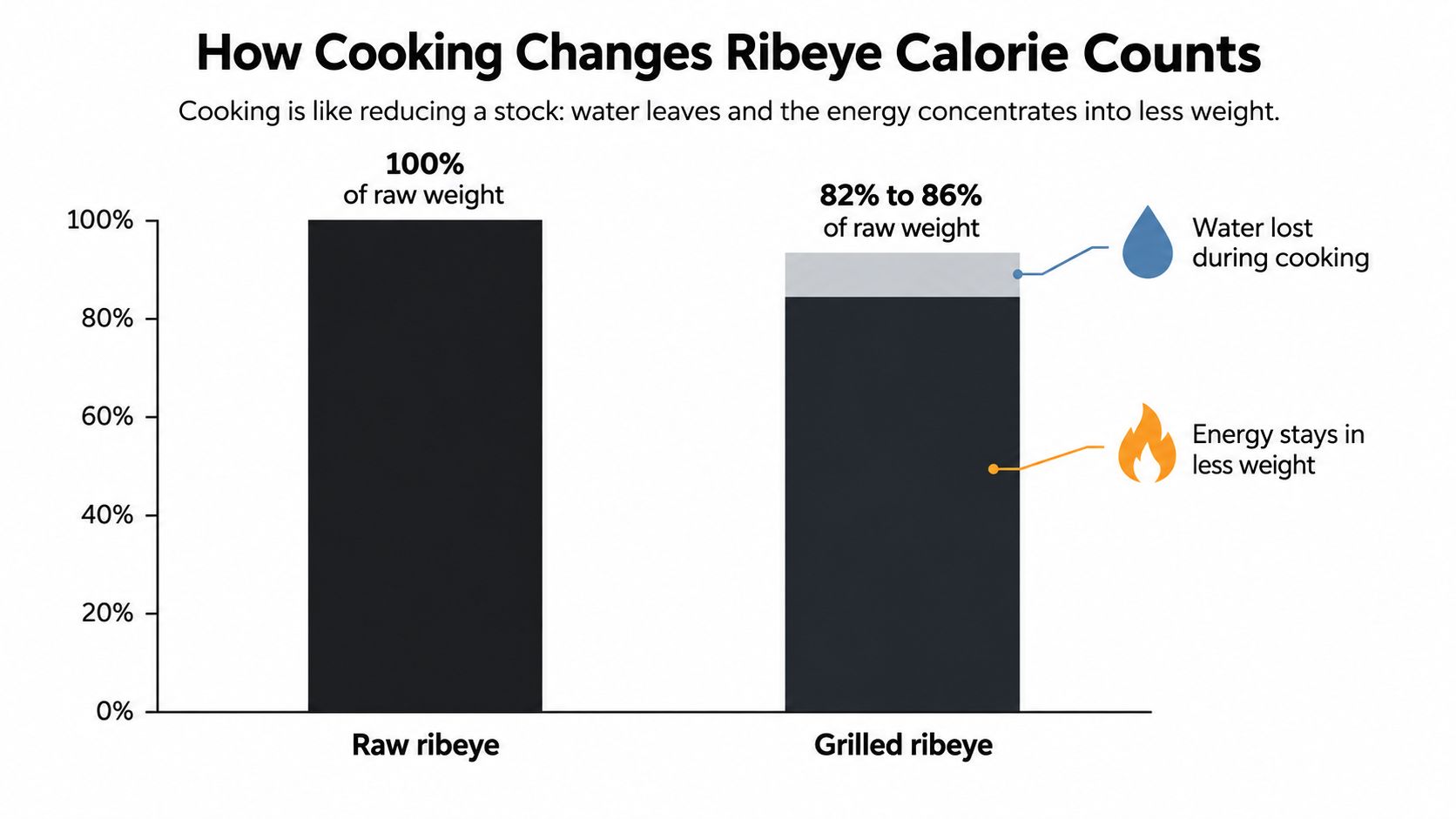
USDA cooking-yield data indicate that grilled ribeye yields roughly 82% to 86% of its starting weight, depending on cut and trimming. A 300-gram raw steak may finish near 246 to 258 grams before any extra cooking fat. The same research found beef fat content from 5 to 21 grams per 100 grams raw and 8 to 24 grams per 100 grams cooked across cuts and cooking conditions. Cooked weight alone does not fix the fat.
A yield range, not one doneness
Rare and well-done steaks do not lose the same water. A rare steak tends to sit toward the high end of the yield, and a well-done steak toward the low end. Treat 82% to 86% as a band. The table below applies that band, then prices the cooked weight at about 291 calories per 100 grams if the fat is still in the meat you eat. Those calorie figures are estimates built on the cooked density, not a second laboratory weighing.
| Raw weight | Expected cooked weight |
|---|---|
| 250 g | 205 to 215 g (about 597 to 626 calories if fat stays) |
| 300 g | 246 to 258 g (about 716 to 751 calories if fat stays) |
| 340 g | 279 to 292 g (about 812 to 850 calories if fat stays) |
Bone, drippings, and the log
A bone-in steak is a different problem. Weighing the whole piece, bone included, overstates the edible calories. Cut the meat off the bone, or subtract the bone, before you enter a weight.
Water loss makes 100 grams of cooked ribeye look more calorie-dense than 100 grams of raw ribeye even when nobody added a calorie. Rendered fat can pull energy back out of the meat at the same time.
If you weighed the steak after cooking, use a cooked database entry. If you weighed it raw, use a raw entry and keep the yield band in mind. Do not convert one into the other with a single shrink factor and call it exact. Rendered fat left in the pan, and butter or oil added in the sear, belong on their own lines.
Why the Same Ribeye Weight Gives Different Calories
A 316-gram Choice ribeye can contain more calories than a 340-gram Select ribeye. USDA-derived listings estimate 760 calories for the Choice steak and 710 calories for the Select boneless, lip-off steak. An unspecified-grade raw steak weighing 326 grams is estimated at 740 calories, according to the same USDA-derived ribeye listings.
| Ribeye version | Weight | Calories |
|---|---|---|
| Select, boneless, lip-off, raw | 340 g | 710 kcal |
| Unspecified grade, raw | 326 g | 740 kcal |
| Choice, raw | 316 g | 760 kcal |
| Choice, lean and fat, per 100 g | 100 g | about 240 kcal |
| Select, lean only, per 100 g | 100 g | 149 kcal |
The per-100-gram comparison is about 240 calories for Choice ribeye with lean and fat, versus 149 calories for Select measured as lean only. That is a difference of about 60%, not a twofold spread. A single published figure such as 271 calories per 100 grams, reported for beef ribeye steak by Listonic, is one estimate, not a universal count.
Four features that set the number
Grade and marbling. Choice generally has more intramuscular fat than Select. For logging, choose a grade-specific entry when the label provides one; otherwise, treat the estimate as less precise.
Fat-cap trim. A lip-off listing describes a steak with separable edge fat removed. If the cap remains and you eat it, choose an entry that includes lean and fat rather than lean only.
Bone. Package weight for a bone-in steak includes the bone. Weigh the edible meat separately, or use a boneless entry for the meat portion.
Database definition. Lean-only entries describe a different portion from lean-and-fat entries. Match the listing to what you eat.
These figures are for raw-weight entries. Keep the raw weight paired with a raw listing, and choose the cooked equivalent if you weigh the steak after cooking.
For a raw steak weighing roughly 320 to 340 grams, the examples support an estimate of about 710 to 760 calories, depending on grade, trim and database definition. Use a range when those details are unknown; a precise single figure would hide the differences.
A photo can help estimate portion size, but it cannot establish grade or show how much fat was trimmed. The same limitation applies when estimating chicken thigh calories: the cut and preparation affect how closely a photo-based estimate matches the meal.
How Fat Drives Ribeye Calories and Add-Ons
The cleanest comparison is two 3-ounce grilled servings of boneless ribeye. MyFoodAnalysis reported in 2026 that grilled boneless lean ribeye contains 175 calories per 3-ounce (85-gram) serving, while the lean-and-fat baseline for the same serving size sits near 247 calories. The separable fat is the gap, on the order of 70 calories, close to 30% of that small serving. That gap is an estimate from two listings, so treat it as the size of the lever rather than a promise about what your knife will remove.
Fat earns this role because each gram carries more than twice the energy of a gram of protein. On the lean-and-fat density, fat supplies most of the steak's calories and protein supplies the rest. There is no carbohydrate to move the total.
The cap is the lever you can see
Trim the cap before cooking if you do not plan to eat it. Fat left on the board never enters the log. Eat the crisp edge and it counts in full, including the share that stayed in the meat rather than rendering into the pan.
Marbling inside the eye cannot be trimmed at the table, so a home trim only ever captures the separable part. A Select listing measured as lean only works out near 127 calories per 3 ounces from 149 kcal per 100 grams. Against the 175-calorie grilled lean serving, lean-only ribeye is more accurately logged as a range of roughly 127 to 175 calories per 3 ounces than as a single figure.
Add-ons are separate foods
| Add-on | Typical amount | Calories |
|---|---|---|
| Butter basting | 1 tbsp (14 g) | about 100 |
| Olive oil for searing | 1 tbsp | about 120 |
| Steak sauce | 1 tbsp | about 15 to 30 |
| Fat left in the pan | left behind | do not log |
Say the sear used a spoon of butter and a spoon of oil. That is roughly 220 calories added beside the steak, counted as extra foods rather than as part of the cut. A restaurant ribeye finished in butter can move the meal's total as much as stepping up a grade. Sauce is the small line at roughly 15 to 30 calories a tablespoon, and the bottle gives the exact figure for the brand on the table. The same split applies to mixed plates. A creamy chicken tikka masala hides its fat in the sauce, while a ribeye hides a lot of it on the rim and in the pan.
Log the steak as the steak. Log each added fat as its own line so the total stays checkable, and skip the rendered fat that stayed in the pan if you never spooned it back.
Judging Ribeye Portions From a Photo
A photo will not tell you the grade. It can still stop you from logging a 6-ounce steak as a 12-ounce one.
A 3-ounce cooked portion is roughly a deck of cards, about three-quarters of an inch thick. A 6-ounce portion is about a palm and clearly thicker. A 12-ounce portion is closer to two palms side by side.
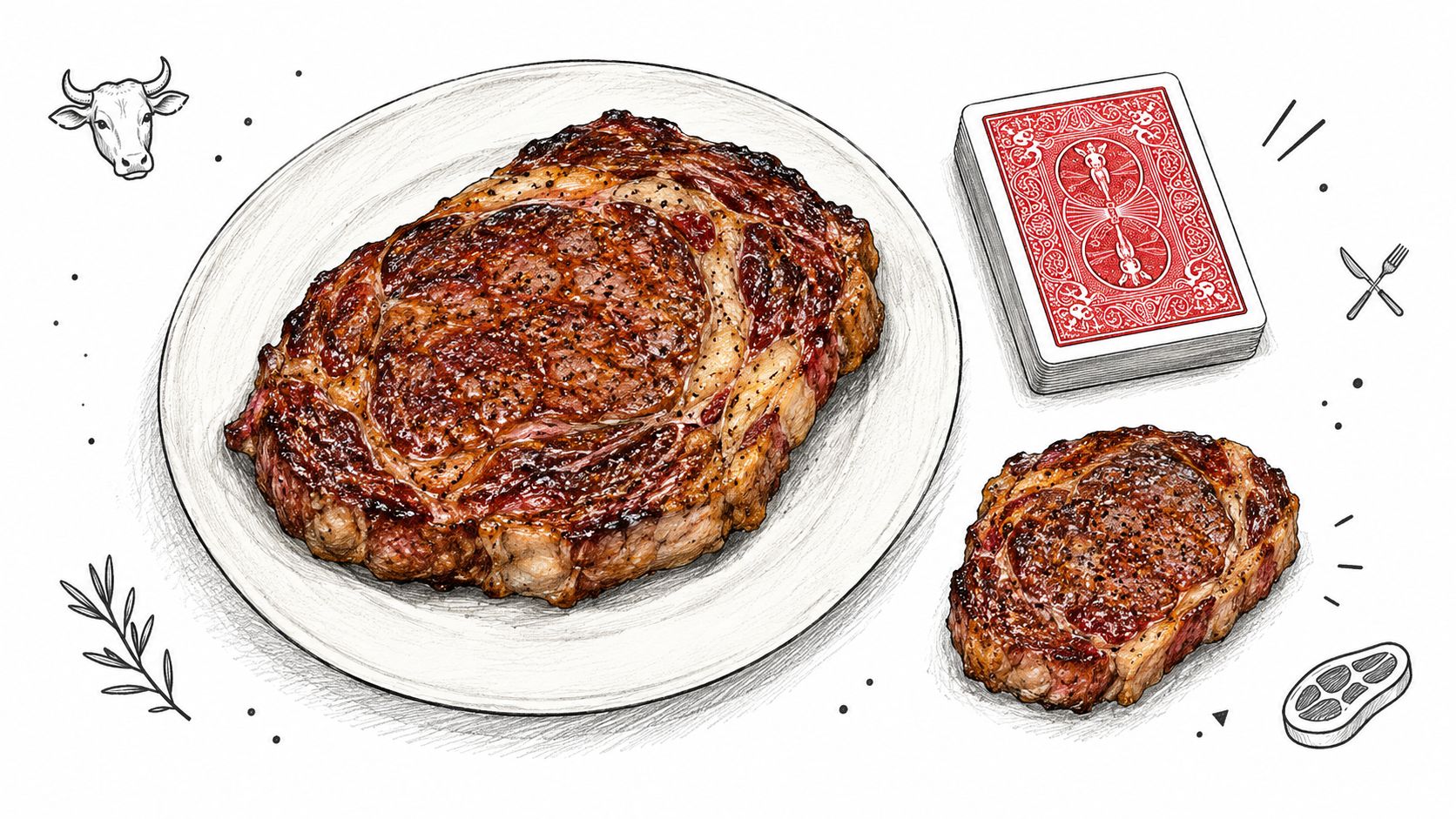
A standard dinner plate is about 10 inches across. A steak that covers most of that plate, with only a little rim showing, is usually 12 ounces or more once it is cooked. If a fork, a knife, or a known object sits in the frame, use it. Thickness matters as much as the footprint, so a side view of the steak is more informative than a flat overhead shot of a thin piece that looks wide.
What the picture cannot see
NutriScan reported in 2026 that a cooked 8-ounce (227-gram) ribeye contains approximately 602 calories. That is one published point for one description of the cut. A photo can narrow the portion toward 8 ounces or away from it. It cannot show whether the cap was eaten, whether the grade was Choice or Select, or whether butter went back over the meat. Those features still set the calorie spread.
If you are between two sizes, log the midpoint, then correct the portion the next time you weigh a steak. Your meal photos are used only to estimate nutrition for you. Calorie estimates are a guide, not medical advice.
The same limit shows up with other foods that look simple on a plate. An avocado half is easy to mis-size from above, and a ribeye is easier still, because the fat is not a separate piece you can point at.
Log Your Ribeye Correctly in Calorie Genie
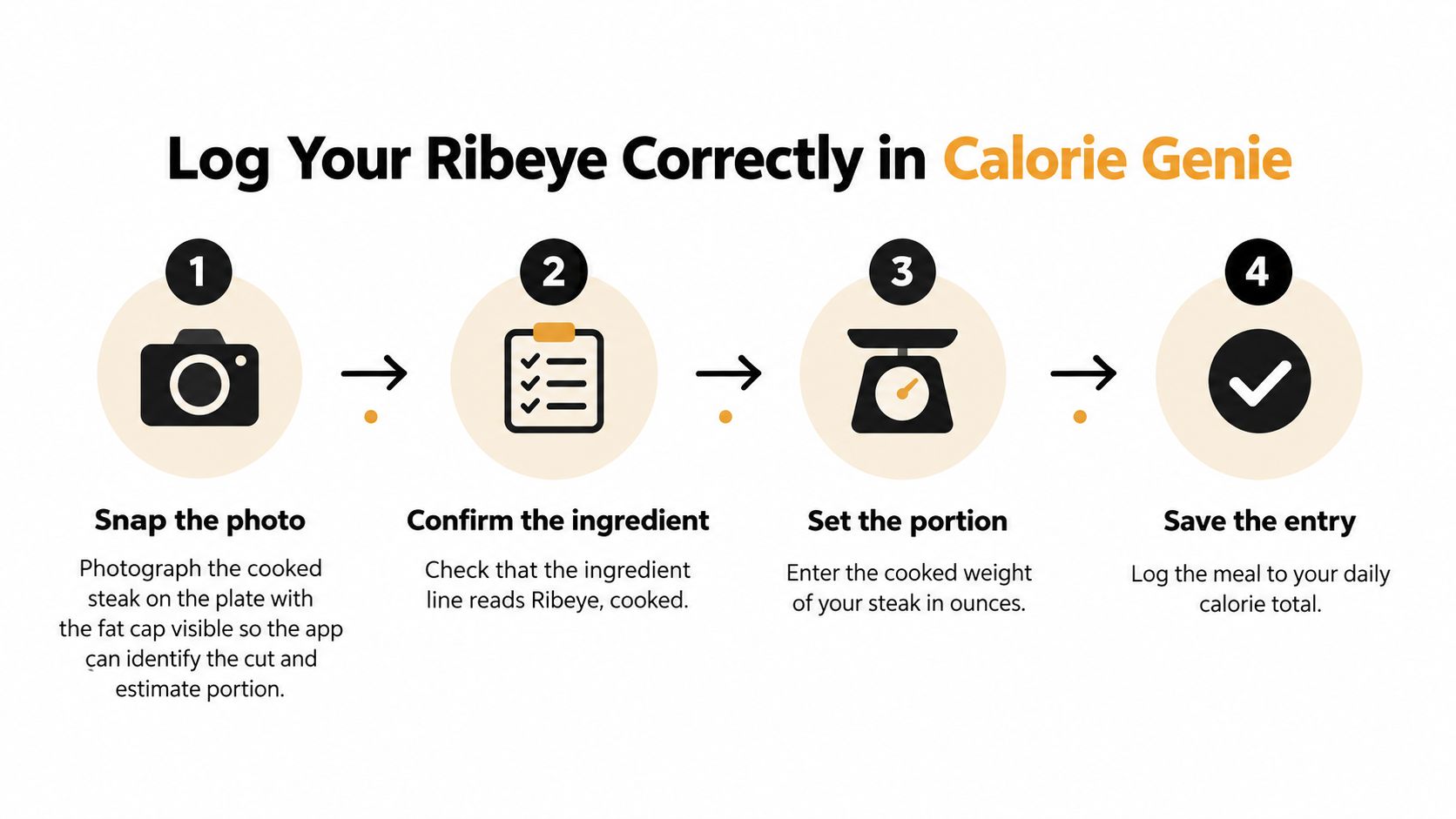
You can point the camera at a meal, a drink, a barcode, or a whole restaurant menu, with no searching and no requirement to weigh. For a ribeye, a few checks after the scan keep the estimate honest.
Snap the cooked steak on the plate with the fat cap visible. The cap is the feature that separates a lean log from a lean-and-fat log. A top-down shot that hides the edge makes the portion look like lean meat. Include a fork or the plate rim so thickness is easier to judge.
Confirm the ingredient line reads ribeye, and that the state is cooked. After a scan, you get calories, protein, carbs, and fat, plus a health score. Tap the ingredient if the line says a different cut, or if it treats a cooked steak as raw. Raw and cooked densities are not interchangeable.
Set the portion to the cooked weight you actually ate. If you know it was about 8 ounces cooked, enter 227 grams. Users can tap any ingredient to adjust its portion or swap it before saving. The lookup values in the portion table are cooked weights, so a package weight typed in here will overstate the plate.
Add cooking fat as its own line. A spoon of butter, a spoon of oil, or a spoon of sauce should not be buried inside the steak line. You can then see whether the total moved because the steak was large or because the basting was generous.
Match the cap to what you ate. If you trimmed it and left it, reduce the portion or switch toward a leaner description. If you ate the crisp edge, leave the fat in the entry. This is the same choice as picking lean-only versus lean-and-fat, just made on your plate.
Snap leftovers. A steak you cooked and a steak you finished are different portions. A second photo of what is still on the plate brings the log back to what you ate, instead of what you served.
Save it to the right meal and look at what is left in the day. The entry is an estimate. It is there so the rest of the day's protein and calories have a number to sit beside, not so the app can diagnose a diet.
A short walk-through of photographing a plate and correcting the lines is here:
If the logged steak differs from the matching row in the cooked table by more than about 10%, check whether the weight was entered raw. Change the portion so the basis matches the scale you used. Do not "fix" a raw entry by editing calories by hand while leaving a raw gram weight in place.
Next time, log the ribeye as three lines: the steak, the cooking fat, and any sauce. You can check each line, and you can see which one moved the meal.
Calorie Genie AI reads a plate from one photo and returns calories, protein, carbs, and fat, with every ingredient open for a portion change before you save. For a ribeye, that means you can match the scan to cooked weight, the fat cap, and any butter or sauce instead of trusting a single steakhouse number. Visit Calorie Genie AI and snap the next steak with the cap in frame.