
The carbs to protein ratio is your carbohydrate grams divided by your protein grams for the day, and adult energy guidance allows it to sit anywhere from about 1.3:1 to 6.5:1. That span, not a single number, is what the reference ranges describe.
So why does nearly every article hand you one tidy figure, usually 2:1 or 3:1, as if it were settled law? Because one number is easier to sell than a range, and much easier to get wrong. A 3:1 target means something different to a 55 kg runner eating in a deficit than to a 90 kg lifter eating in a surplus, and the two of them aren't eating the same quality of carbohydrate either. The skill worth learning isn't memorising a ratio. It's knowing which part of the range your goal puts you in, then checking it in a food diary without turning dinner into an exam.
Table of Contents
- Carbs to Protein Ratio Reference Points at a Glance
- How to Calculate Your Carbs to Protein Ratio
- Why the Right Ratio Changes With Your Goal
- Carbs and Protein Around Your Workouts
- Why Meal Timing Matters More Than the Daily Number
- Misconceptions That Make the Ratio Mislead You
- Pick Your Ratio and Track It for One Week
Carbs to Protein Ratio Reference Points at a Glance
Start with the numbers you can check in seconds, before any advice about your own plate.
The National Academies' Acceptable Macronutrient Distribution Ranges set adult carbohydrates at 45% to 65% of daily calories and protein at 10% to 35%. Those are shares of energy, not grams. Because both nutrients carry roughly the same calories per gram, an energy-share ratio and a gram ratio point to the same place on the plate. The same guidance keeps fat separate at 20% to 35% of adult energy, which is the reminder that you're never dividing the whole plate between two nutrients.
| Reference point | Carbs (% of energy) | Protein (% of energy) | Carbs to protein ratio |
|---|---|---|---|
| Lower carb limit, upper protein limit (adult AMDR) | 45% | 35% | 1.3:1 |
| WHO population example (midpoints) | 60% | 12.5% | 4.8:1 |
| Upper carb limit, lower protein limit (adult AMDR) | 65% | 10% | 6.5:1 |
| Endurance recovery after exercise (gram basis, not % of energy) | n/a | n/a | 3:1 to 4:1 |
What Each Row Is Measuring
The first and third rows are the two corners of the adult range. Pair the lowest carbohydrate share with the highest protein share and you get 45 divided by 35, which is 1.3:1. Pair the highest carbohydrate share with the lowest protein share and you get 65 divided by 10, which is 6.5:1. Every defensible daily ratio for a healthy adult sits inside that box.
The middle row comes from the midpoints of international adult ranges, 60% carbohydrate and 12.5% protein, which lands at about 4.8:1. It describes a population pattern, not a personal target.
The last row is a recovery protocol measured in grams after hard endurance work. It is not a daily eating plan, and treating it as one is the most common mix-up in this whole topic.
Practical rule: if a number you see online falls outside 1.3:1 and 6.5:1 for everyday eating, it's probably a workout protocol wearing a daily-plan costume.
The width is deliberate. Total calories, training load, age, health status and food culture all move you along the range, and the adult bands shift for children too. Protein is 5% to 20% of energy at ages 1 to 3 and 10% to 30% at ages 4 to 18, while carbohydrate stays at 45% to 65% for both groups. That alone explains why a child's plate shouldn't be built from an adult's ratio.
How to Calculate Your Carbs to Protein Ratio
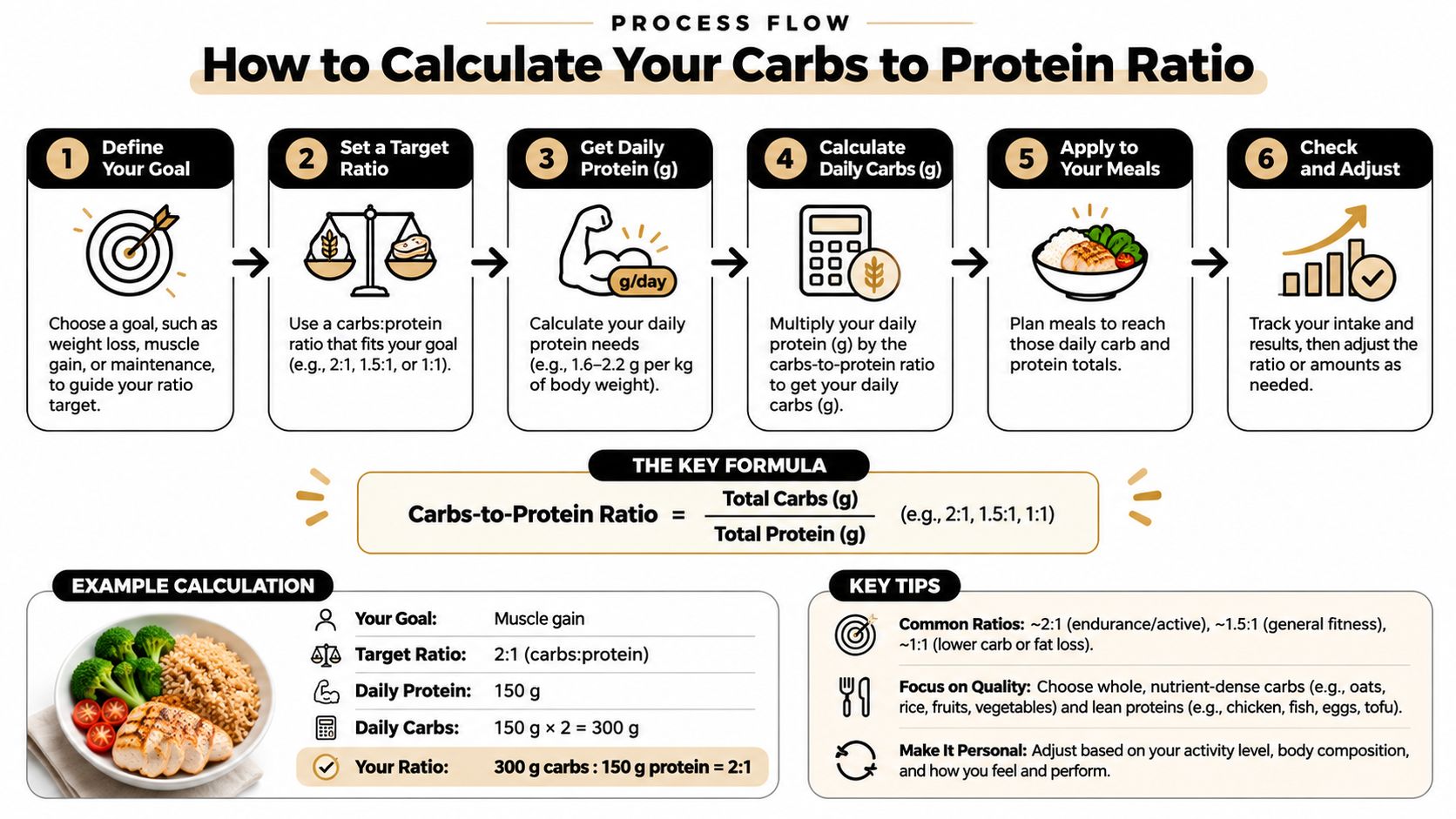
How do you turn a daily calorie target into a carbs-to-protein ratio? Start with the grams, then divide. Protein is commonly set at about 10% to 15% of adult daily energy. On a 2,000-calorie diet, that equals about 50 to 75 grams a day. Carbohydrate quality matters too: choose minimally refined sources where practical rather than chasing a ratio at the expense of food quality.
The Five Steps in Order
- Set your daily calorie target. The gram amounts depend on this starting point, so use a target that fits your needs rather than guessing.
- Set protein in grams first. Protein gives the calculation an anchor. For example, using 10% to 15% of energy as a reference, a 2,000-calorie day provides roughly 50 to 75 grams.
- Choose a fat share. Fat is the third macronutrient, so its share determines how many calories remain for carbohydrate. Choose an amount you can maintain, rather than automatically choosing the lowest.
- Assign the remaining calories to carbohydrate, then convert to grams. Carbohydrate and protein each provide about 4 calories per gram. Divide the calories left for carbohydrate by four.
- Divide carbohydrate grams by protein grams. That gives you the day's ratio. For instance, 200 grams of carbohydrate divided by 100 grams of protein makes a 2:1 ratio.
A Worked Example at 2,000 Calories
Take 75 g of protein. That provides 300 calories, or 15% of the day. Set fat at 30%, which is 600 calories, or about 67 g. Subtract those amounts from 2,000 calories, leaving 1,100 calories for carbohydrate. That equals 275 g. Divide 275 by 75, and the result is roughly 3.7:1 for that day.
A few arithmetic slips can skew the result. Keep calorie percentages separate from gram totals: convert calories to grams before dividing. Include fat in the calculation, since leaving it out makes the carbohydrate allowance look larger than it is. And treat a single unusual day as one data point, not a verdict on your usual eating pattern.
Your result is an estimate, not a prescription or a universal cutoff. The ratio shifts with your calorie target, chosen protein and fat amounts, and food choices. For another worked explanation of the same calculation, see this guide to how to calculate macros. The adult protein reference above is not meant to set children's meals; their needs differ, so get professional guidance rather than scaling an adult ratio down.
Why the Right Ratio Changes With Your Goal
Two people can both eat at a 2:1 ratio and have very different meals. The ratio describes how carbohydrate compares with protein in grams. Your goal, activity and food choices help determine where within a reasonable range that ratio fits.
| Goal | Protein priority | Carb approach | Illustrative ratio |
|---|---|---|---|
| Fat loss in a calorie deficit | Set a protein floor first | Choose fiber-rich carbs and trim portions | About 1.3:1 to 2:1 |
| Maintenance | Keep protein steady across meals | Carbs fill remaining energy | About 2:1 to 3:1 |
| Strength training | Spread protein across the day | Include moderate carbs around sessions | About 1.5:1 to 2.5:1 |
| Endurance training | Get enough protein for repair | Use carbs as the main fuel | About 3:1 to 4:1 on training days |
In a calorie deficit, there is less energy to allocate, so setting protein first can leave less room for carbohydrate. Fiber-rich choices such as oats, beans, whole grains and potatoes with skin can make smaller portions more filling. For a closer look at setting protein before adjusting carbs, see this guide to macros for weight loss.
At maintenance, you may have more room for carbohydrate while keeping protein steady across meals. Strength training can call for a higher protein emphasis, with carbs placed around sessions. Endurance training shifts more of the balance toward carbohydrate as fuel. These are starting ranges, not prescriptions: timing and food quality matter, and the same ratio will not suit every day.
Same Ratio, Two Different Plates
A ratio shows proportion, not total intake. One person eating 1,800 calories might have a 2:1 ratio with 120 g protein and 240 g carbohydrate. Another person eating 2,600 calories could have the same ratio with 150 g protein and 300 g carbohydrate. The proportions match, but the amounts and plate sizes differ.
Use the ratio as a guide for choosing foods across the day, not as a rule that every meal must match. For vegetarian and vegan eaters, reaching a chosen protein floor may take extra attention; set that first, then let carbohydrate vary with the goal and activity. A single ideal number can hide these differences, so treat the ranges as estimates and adjust them to fit your overall needs.
Carbs and Protein Around Your Workouts
Recovery is the one place where a specific ratio earns its reputation. After prolonged or high-volume endurance exercise, a carbohydrate-to-protein ratio of about 3:1 to 4:1 can be used when carbohydrate intake falls below what maximal glycogen restoration needs, according to sports nutrition guidance on recovery from endurance exercise.
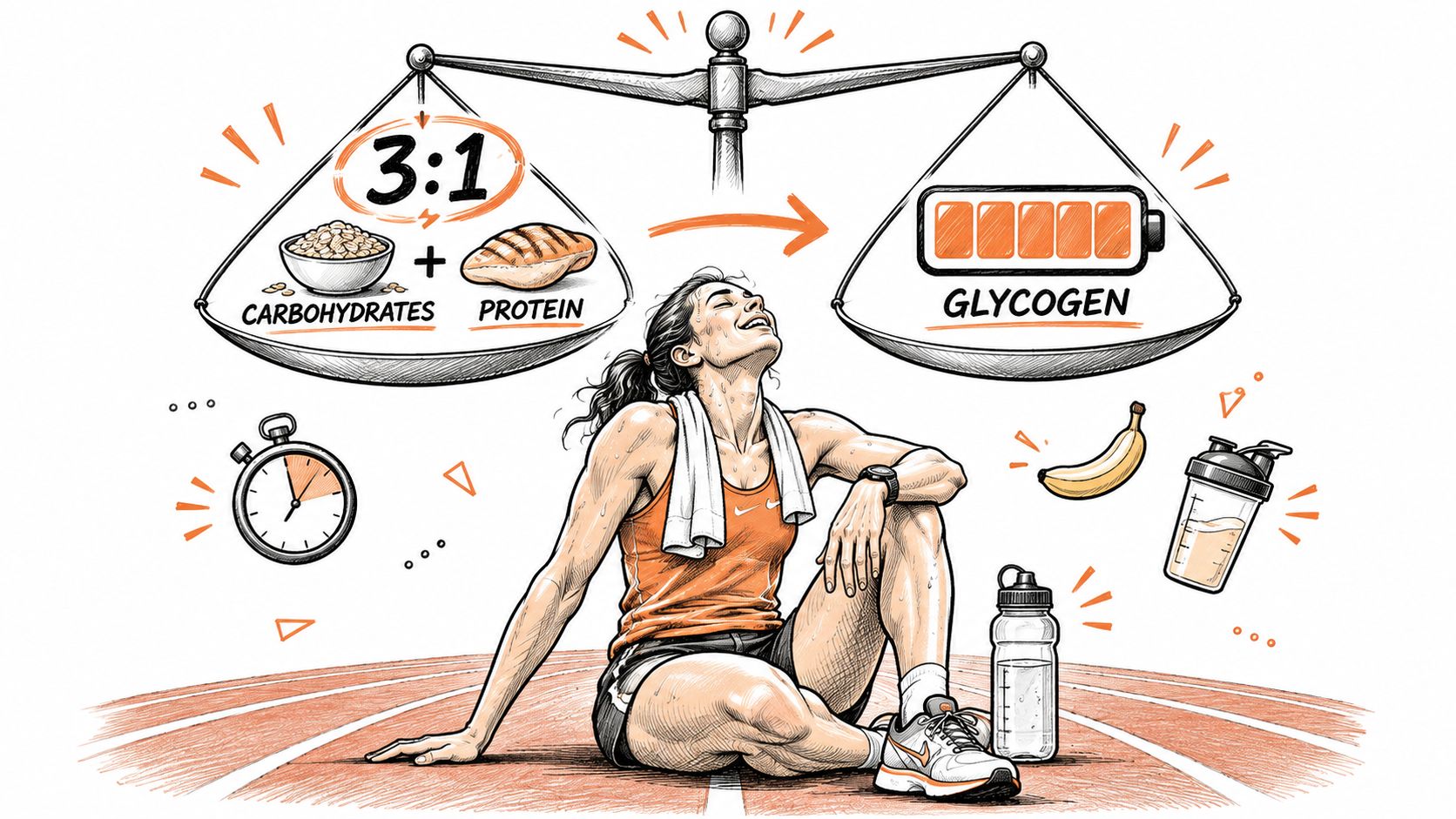
The practical target is about 1.2 to 1.5 g of carbohydrate per kilogram of body weight plus 0.3 to 0.5 g of protein per kilogram, eaten soon after you stop. For a 70 kg athlete, that's 84 to 105 g of carbohydrate, or 336 to 420 calories, and 21 to 35 g of protein, or 84 to 140 calories.
The two nutrients do different jobs. Carbohydrate supplies glucose for muscle glycogen synthesis. Protein supplies essential amino acids for repair, and when carbohydrate intake is low, it may also help glycogen resynthesis move faster.
For a short or moderate session, none of this is necessary. A normal meal with a balanced plate covers it, and chasing a ratio after a 30-minute walk is effort spent on nothing. The dose that matters depends on how long and how hard you trained, your body mass, and how much time sits between now and your next demanding session.
Why Meal Timing Matters More Than the Daily Number
Here are two people with an identical 2:1 daily gram ratio. The first eats almost all of her protein at dinner, a large chicken portion at 8pm. The second spreads it across three meals and a snack. Their daily totals match. Their bodies get very different signals.
The second pattern is easier to sustain and fits the practical target of roughly 20 to 40 g of protein per meal noted in everyday guidance on protein timing. That same summary reports that protein timing alone may not substantially change muscle strength or mass, so the daily total still comes first. Timing sharpens a good diet. It doesn't rescue a bad one.
One more nuance worth knowing without over-applying it: eating protein before carbohydrate may reduce post-meal glucose spikes in some contexts. It isn't a universal rule, and anyone managing blood sugar should be following their clinician's plan rather than a blog.
Practical rule: build the plate so protein appears at breakfast, not only at dinner. That single change fixes most lopsided days.
- Breakfast carbs need a protein partner. Add Greek yogurt to oats, or eggs to toast, rather than eating the carbohydrate alone.
- Protein first at restaurants. Start with the protein portion and let the carbohydrate sides follow your hunger and your training that day.
- Match carbs to activity. A rest day doesn't need the same carbohydrate load as a long run day.
- Estimate, then correct. In mixed cuisines, plant-based bowls and restaurant plates, grams are always estimates. Adjust the portion rather than pretending the first number was exact.
Misconceptions That Make the Ratio Mislead You
Four beliefs cause most of the confusion. Each one has a correction that changes how you use the number.
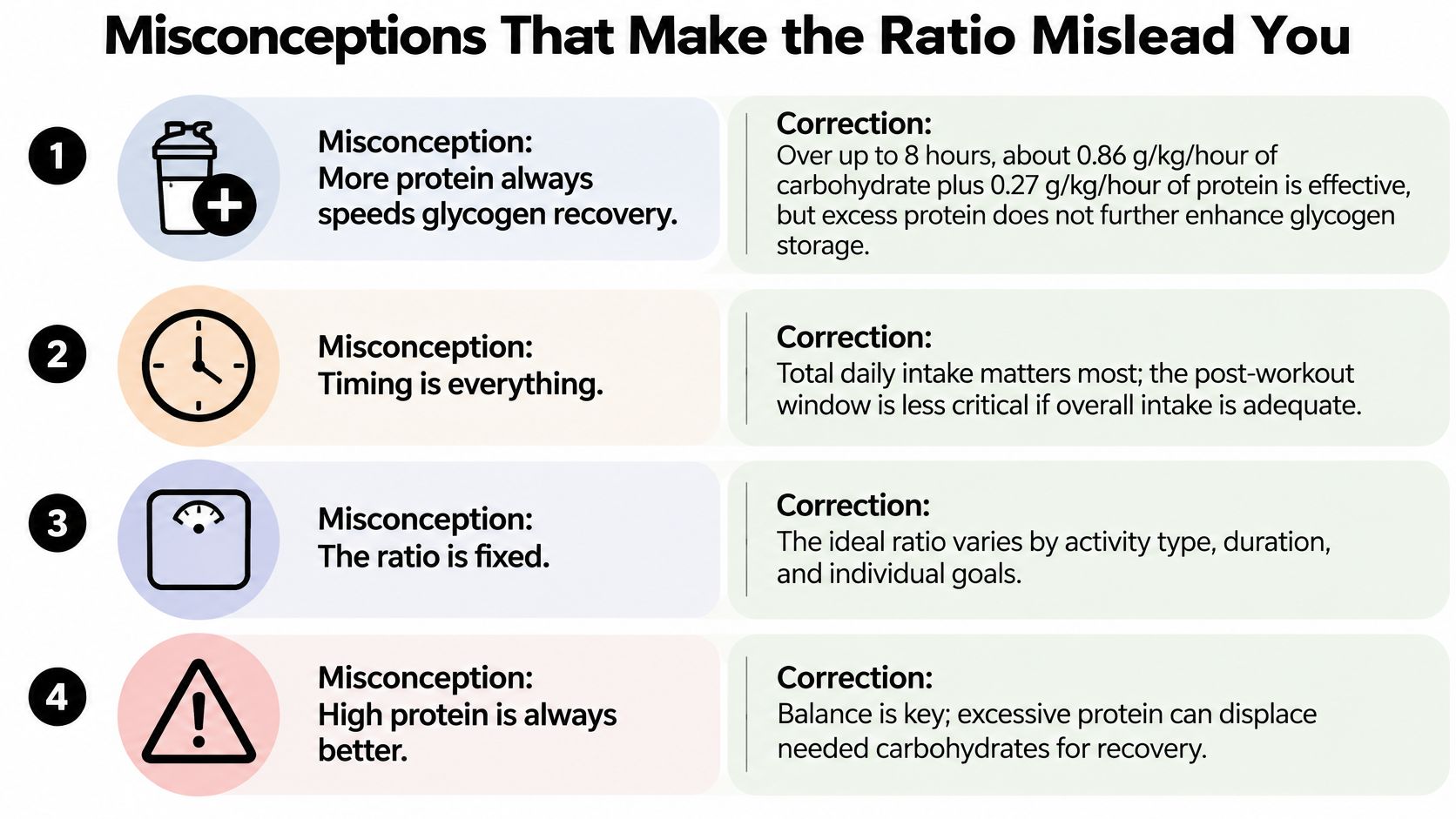
More protein always speeds glycogen recovery. It doesn't. During short-term recovery of up to 8 hours, about 0.86 g/kg/hour of carbohydrate plus 0.27 g/kg/hour of protein did not restore glycogen faster than about 0.95 g/kg/hour of carbohydrate alone, as reported in evidence on carbohydrate and protein for glycogen resynthesis. Carbohydrate dose is the driver. Protein helps most when carbohydrate is suboptimal, and one example uses 0.9 g/kg/hour carbohydrate with 0.3 g/kg/hour protein, roughly a 3:1 mass ratio. For a 70 kg person that's 63 g of carbohydrate and 21 g of protein per hour, applied selectively rather than treated as a meal template.
There's one ideal ratio. Adult guidance describes bands, not points, and shifts with age, activity and health. Two people training differently can both be eating well at different ratios.
All carbohydrate grams are equal. The WHO healthy diet fact sheet recommends whole grains, vegetables, fruits and pulses as the main carbohydrate sources. A 3:1 day built on those isn't the same diet as a 3:1 day built on refined snacks.
A low ratio always means a better diet. The ratio is blind to fiber, total calories and processing. Someone can hit 1:1 with fried food and a protein shake and still be eating poorly.
The Four Corrections in Brief
- Carbohydrate dose drives glycogen. Protein supports the process rather than replacing the carbohydrate.
- Ranges beat points. Pick the band that fits your goal and adjust from feedback.
- Quality counts inside the ratio. Whole grains, pulses, vegetables and fruit carry fiber you won't see in the number.
- Context decides. Total energy, fiber, training demand and food quality often matter more than hitting a ratio exactly.
Pick Your Ratio and Track It for One Week
Start with a workable range, then use a week of ordinary meals to see how it fits your goal. Ratios are estimates, not prescriptions, and the best fit can shift with training, meal timing, and food quality.
- Choose your goal row. Select fat loss, maintenance, strength, or endurance. Set the protein floor for that goal before considering carbohydrate.
- Calculate one typical day. Use the five steps on a normal day, rather than an unusual occasion.
- Log several days across one week. A single meal offers little context, and one unusual day should not set your plan.
- Adjust one variable at a time. Spread protein across more meals, replace a refined carbohydrate with a whole-food source, or shift carbohydrate toward training days. Then note what changes.
A simple log makes patterns easier to spot. Calorie Genie identifies foods in a plate photo, estimates portions, and returns calories, protein, carbs, and fat. You can edit each ingredient before saving, helping you review the day's ratio without weighing food. For a repeatable logging routine, follow this guide to how to keep a food diary. Calorie Genie is available on iOS and Android, with photo-based calorie and macro estimation. Estimates are a guide, not medical advice. If you have a medical condition or specific dietary needs, consult a qualified professional.
Keep the goal practical: collect enough ordinary meals to see whether your chosen range suits your routine. Calorie Genie AI can read a plate photo and return calories, protein, carbs, and fat for you to review and correct. Track a few meals this week, then consider how your carbohydrate and protein intake relates to your goal, training, and food choices. Calorie Genie AI can help you gather those numbers.