
A plain broiled pork loin chop is about 180 calories for a 3-ounce (84-gram) cooked edible serving. Trim, cut, and cooking method move that number, often by more than swapping one lean chop for another.
What stays on the meat is the part most logs miss. Visible fat, a slick of oil, a breadcrumb crust, or a spoon of glaze can outweigh the difference between two similar loin chops. Treat the plate as the unit. Log the edible chop on one line, then log added fat and sauce on their own lines. Bone weight is not food, and a menu name is not a cooking method.
Table of Contents
- Pork Chop Calories by Cut and Cooking Method
- Weigh the Chop and Log It Step by Step
- When Oil Breading and Sauce Outweigh the Meat
- Home Chops Versus Dining Hall Plates
- Estimating a Chop Without a Scale
- Log the Chop You Actually Ate
Pork Chop Calories by Cut and Cooking Method
The figure needed tonight is simple. For a standard 3-ounce (84-gram) reference serving, the USDA pork composition tables list a broiled pork loin chop at 180 calories, with about 24 grams of protein, 9 grams of fat, and no carbohydrate from the plain meat. Those values cover pork cooked by moist or dry heat with nothing added.
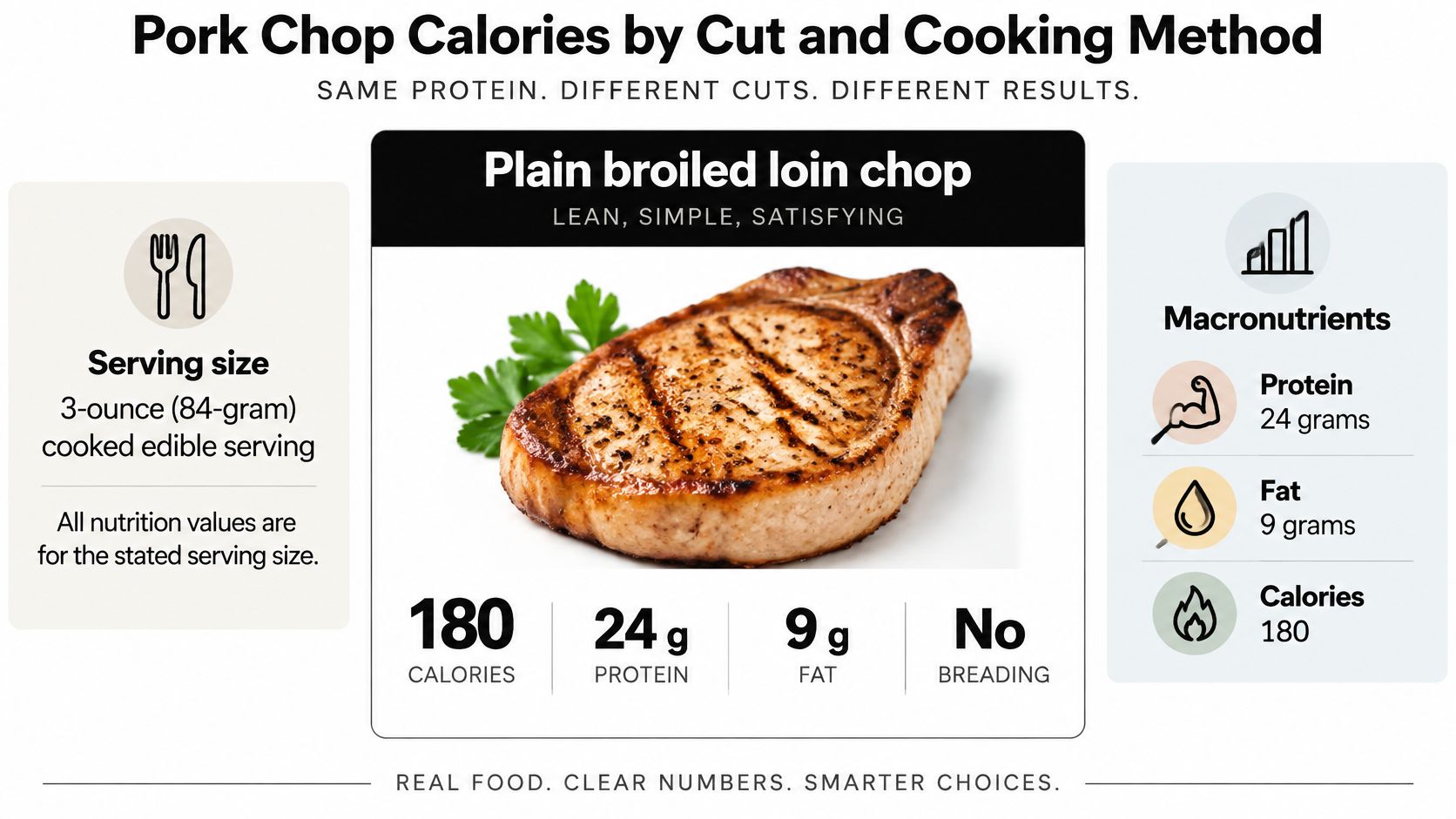
Every row below uses cooked edible weight unless it is marked raw. Never mix a raw database entry with a cooked weight, or the reverse. Cooking drives water out, so the same chop weighs less and each remaining gram holds more energy.
Why raw and broiled numbers disagree
The same USDA tables put top-loin or strip-loin chops, lean and fat included, at about 156 calories per 100 grams raw and 195 calories per 100 grams after broiling. That gap is about 25 percent on a per-100-gram basis, mostly because water leaves and the remaining protein and fat concentrate. A 115-gram raw portion at roughly 180 calories and an 85-gram broiled portion at roughly 165 calories are different entries, not two ways of writing the same meal. Comparing them as if they were the same chop is how a log jumps for no real reason.
Three clusters of cuts
Read the table in three groups. Lean loin references sit near the plain broiled standard. Bone-in loin at about 3 ounces edible swings with the fat cap and the pan. Center and blade cuts sit higher per 100 grams once frying or braising enters.
| Cut and method | Per 100 g | Per 3 oz edible | Protein and fat |
|---|---|---|---|
| Top loin or strip loin, raw, lean and fat | 156 kcal | about 131 kcal | not stated |
| Top loin or strip loin, broiled, lean and fat | 195 kcal | about 164 kcal | not stated |
| Loin chop, broiled, plain (FSIS reference) | about 214 kcal | 180 kcal | 24 g protein, 9 g fat |
| Bone-in loin, broiled, lean only | about 202 kcal | 172 kcal | lower fat than the lean-and-fat row |
| Bone-in loin, broiled, lean and fat | about 240 kcal | 204 kcal | about 11 g fat |
| Bone-in loin, pan-fried, lean and fat | about 277 kcal | 235 kcal | about 14 g fat |
| Center loin, broiled, lean and fat | 209 kcal | about 178 kcal | not stated |
| Center loin, pan-fried | 238 kcal | about 202 kcal | not stated |
| Blade chop, braised | 255 kcal | about 216 kcal | not stated |
A third-party nutrition listing from Listonic puts pork chops at 231 kilocalories per 100 grams. Expect a range, not a single official chop. Butter, oil, breading, and sauce sit outside these rows. The same habit of separating the meat from the extras applies when you compare a chop with a ribeye steak's calories.
Practical rule: Weigh or estimate only the meat you swallow, pick the row that matches cut and heat, and keep added fat off that line.
Weigh the Chop and Log It Step by Step
Databases expect a 3-ounce (84 to 85 gram) edible cooked serving, not the chop the butcher wrapped. A bone-in center chop often looks like 6 to 8 ounces on the board. After the bone comes off and any leftover meat stays on the plate, the eaten portion is smaller. Two chops means double the edible meat, not double the bone.
USDA cooking-yield figures compiled by Nutri-DB show why the unit matters. A 4-ounce raw boneless lean top-loin chop is listed at 144 kcal, 25.3 g protein, and 3.86 g fat. A cooked broiled bone-in center-loin chop with lean and fat is about 209 kcal per 100 g, or roughly 178 kcal per 3 ounces. Heat drives water out, so the cooked piece weighs less and each remaining gram is denser. Those two states are not interchangeable.
Match the plate to one entry
| What is on the plate | Weight to log | Approx. calories | Entry to use |
|---|---|---|---|
| Database reference, broiled loin | 3 oz (84 g) edible cooked | 180 kcal | cooked plain loin |
| Broiled bone-in loin, fat eaten | 3 oz (85 g) edible cooked | 204 kcal | cooked lean and fat |
| Broiled bone-in loin, fat trimmed | 3 oz (85 g) edible cooked | 172 kcal | cooked lean only |
| Raw boneless lean top loin | 4 oz (113 g) raw | 144 kcal | raw entry only |
| Broiled center loin, lean and fat | 100 g cooked edible | 209 kcal | cooked per 100 g |
| Two reference chops | 6 oz (168 g) edible cooked | 360 kcal | double the cooked serving |
Related USDA-derived chop entries put center-loin chops near 209 kcal per 100 g broiled and about 238 kcal per 100 g pan-fried, with braised blade chops near 255 kcal per 100 g. The useful question is how many calories the method added, not a single fried-pork number.
The logging order
- Name the cut you see, and say whether it is bone-in. Loin, center loin, and blade are different rows.
- Pick one measurement state. Raw weight with a raw row, or cooked edible weight with a cooked row. Don't cross them.
- Subtract bone and meat left on the plate. Only swallowed meat counts.
- Choose broil, grill, braise, or pan-fry, and note whether the fat cap was eaten.
- Add oil, butter, breading, and sauce as separate lines. A sugar marinade belongs on the sauce line. If several chops shared a pan, log only the oil on your plate.
- Trust the scale when a photo guess and the scale disagree, and keep the method you used.
The same edible-weight habit works for other mixed pieces, including chicken thigh calories, where bone and skin also split the plate from the database serving.
Lean does not stay low-calorie once oil and breading enter the pan. A plainly broiled chop can still deliver a lot of protein for a moderate calorie line.
When Oil Breading and Sauce Outweigh the Meat
A lean label does not survive a breaded fry. A plainly broiled chop can be the higher-protein, moderate-calorie choice once the crust and the glaze are counted.
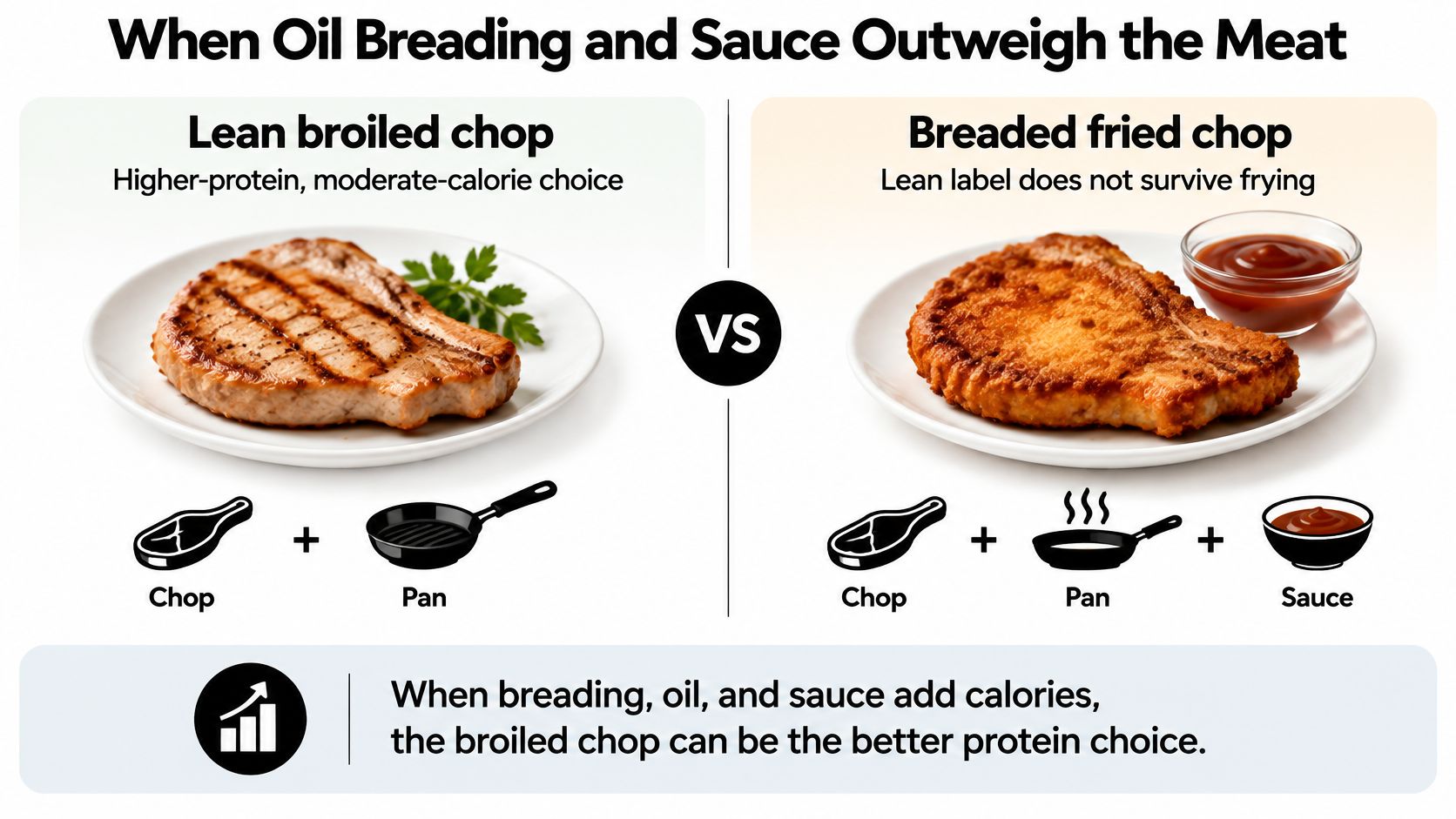
The USDA nutritive-value tables make the meat-only gap concrete. A cooked bone-in loin chop, about 3 ounces or 85 grams edible, is 204 kcal with lean and fat after broiling, versus 172 kcal for lean meat only. That is 32 kcal, about 19 percent. Pan-frying raises the lean-and-fat value to 235 kcal per 3 ounces, 31 kcal above broiling. Broiled lean-and-fat chops provide about 11 g fat per 3 ounces. Pan-fried chops provide about 14 g. Leftover cooking fat can add still more if it stays on the surface.
Add-ons as their own lines
Leave the meat chart and log what you added.
| What changed | Typical add | How to log it |
|---|---|---|
| Eat the fat cap instead of trimming | about 32 kcal per 3 oz | switch lean-only 172 to lean-and-fat 204 |
| Pan-fry instead of broil, fat eaten | about 31 kcal per 3 oz | use 235 rather than 204, then add leftover oil only if extra |
| Oil left on the meat | about 40 kcal per teaspoon, about 120 per tablespoon | extra line, not inside the meat row |
| Butter on the chop | about 35 kcal per teaspoon, about 100 per tablespoon | extra line for the amount eaten |
| Flour or breadcrumb coating, fried | often on the order of 50 to 150 kcal | coating line plus fry oil that stayed on |
| Sweet glaze or barbecue sauce | often about 30 to 70 kcal per tablespoon | sauce line for the spooned amount |
Grilling and broiling add little when the chop is not basted. Braising can look moderate per bite if you spoon the sauce off, or high if you eat the reduced liquid. Cooking habits differ by kitchen, so grilling, broiling, braising, pan-frying, and breaded frying each need their own add-on line.
Log in this order when the parts are known.
- Record the chop from the matching cooked or raw row.
- Estimate edible weight after bone and leftovers.
- Add only what was eaten, oil, butter, breading, and sauce.
- Skip a generic fried-pork entry once those parts are known.
A photo guess stays a range until portion size and added oil or butter are confirmed.
Home Chops Versus Dining Hall Plates
Three plates show why one restaurant chop does not exist.
Plate one, a home broil. You cook one bone-in loin, trim the fat cap, and eat about 85 grams of meat. The calorie line stays near the lean-only broiled row, and it still carries a large share of dinner's protein. A pile of plain vegetables barely moves the total. The chop is the decision. The broccoli is not.
Plate two, a breaded fry. Princeton University's 2023 dining label reports 296 calories for one 5-ounce serving of fried pork chop. Five ounces is about 142 grams, so part of the jump past a smaller broiled loin is more meat. The rest is coating and fry fat. Searching "fried pork chop" and hoping the database plate matches yours will miss one of those two pieces.
Plate three, a sauced chop. The University of Connecticut's 2023 label lists 153 calories per serving for Korean BBQ pork chops, with one chop as the serving. The name sounds rich. The piece can still sit under a plain broiled reference when it is smaller or leaner.
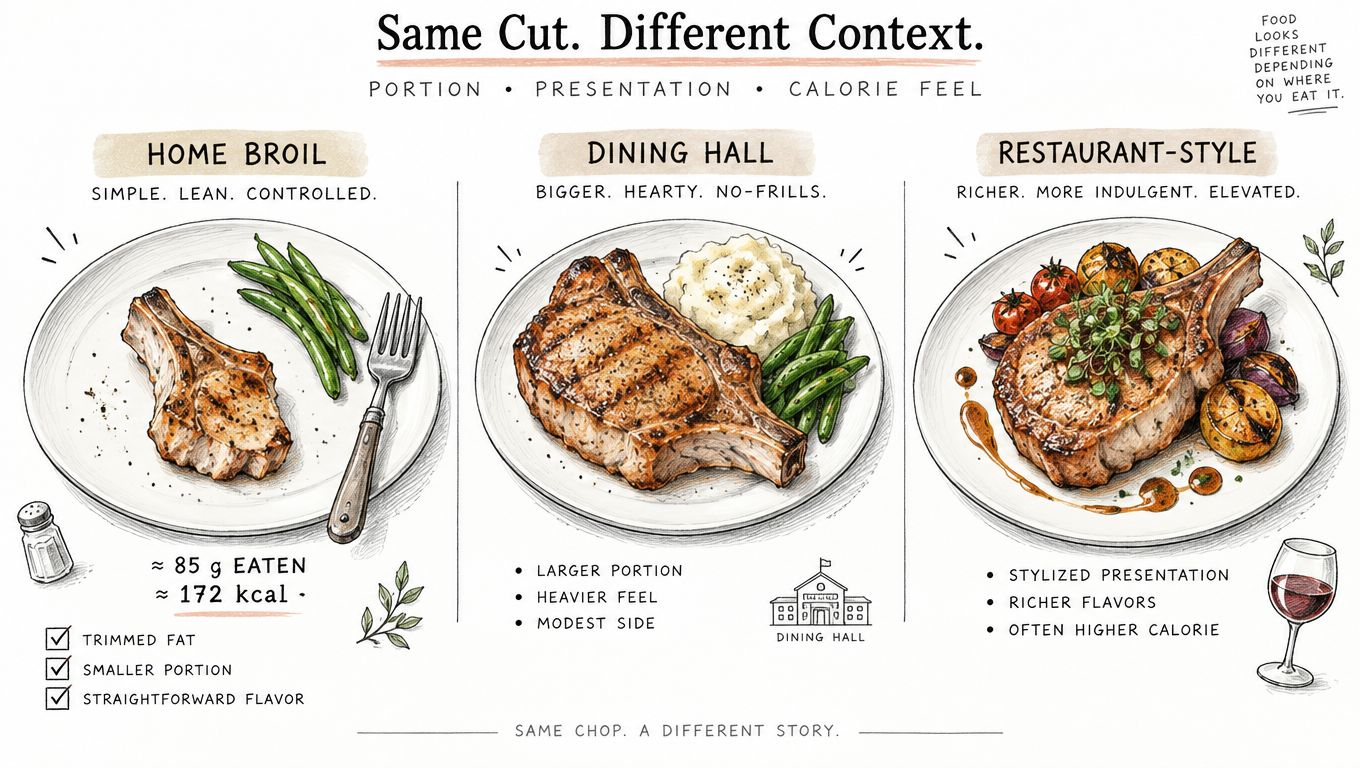
A menu name is not a method. Weigh or eyeball the edible meat, then add the glaze or crust you can see.
Log the piece that was served, not an average chop from a search box.
Estimating a Chop Without a Scale
Use this when the chop is already on the plate and no scale is nearby. You are building a range, not a lab result.
Judge the edible meat, not the bone. Set the piece next to a mental 3-ounce cooked reference, about the size of a deck of cards in meat only, and ignore the bone sticking out. Thickness matters more than length. A thick center chop usually means more eaten meat than a thin cutlet of the same outline.
Check the fat cap. If the white rim is still attached and you ate it, use the lean-and-fat side of the matching method. If you trimmed it or left it on the plate, use the lean-only side. That single choice is often larger than swapping broil for a light pan coat.
Give each add-on its own line.
- Oil: about 40 kcal for a teaspoon left on the meat, about 120 kcal for a tablespoon.
- Butter: about 35 kcal per teaspoon, about 100 kcal per tablespoon of what you ate.
- Fried breading: often roughly 50 to 150 kcal once it has taken up oil, before any sweet glaze.
- Glaze or barbecue sauce: about 30 to 70 kcal per tablespoon you spooned on.
Add those lines to the meat estimate and keep the total as a range. Narrow it before you save by confirming four things: approximate grams of meat, the cooking method, whether the fat was eaten, and how much sauce landed on the plate. A photo estimate stays a range until those details are in. If you later weigh a matching portion, the weighed number wins.
The same split, food on one line and added fat on another, is how people keep avocado calories honest when the fruit is mashed into a sauce rather than eaten plain.
Log the Chop You Actually Ate
Save one entry tonight, built from what left the plate. Use the cooked edible weight of the chop you ate. Pick the row for broil, grill, braise, or pan-fry. If the fat was trimmed, stay on the lean-only side of that method. If you ate the cap, use the lean-and-fat side. Then add separate lines for any oil, butter, breading, or sauce that was eaten. Skip a generic fried chop when you already know those parts.
These figures are tracking guides. They are not medical advice, and they are not a promise about weight change. Calorie estimates are a guide, not a prescription.
If weighing every piece is unrealistic, Calorie Genie AI can start from a photo of the plate. One photo returns calories, protein, carbs, and fat for the whole plate, plus a 1 to 10 health score with a one-line reason, and every ingredient stays editable. After a scan you can tap the chop, the oil, or the sauce and change the portion before you save. Treat that result as a starting estimate, then adjust those lines to match what you ate.
Calorie Genie AI turns a photo of your pork chop plate into calories, protein, carbs, and fat, with a health score you can edit ingredient by ingredient before saving. Use it to separate the edible chop from the oil, breading, and sauce instead of guessing one fried number. Visit Calorie Genie AI and log the chop you ate.