
A USDA reference for a raw, boneless, skinless chicken breast lists a weight of 272 g (9.6 oz). That figure describes one reference entry, not a universal average.
Two breasts that look similar can differ in weight and calories, especially if one is weighed raw and the other cooked. Water loss during cooking changes the weight, so log the breast using the same state, raw or cooked, as the nutrition entry.
For a useful size estimate, record the weight and whether the breast was raw or cooked. A piece count alone cannot show how much meat the portion contains.
Table of Contents
- Average Chicken Breast Size by Weight Class
- How to Judge Breast Size by Eye
- How to Weigh a Breast Before You Log It
- Why the Same Breast Weighs Differently
- How Breast Size Changes Calorie Counts
- Restaurant and Store-Bought Portions
- Common Logging Mistakes and How to Fix Them
- Confirm Your Breast Size and Log It Today
Average Chicken Breast Size by Weight Class
Size labels such as small, average, and large are practical categories, not official retail grades. A breast half, a trimmed fillet, and a whole breast can differ in both portion and preparation, so the weight class needs a clear definition.
The USDA FoodData Central reference lists a raw, boneless, skinless breast at 272 g (9.6 oz) and a cooked half-breast with bone and skin removed at 86 g. These are separate reference entries, not matching raw and cooked weights for one piece.
Chicken breast size by weight class
| Size class | Raw weight | Cooked weight | Typical use |
|---|---|---|---|
| Small, trimmed half-breast | About 113 g (4 oz), working example | About 85 g (3 oz), estimated | Light lunch or smaller portion |
| Average, boneless fillet | Use the package net weight divided by the number of fillets | Weigh the cooked fillet | Dinner portion |
| Large, whole breast, USDA reference | 272 g (9.6 oz) | About 198 g (7 oz), estimated | Larger portion or bulk-pack comparison |
| USDA half-breast, bone and skin removed | No matching raw weight established by this cooked entry | 86 g | Cooked reference entry |
The raw-to-cooked examples are approximate. Use them for planning, not in place of a measured weight. For an everyday average, divide the package's net weight by the number of fillets, then compare your portion with that working reference.
What an average label leaves out
A fillet that looks typical beside others in its package does not establish a general average. It also does not show whether a nutrition entry refers to raw or cooked meat, or to a whole breast or a portion.
Check the package weight and cut description before choosing a row. If you weigh the meat, use the column that matches its state.
- Raw meat: Use the raw weight.
- Cooked meat: Use its measured cooked weight.
- Unfamiliar database entry: Check the preparation description and serving size.
A weight paired with its preparation state gives a more useful logging reference than an average-sounding portion name. All figures are estimates for comparison, not exact weights for every breast.
How to Judge Breast Size by Eye
Use appearance to make a provisional estimate, not to establish an exact weight. The illustration offers a way to compare overall shape and bulk.
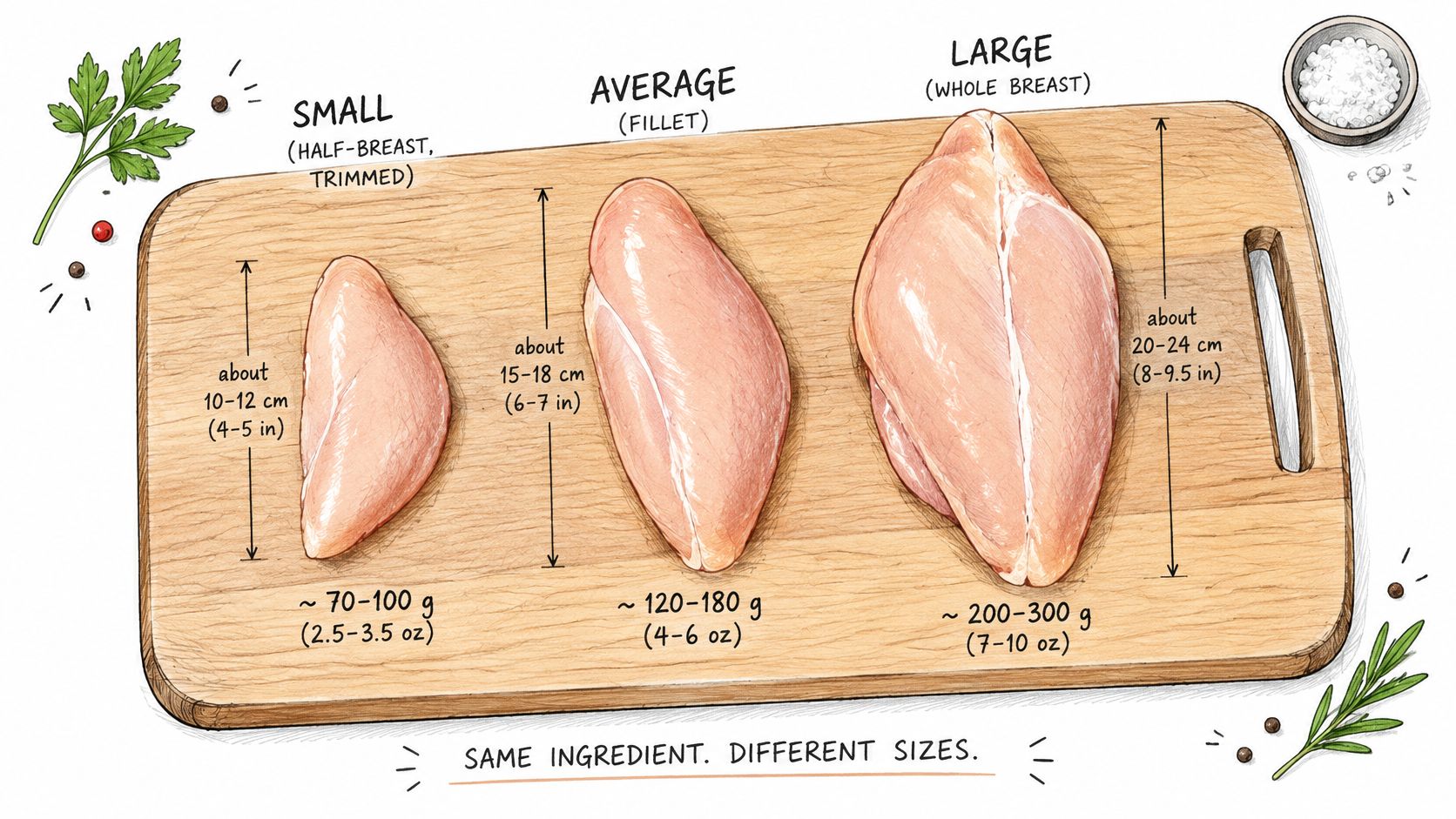
Start with thickness, then consider length and width together. A broad, flattened cutlet can look more substantial from above than a compact, thick fillet, so plate coverage alone is a weak guide to mass.
Check what the camera can't establish
Before assigning a size class, answer these questions:
- Preparation state: Is the piece raw or cooked?
- Edible portion: Does it contain bone?
- Surface and additions: Is it skin-on, breaded, or covered in sauce?
Your palm can provide a familiar reference, but it isn't a calibrated measuring tool. Hand size differs, and a fillet's thickest section may be hidden by the camera angle.
For a side-by-side comparison, think of a thin trimmed half-breast, a fuller fillet, and a thick whole-breast portion placed on the same plate. Compare their height as well as their outline rather than assigning grams from length alone.
The video provides another visual reference for judging portions.
Calibrate your eye with your own food. Estimate a piece, weigh it, and compare the result before saving the meal. If your estimate repeatedly puts similar pieces in the wrong class, use the scale rather than trying to make the visual rule more precise.
For occasional meals without a scale, a clearly identified estimate is still useful. Just don't mistake consistency of appearance for proof of weight.
How to Weigh a Breast Before You Log It
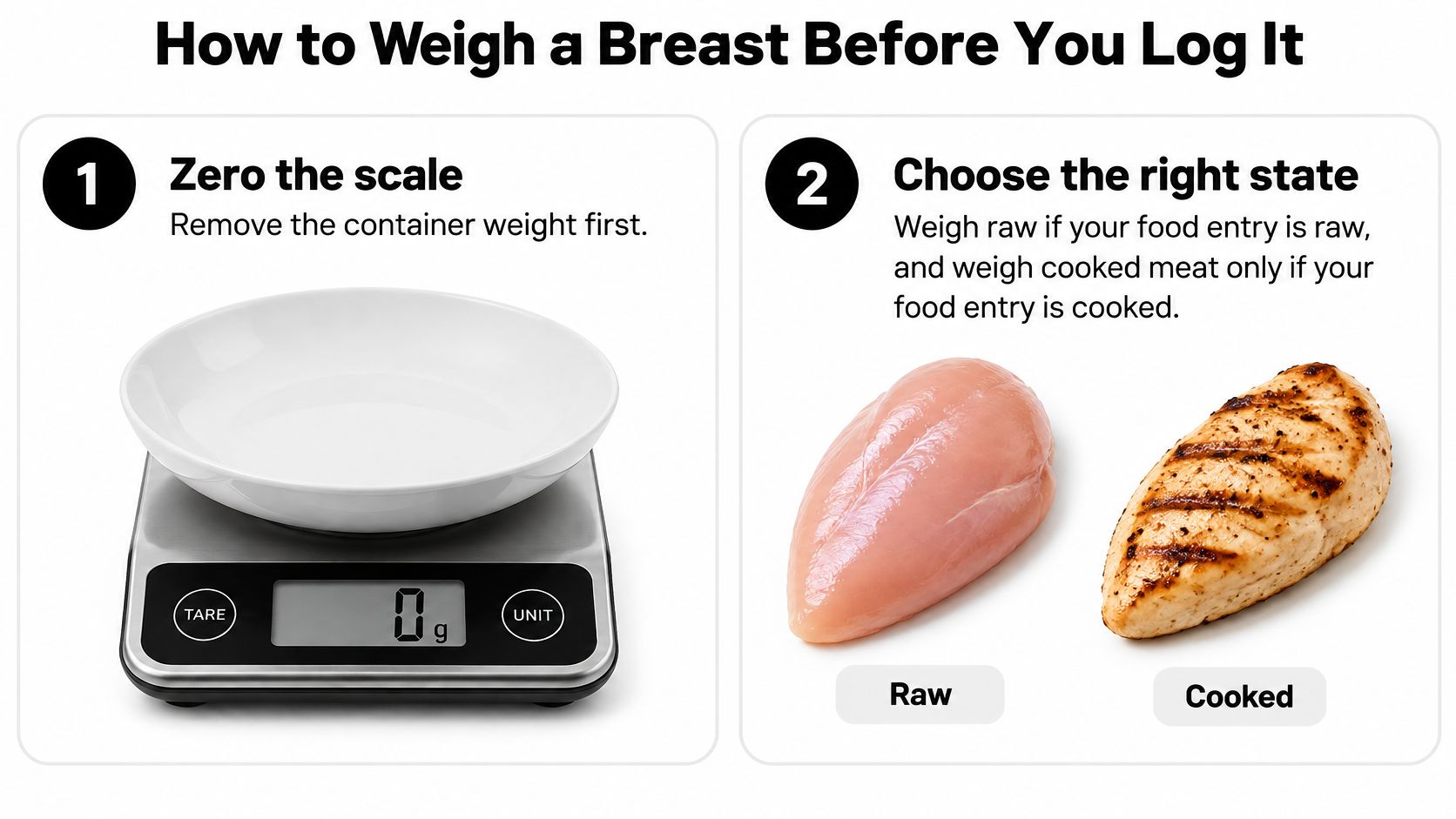
Choose the nutrition entry's state before you weigh the meat. That prevents a precise scale reading from being attached to the wrong food description.
This graphic captures the first decisions to make at the counter.
A repeatable weighing method
Zero the scale with the container in place. Put an empty plate or bowl on a digital kitchen scale and press tare, so your raw or cooked reading excludes the container.
Choose raw or cooked before selecting the entry. If you're weighing uncooked meat, select a raw entry; if you're weighing finished meat, select the appropriate cooked description.
Prepare the edible portion to match. For a raw boneless, skinless entry, remove bone and skin before weighing, rather than assigning their weight to lean meat.
Weigh cooked meat after resting. Place the edible cooked portion on the tared plate without counting pooled cooking liquid as breast meat.
Keep the preparation name visible in the log. Raw, grilled, and roasted descriptions help you verify that the entry matches what you weighed.
Enter the measured grams. Check both the amount and the serving unit, because entering a correct weight into an incorrect unit still produces a wrong portion.
Use package division only as a fallback. Divide the uncooked package's net weight by its breast count for an average raw estimate, then weigh individual pieces when their sizes differ noticeably.
According to the USDA-derived conversion examples published by Nutrify Tracker, 272 g raw becomes approximately 198 g cooked, a yield of about 73 percent, while 4 oz (113 g) raw commonly becomes roughly 3 oz (85 g) cooked. These are starting estimates, not mandatory outcomes for every cooking method.
Check yield without treating it as a target
Cooking removes mainly water, which concentrates calories and protein per gram. It doesn't mean that the smaller cooked piece has lost the same proportion of its total protein or calories.
Weighing accurately only helps when the database entry describes the food on the scale.
If your cooked result is far from the estimate, check the tare, units, trimming, and whether you included liquid. Then consider the preparation itself: moisture retention and doneness can change yield.
Don't change a genuine scale reading merely to make it fit a conversion rule. The measured edible portion should take priority over the estimated yield.
Why the Same Breast Weighs Differently
The assumption that a breast is a stable natural portion breaks down before the chicken reaches your kitchen. Breeders, processors, and retailers all influence what ends up in the package.
A 2016 review of U.S. broiler-industry data in Animal Frontiers reported that average market weight increased from 2.3 kg (5.1 lb) in 2000 to 2.8 kg (6.2 lb) in 2015, approximately 22 percent. The review also describes selection focused on breast-meat yield, helping explain why older portion expectations may not fit a contemporary large fillet.
That finding concerns whole-bird market weight, not a measured average for every retail breast. Its practical implication is narrower: don't assume a recipe's piece count guarantees your package's portion weight.
Processing changes the weight you buy
The assumption that all weight differences reflect more muscle is also unreliable. In a 2014 commercial broiler-processing study in Poultry Science, post-chill carcass weights were 2,031 g for water-chilled carcasses versus 1,899 g for air-chilled carcasses, a 132 g difference under the study conditions.
Those are carcass measurements, not a conversion factor for supermarket fillets. They demonstrate why processing and moisture can affect weight without establishing a universal correction for your dinner.
| Assumption | Why it fails | Useful correction |
|---|---|---|
| Every breast is the same cut | Retailers sell whole breasts, halves, and trimmed fillets | Read the product description |
| Package weight equals edible lean meat | Bone and skin change what the weight includes | Match the entry to the edible portion |
| Equal raw weight means identical composition | Processing and added solution can change moisture content | Prefer the specific product label |
| Older recipes define today's portion | Bird size and breast yield have changed | Weigh your own ingredient |
Product form matters as much as size
Bone contributes to the scale reading but isn't part of the breast meat you eat. Skin must either remain in the matching nutrition entry or be removed before using a skinless entry.
For products containing added solution, use the package's nutrition information rather than assuming a generic plain-meat entry is equivalent. Don't subtract an invented amount of water from the weight.
The same cut-description discipline applies when comparing breast with other poultry, including chicken thigh calories. A scale measures mass; the label tells you what that mass represents.
How Breast Size Changes Calorie Counts
Calories and protein by cooked breast weight
| Cooked weight | Calories, approximately | Protein, approximately | Size class |
|---|---|---|---|
| 85 g (3 oz) | 140 | 26.4 g | Reference serving |
| 113 g (4 oz) | 186 | 35 g | Small cooked portion |
| 170 g (6 oz) | 280 | 52.8 g | Average working label |
| 198 g (7 oz) | 326 | 61.5 g | Large cooked portion |
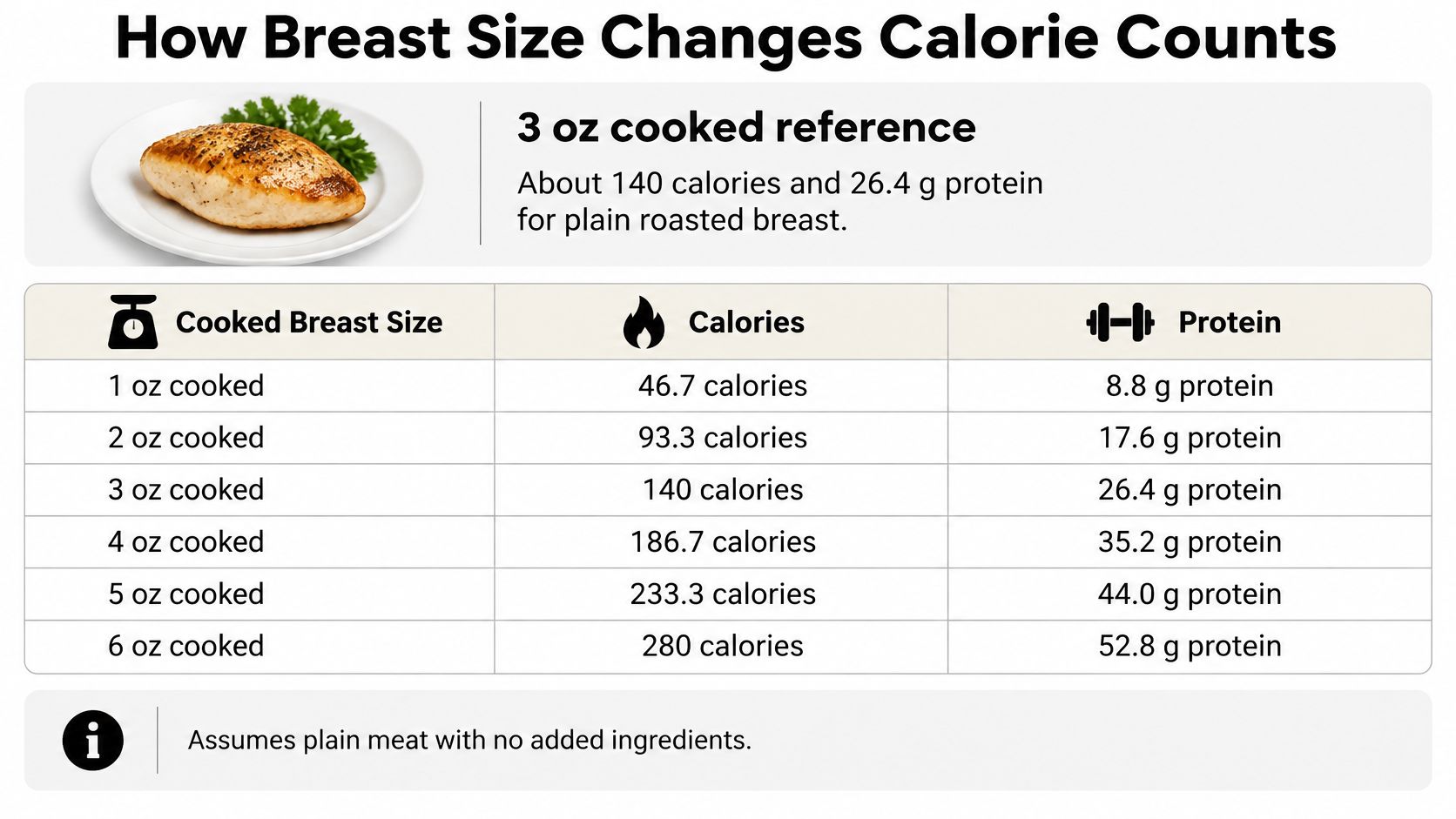
These calculated values scale by gram weight from the USDA-based plain roasted breast reference published by Nutrition Fact Label: approximately 140 calories and 26.4 g protein per 3 oz cooked, represented here as 85 g. The table assumes plain breast meat without skin, oil, breading, or sauce; rounding means ounce and gram calculations won't always agree exactly.
The chart provides a visual comparison of cooked portion sizes.
Scale the portion, not the name
Use the cooked weight to calculate the fraction of the reference portion, then multiply both calories and protein by that fraction. Keep the same reference throughout the calculation rather than combining calories from one database entry with protein from another.
The size labels are conveniences, not nutrition categories. A piece called average doesn't acquire a fixed calorie count, and a small cooked portion isn't necessarily the cooked equivalent of the small raw example in a different table.
A serving is also different from a whole breast. The National Chicken Council's nutrition guidance describes a standard chicken-breast serving as about 3.5 oz, while noting that serving size varies.
Why similar-looking pieces can log differently
Raw and cooked weights aren't interchangeable because they describe meat with different moisture concentrations. If you assign a raw entry to a cooked scale reading, the database can interpret part of the weight as water that the cooked piece no longer contains.
That's a database-matching error, not necessarily a failure to judge the piece's visible size. Improving the photo angle won't correct the preparation state.
- Find the edible cooked weight before using the cooked nutrition table.
- Choose the closest preparation description rather than the first chicken result.
- Account for additions separately unless the selected entry already includes them.
- Retain sensible rounding because reference composition and cooking yield are estimates.
The useful distinction: More calories in a larger portion doesn't mean the meat itself is more calorie-dense.
A meal photo can suggest a portion class, but it can't directly establish the water lost during cooking or the ingredients absorbed during preparation. Correct those details when you know them instead of treating the initial visual estimate as a final measurement.
Our meal photos policy is straightforward: your meal photos are used only to estimate nutrition for you.
Restaurant and Store-Bought Portions
Start with the menu, package, or product description, not the apparent size of the plate. A stated weight is only useful once you know whether it describes raw meat, cooked meat, or a finished dish containing other ingredients.
For packaged cooked chicken, use the product's own nutrition label when available. A generic roasted-breast entry may not describe a product with added solution, skin, breading, or sauce.
When a weight is available
- Check the state. Don't assume a menu's listed breast weight is the cooked weight served.
- Identify the cut. Look for boneless, bone-in, skinless, skin-on, fillet, or breast half.
- Check what the portion includes. A dish weight may include vegetables, sauce, or coating.
- Use a conversion cautiously. If only raw weight is known, treat the cooked estimate as provisional.
When the description doesn't specify the state, ask whether the weight is taken before cooking. That question is more useful than asking whether the breast is medium or large.
When the menu gives only a dish name
Choose a working size class from the meat's thickness and overall bulk, then select a cooked entry that fits the visible preparation. Keep the chicken separate from side dishes so you can adjust its portion without changing everything else.
For sliced chicken, assess the combined pile rather than the length of a single strip. For mixed dishes, such as those discussed in our guide to chicken taco calories, distinguish the meat from the tortilla, cheese, and toppings.
Don't add sauce twice if it's already included in the selected dish entry. Conversely, don't assume a plain chicken entry accounts for the restaurant's coating or finishing ingredients.
Save the most defensible estimate available, then revise it if the restaurant or package later provides a clearer weight.
Common Logging Mistakes and How to Fix Them
The most common conceptual mistake is using one breast as though it were a measured quantity. The entry can look plausible while describing a substantially different portion from the one you ate.
Use this diagnosis list before saving an uncertain meal.
Logging mistakes, their effect and the fix
| Mistake | Effect on the log | Fix |
|---|---|---|
| Using one breast as the portion | Can put the portion in the wrong size class | Weigh and log grams |
| Skipping oil, butter, or pan spray | Leaves added-fat calories out | Add each fat using its label |
| Estimating from a photo without a scale | Can misclassify portion size | Correct the portion when weight is available |
| Leaving out sauce, breading, or marinade | Omits ingredients from a plain-meat entry | Log additions separately |
| Correcting the photo but not the portion | Leaves the ingredient amount unchanged | Set the ingredient weight directly |
Separate portion errors from ingredient errors
A wrong weight and a missing ingredient require different corrections. Increasing the chicken portion to account for unlogged oil changes the estimated protein as well as calories, so it doesn't accurately represent what you ate.
For home cooking, record the fat or sauce used in the recipe and allocate it across the portions you serve. Don't assume everything poured into the pan ends up on your plate, but don't automatically treat it as absent either.
The same distinction matters for processed poultry. A prepared product described in a guide to sliced turkey breast calories needs its own label or matching entry, not a borrowed plain chicken value.
Before saving: Check the food description, preparation state, serving unit, and ingredient amount.
A photo correction is only useful if the saved ingredient reflects it. Review the resulting weight rather than assuming that changing the description also changed the portion.
For consistent tracking, choose a weighing habit you can maintain and keep the database state aligned with it. That makes comparisons across meals more meaningful than alternating between unrelated raw, cooked, and piece-count entries.
Confirm Your Breast Size and Log It Today
Chicken breasts that look similar can differ in weight and calories, especially when one is weighed raw and the other cooked. Weigh your next portion and record its preparation state to make the nutrition entry more useful.
At home, weigh the same trimmed piece or batch before and after cooking. Use those readings to estimate the yield for similar preparations, then weigh future portions in the state you plan to log.
Make the next entry easier
- At home, keep the scale near your preparation area and select an entry that matches the chicken's raw or cooked state.
- When eating out, use the menu description as a starting point and account for additions separately.
- Before saving, check the chicken's ingredient amount rather than relying on the meal name.
Calorie Genie can turn a plate photo into an estimate of calories, protein, carbs and fat, with a 1 to 10 health score and a one-line reason. Each ingredient is editable, so you can adjust the chicken portion before saving. Calorie estimates are a guide, not medical advice.
The aim is a useful record, not a universal breast size. Measure when you can, and keep the weight state consistent in your log.
Visit Calorie Genie AI to estimate nutrition from a plate photo. Check whether the chicken is raw or cooked, enter its measured portion when available, and review the other ingredients before saving.