

Massaman curry can range from 82 to 690 kcal per serving, depending on the recipe and portion. The University of Maryland nutrition label lists 82 kcal for a 4-ounce chicken serving. A separate chicken recipe in the comparison reaches 690 kcal per serving, showing how far a richer or larger portion can shift the total.
A single database entry cannot account for whether the sauce uses a small amount of coconut milk or a more generous pour, or whether the serving is a modest ladle or a deep bowl. Treat a fixed figure as a starting point, then adjust your estimate to match the ingredients and portion in front of you.
Table of Contents
- Massaman Curry Calories at a Glance
- The Ingredients That Move the Count Most
- How to Estimate Calories in Your Own Bowl
- Portion Size and Rice Change the Total
- Choosing a Version for Your Goal
- Logging Your Bowl With Calorie Genie
Massaman Curry Calories at a Glance
The name “massaman curry” doesn't predict a calorie count. The figures below range from 82 to 690 kcal, reflecting different recipes, serving sizes, and whether rice is included. Use them as reference points, not interchangeable entries.
The lightest documented example is the University of Maryland nutrition label, which lists 82 calories per 4-ounce portion, about 72 calories per 100 grams, with 1.6 grams of fat and 9.7 grams of carbohydrate. It's a small serving of an institutional recipe, so it may not resemble a restaurant bowl.
The Verywell Fit Thai-food nutrition guidance puts chicken-and-vegetable massaman at about 180 calories per cup, excluding rice or noodles. A beef recipe in the table is listed at 302 kcal, but its serving size is not stated, making it difficult to compare with the other entries.
Reading the Middle and Top of the Range
Vegetarian and chicken examples span the middle of the table. The Samsung Food chicken massaman recipe lists 444.7 calories per serving. At the richer end, the New York Times massaman curry recipe lists 596 calories per serving, based on six servings. The table also includes a chicken recipe at 690 kcal; its source and serving size are not stated, so treat it as a reported comparison rather than a directly comparable estimate.
| Version | Serving | Calories (kcal) | Context |
|---|---|---|---|
| Chicken, University of Maryland label | 4 oz (113 g) | 82 | Lean, controlled institutional recipe |
| Chicken and vegetable, Verywell Fit | 1 cup | 180 | Excludes rice or noodles |
| Beef recipe | 1 serving, size not stated | 302 | Serving size not stated |
| Vegetarian, Cleveland Clinic | 1 of 6 servings | 360 | Low-fat coconut milk, no meat |
| Beef, restaurant with Thai fried rice | 8 oz (227 g) | 390 | Rice included |
| Chicken and aubergine recipe | 1 serving | 424 | Reduced-fat coconut milk, lean chicken breast |
| Chicken, Samsung Food | 1 serving, size not stated | 444.7 | Serving size not stated |
| Recipe analyzed at 596 kcal, New York Times | 1 of 6 servings | 596 | 38 g fat, 27 g saturated fat |
| Chicken recipe, source and serving size not stated | 1 serving, size not stated | 690 | 41 g fat, 38 g protein |
| Massaman curry paste, Samsung Food | 1 serving | 165.6 | Paste alone, not a finished curry |
The Indian food calories guide offers another example of why dish names alone are not enough for comparison. Match the closest recipe and serving size, and count rice separately when it is not included.
The Ingredients That Move the Count Most
Coconut milk is the biggest lever by a wide margin. Its fat is energy-dense, so swapping a thin splash for coconut cream or full-fat milk raises the total fast without making the bowl look much bigger. That's why two curries of identical volume can sit hundreds of calories apart.
The BBC chicken and aubergine massaman recipe provides 424 kcal per serving, with 45 g protein, 20 g fat, 13 g carbohydrate, and 11 g saturated fat, using reduced-fat coconut milk, lean chicken breast, vegetables, and stock. A richer analyzed recipe reaches 596 kcal per serving with 38 g fat, including 27 g saturated fat. The gap is mostly fat, and fat carries approximately 9 kcal per gram.
A curry can look identical in the bowl and still differ by a ladle of coconut cream. Judge the sauce, not the volume.
The Rest of the Checklist
Run through these after coconut milk, since each one adds energy in a different way.
- Protein choice: Fattier beef generally contributes more energy than skinless chicken breast, so name the cut when you log.
- Potatoes: They add carbohydrate calories and soak up sauce, which means they carry fat calories too.
- Peanuts: A small handful adds fat quickly, and they're easy to underestimate when scattered on top.
- Oil for frying the paste: It disappears into the sauce, so home cooks often forget to count it.
- Sugar in the sauce: It won't dominate the total, but it nudges carbohydrate up in sweeter restaurant versions.
- Rice on the side: It's a separate item, not part of the curry figure, so it needs its own entry.
The lighter vegetarian version at 360 kcal shows the same logic in reverse, since swapping out meat and choosing low-fat coconut milk pulls the total down. If you track creamy curries often, the same coconut and protein checks apply to chicken tikka masala calories. For any recipe or menu description, check three things first: the amount and type of coconut milk, the protein, and the peanut or oil content. Those three variables explain most of the spread in massaman curry calories.
How to Estimate Calories in Your Own Bowl
Your own bowl won't match any published row exactly, so build the estimate from parts you can see and weigh. Each step below fixes one common slip, and the steps work in order.
The three core moves are separating, weighing, and logging each part on its own.
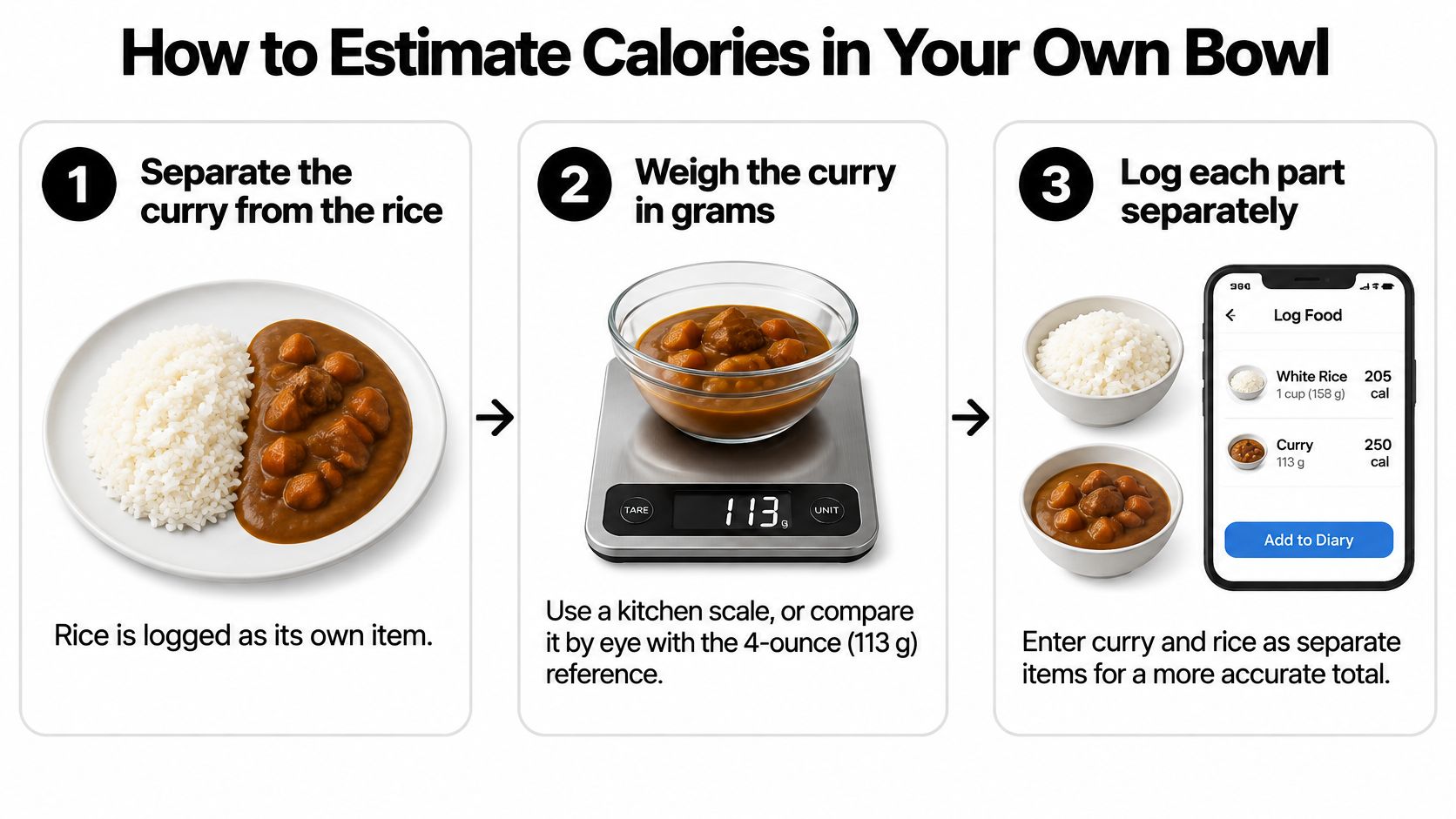
- Separate the curry from the rice on your plate, because rice is logged as its own item. The common slip is searching for one combined entry that matches neither part.
- Weigh the curry in grams with a kitchen scale, or compare it by eye with the 4-ounce (113 g) reference portion. Guessing by bowl size alone is where most errors start.
- Identify the protein, whether it's skinless chicken breast, chicken thigh, or beef, since fattier beef adds the most energy. Don't log a generic meat entry if you know the cut.
- Judge the coconut milk, because a splash of thin milk is far less than a ladle of thick cream. If you can't tell, log a range instead of one confident number.
- Count potatoes and peanuts by spoonful or handful, since both add energy quickly and hide under the sauce. A quick count before you eat beats reconstructing it afterward.
- Add the oil and sugar if you cooked it, including the oil used to fry the paste. These are the items home cooks miss most often, precisely because they're invisible in the finished dish.
- Multiply your curry grams by a calories-per-100-g density from the closest reference row. Use the lean figure of about 72 kcal per 100 g only for a lean, low-coconut curry, because it'll undercount a visibly rich one.
- Add the rice as its own entry, then sanity-check the total against the reference row you chose. If your total lands far outside the published range, recheck the weight first.
Why a Range Beats a Single Number
A range isn't a cop-out. It's an honest reflection of what you can and can't see, especially the coconut milk and oil inside the sauce. Log the midpoint for your daily total and keep the range in your notes.
Practical rule: Correct one ingredient per meal and your estimate sharpens fast. You don't need perfection on the first bowl.
The result is a starting estimate, and it gets more accurate each time you fix one ingredient. Next time you eat the same dish, you'll already know which line to adjust.
Portion Size and Rice Change the Total
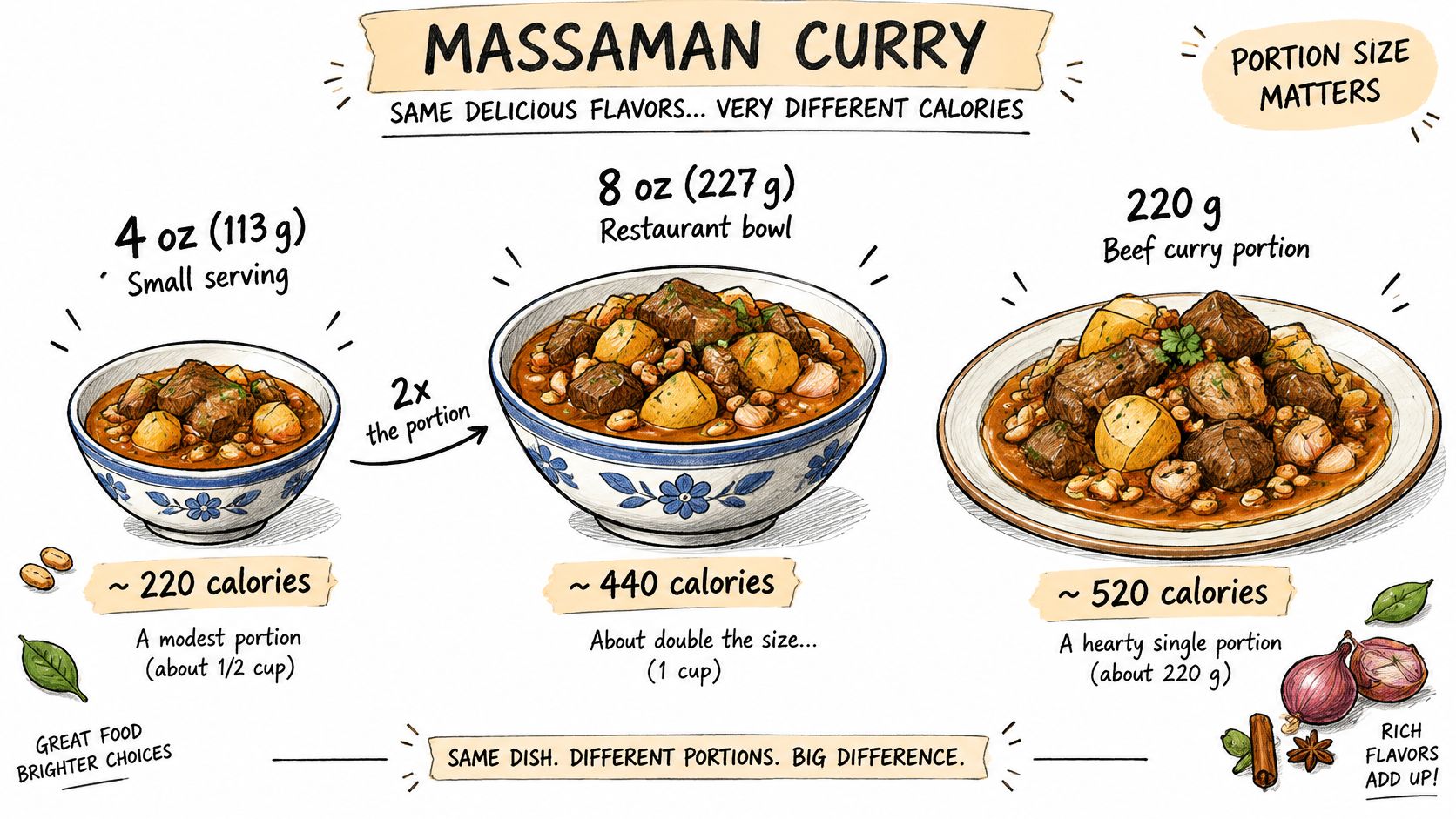
A Massaman curry bowl does not have one fixed calorie count. Portion weight alone can nearly double the total, even before rice is added.
The Cleveland Clinic lighter Thai vegetable Massaman curry recipe lists 360 kcal per serving, with the recipe divided into six servings. Each serving also has 11 g fat, 2.5 g saturated fat, 57 g carbohydrate, 5 g fiber, and 11 g protein. Those figures describe that recipe and serving size, not every curry called Massaman.
Picturing Each Portion
A 4-ounce serving is a modest ladle, with a few pieces of meat and a small amount of sauce. An 8-ounce bowl is about twice the weight, so it can contain roughly twice as much curry if its ingredients are similar. A richer or more potato-heavy version may push the calorie total higher still.
This short video shows a homemade version and gives a visual reference for the amount of sauce in a bowl.
Rice is usually served alongside the curry, so count it separately rather than treating it as part of the curry's listed calories. A weighed rice portion makes the total clearer; this guide to jasmine rice calories can help you estimate that side. Restaurant bowls vary, so a range is more realistic than a precise-looking single figure.
Choosing a Version for Your Goal
Massaman can range from a relatively light bowl to a calorie-dense one, even when both are called the same dish. The recipe comparison below shows how the balance of meat, vegetables, sauce, and portion size affects the choice.
| Version | Calories (kcal) | Protein (g) |
|---|---|---|
| Chicken and aubergine recipe | 424 | 45 |
| New York Times recipe | 596 | 35 |
| Chicken recipe, source not stated | 690 | 38 |
| Beef recipe, source not stated | 302 | 11 |
| Vegetarian, Cleveland Clinic | 360 | 11 |
The chicken recipe listed at 690 kcal has 38 g protein, while the beef recipe listed at 302 kcal has 11 g protein. Neither is attributed to Allrecipes in the comparison, so treat them as recipe-specific examples rather than representative values for all chicken or beef massaman. The New York Times recipe lists 596 kcal per serving.
Verdicts by Goal
- For weight loss: The 302 kcal beef recipe and 360 kcal vegetarian bowl are lower-calorie options in this comparison. Each provides 11 g protein, so consider how the rest of the meal fits your needs.
- For muscle-focused eating: The chicken and aubergine recipe provides 45 g protein at 424 kcal, the strongest protein-to-calorie balance among these examples.
- For a higher-calorie day: The 690 kcal chicken recipe provides 38 g protein. It may suit a meal where you want more energy, provided it fits your overall intake.
- For sodium and saturated fat: The 596 kcal New York Times recipe lists 695 mg sodium and 27 g saturated fat per serving. Those values matter alongside calories when comparing versions.
The figures are recipe estimates, not fixed properties of massaman. A smaller serving or a lighter sauce can change the total, while a larger portion can widen the gap. Choose based on the recipe's actual nutrition and serving size, not its name alone.
Logging Your Bowl With Calorie Genie
A photo estimate works best when the app can see the whole meal and you correct the lines that matter most. Here's the workflow, tied to the calorie drivers you've already met.
This is what a logged massaman bowl looks like once the estimate comes back.
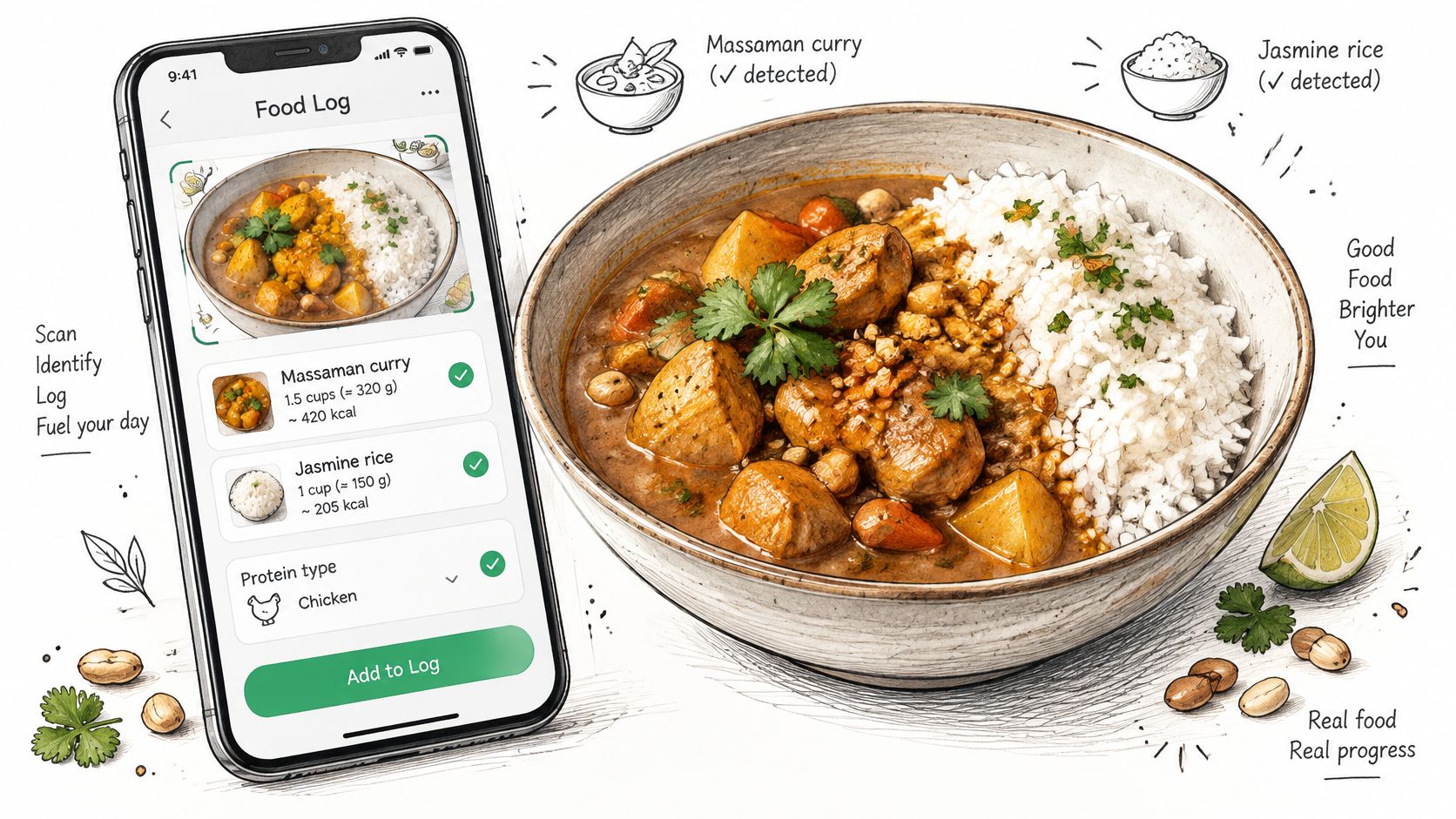
- Photograph the bowl with the rice on the same plate, so Calorie Genie sees the full meal in one shot. Shooting the curry alone forces a second entry later.
- Let the app identify each food and estimate each portion. Calorie Genie identifies each food in a photo of a plate, estimates the portion, and returns calories, protein, carbs and fat.
- Check the protein type, since chicken breast, thigh, and beef sit at different calorie levels. Tap any ingredient to correct its portion before saving.
- Describe what's off in plain words, such as cooked with extra coconut milk or the chicken was a large portion, and the estimate updates. The coconut milk correction happens at this step, and it's the highest-value fix you can make.
- Save the meal and review the breakdown across calories, protein, carbs, and fat. Compare the protein line against your goal before you close the app.
Why Two Lines Matter Most
The protein and coconut milk lines carry the largest calorie swings in this dish, so they're worth ten seconds of attention. Correcting the potato count helps, but it won't move the total like a cream correction will. Your meal photos are used only to estimate nutrition for you, and you can delete your account and data from inside the app at any time.
One correction turns a generic estimate into your estimate. The photo gets you close, and your knowledge of the recipe closes the gap.
A photo estimate is a starting value, and it improves with one correction. The final number still depends on recipe, protein, coconut milk, portion, and rice, which is exactly what you're checking. Tonight, snap your next massaman bowl with the rice on the same plate, then correct the coconut milk or protein line once and watch how the estimate changes.
Before your next Thai takeaway, download Calorie Genie free on iOS or Android and snap your massaman bowl with the rice in frame. You'll get calories, protein, carbs, and fat in seconds, then you can fix the coconut milk or protein line in plain words until the estimate matches your bowl. Start tonight at Calorie Genie AI and log your first curry in under a minute.