

The rule you'll find on every keto forum sounds complete: take total carbohydrate, subtract fiber, subtract sugar alcohols, and that's your number. It's easy to remember, it fits on one line, and on a bar sweetened with maltitol it can land about five grams off. Five grams is enough to matter on a day when everything else went right.
The rule fails because "sugar alcohol" is a category, not a substance. Erythritol, xylitol, sorbitol, maltitol, isomalt, lactitol, mannitol and the blended hydrogenated starch hydrolysates are absorbed differently, carry different calorie factors, and don't deserve identical treatment. A universal formula treats them as interchangeable, and many labels don't print the grams you'd need anyway.
Two tools fix that. A lookup table that says exactly how much comes off for each sweetener, and a six-step label read that tells you which row you're on. Get those right and the same bar can be counted whichever polyol sits inside it.
Table of Contents
- Net Carb Formula, Sugar Alcohol Rules and Label Steps
- Why Sugar Alcohols Only Partly Count as Carbs
- Erythritol, Xylitol and Other Common Sugar Alcohols Compared
- When Sugar Alcohols Cause Symptoms or Add Up
- Common Net Carb Myths About Sugar Alcohols
- Choose Your Net Carb Method and Start Tracking
Net Carb Formula, Sugar Alcohol Rules and Label Steps
Start with the arithmetic in one line. Net carbs equal total carbohydrate minus fiber minus sugar alcohols. That is a consumer calculation, not a term the Food and Drug Administration defines for labels, and it is only an estimate. The American Diabetes Association's carb-counting guide explains why: fiber and sugar alcohols differ in how much the body absorbs and metabolizes, and some polyols are partly digested, so subtracting every gram can overstate the reduction in usable carbohydrate. The association's own advice is to watch total carbohydrate and your individual glucose response rather than treating a net figure as official.
The sweetener is what decides how far the estimate can be trusted. The FDA's sugar alcohol labeling guidance assigns each polyol its own calorie factor, from 0 kcal per gram for erythritol up to 3.0 for hydrogenated starch hydrolysates, and lists the Sugar Alcohol line as voluntary unless a product makes certain claims about sugar alcohols or sugars.
| Sugar alcohol | Calories per gram (FDA factor) | Common net carb rule |
|---|---|---|
| Erythritol | 0 | Subtract all grams |
| Xylitol | 2.4 | Subtract half when over 5 g |
| Sorbitol | 2.6 | Subtract half when over 5 g |
| Maltitol | 2.1 | Subtract half when over 5 g |
| Isomalt | 2.0 | Subtract half when over 5 g |
| Lactitol | 2.0 | Subtract half when over 5 g |
| Mannitol | 1.6 | Subtract half when over 5 g |
| Hydrogenated starch hydrolysates | 3.0 | Subtract no more than half the grams |
The half-gram convention isn't arbitrary. WebMD's guide to sugar alcohols describes it plainly: when a food contains more than 5 grams of sugar alcohols, a common diabetes carb-counting approach is to subtract half the sugar alcohol grams from total carbohydrate, and erythritol is the exception where all grams come off. The 5-gram threshold is a working convention, not a legal one, so treat it as a handrail rather than a rule you can be fined for breaking.
The six-step label read
- Find Total Carbohydrate. This is your base number. Don't start from Total Sugars or from the claim on the front of the box.
- Subtract Dietary Fiber. It sits directly under total carbohydrate, usually with soluble and insoluble sub-lines you can ignore here.
- Take the Sugar Alcohol line if it's printed. That single gram count covers every polyol in the serving combined.
- If there's no sugar alcohol line, read the ingredient list. Names such as erythritol, maltitol, xylitol, sorbitol, isomalt, lactitol, mannitol or hydrogenated starch hydrolysates mean polyols are present even when the grams are missing. Flag the result as an estimate, because that line is often optional.
- Apply the rule for that specific sweetener using the table above.
- Round to the nearest gram and write the sweetener name beside the figure. The name is what makes the number reusable tomorrow.
The same bar, two sweeteners
Say a protein bar lists 30 g total carbohydrate, 5 g fiber and 10 g sugar alcohols, and the ingredients name erythritol. Thirty minus five minus ten leaves 15 g net carbs. Swap the recipe so the same bar carries 10 g maltitol instead, and the half convention applies: thirty minus five minus five leaves 20 g. Same total carbohydrate, same fiber, five grams apart, and the only variable is which polyol the manufacturer picked.
That gap is why a single formula can't be right for every product. Once you know the sweetener name and the grams per serving, the arithmetic takes under a minute. What you can't do is skip the name, because it's the difference between a figure you can defend and one you're guessing at. Mixed dishes go through the same steps, and our walkthrough of how many carbs are in a bowl of chili shows the fiber and carbohydrate lines working together on a food with no label at all.
Why Sugar Alcohols Only Partly Count as Carbs
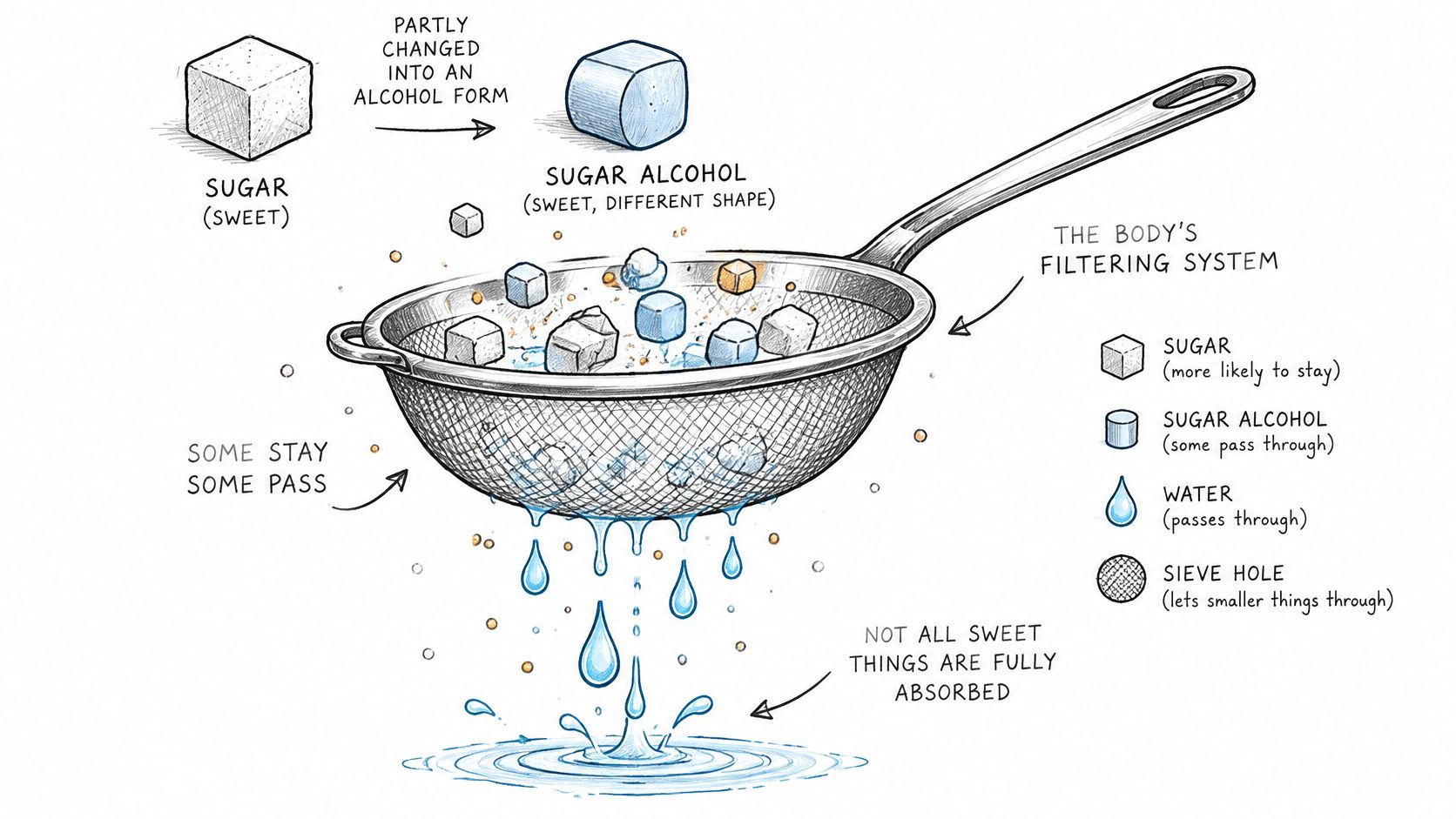
A sugar alcohol is a sugar molecule with one structural change that turns it into an alcohol form. It still tastes sweet, but your body handles it differently. Digestion works like a sieve here: pour in a cup of ordinary sugar and all of it passes through, while a cup of polyol leaves part of itself caught in the mesh.
The small intestine absorbs only a fraction of most polyols, which is why they carry fewer calories per gram than sugar's four. The FDA's Total Carbohydrate labeling materials list sugar alcohols as a separate carbohydrate category from total sugars rather than a subtype of them, and the label fields are measured separately because they behave separately. Labeling convention assigns 2 calories per gram to soluble nondigestible carbohydrate and 0 to the insoluble kind, which is the same logic the polyol factors follow.
Where the unabsorbed part goes
Whatever the small intestine turns away reaches the large intestine intact. Gut bacteria ferment some of it, producing gas and short-chain fatty acids, and the remaining polyol draws water into the bowel. That combination is the source of the bloating and loose stools people report at high intake. It's a mechanical effect, not an allergy.
The absorbed fraction is what separates the sweeteners from each other. Erythritol is largely absorbed early and leaves the body in urine mostly unchanged, so its calorie factor sits at zero. Maltitol and sorbitol are absorbed more slowly and partly metabolized, so a share of their grams behaves like ordinary carbohydrate. Every polyol lands somewhere on the line between fully counted and fully excreted, which is exactly why the label math gives each sweetener its own factor rather than one shared guess.
What this means for your count: subtracting sugar alcohols is a model of partial absorption. The model is accurate for erythritol, generous for maltitol, and somewhere in between for everything else.
The chemistry of the sweetener, not the phrase "sugar alcohol" on the package, decides how much of the food counts. If you're tracking the wider picture rather than carbs alone, our explainer on what macros are covers how carbohydrate, protein and fat targets fit together.
Erythritol, Xylitol and Other Common Sugar Alcohols Compared
Erythritol is the reference case because it's the one most low-carb products lean on. It tastes less sweet than sugar, leaves a distinct cooling sensation on the tongue, and carries the 0 kcal per gram factor that makes full subtraction defensible. That's why keto baking blends, flavored protein drinks and most "zero sugar" candy use it as the base.
Xylitol is about as sweet as sugar, which is why gum, mints and toothpaste can use it alone without a high-intensity sweetener to prop it up. Keep xylitol products away from dogs. It causes severe hypoglycemia and liver damage in dogs at doses far below anything that would bother a person.
Sorbitol is less sweet still and appears in sugar-free candy and gum, where it also keeps products moist. Maltitol comes closest to sugar in both sweetness and texture, which explains its heavy use in sugar-free chocolate and ice cream. It also raises blood glucose more than the other polyols here, so it deserves the most caution of the group.
The less common names still turn up on labels. Isomalt goes into hard candy and sugar-free cough drops. Mannitol appears in mints and tablet coatings. Lactitol shows up in chocolate and sugar-free sweets, though it's rare on US shelves.
Use this table as a lookup when an unfamiliar name appears in an ingredient list.
| Sugar alcohol | Sweetness vs sugar | Typical products | Watch for |
|---|---|---|---|
| Erythritol | Less sweet | Keto baking, tabletop sweeteners | Cooling aftertaste |
| Xylitol | About as sweet | Chewing gum, mints, toothpaste | Gas and bloating at higher intake; toxic to dogs |
| Sorbitol | Less sweet | Sugar-free candy, chewing gum | Laxative effect at higher intake |
| Maltitol | Nearly as sweet | Sugar-free chocolate, ice cream | Raises blood glucose more than most others |
| Isomalt | About half as sweet | Hard candy, sugar-free confectionery | Laxative effect at high intake |
| Mannitol | Somewhat less sweet | Mints, tablet coatings | Strong osmotic effect |
| Lactitol | Much less sweet | Chocolate, sugar-free sweets | Laxative effect at high intake |
Which name to check first
When a net carb count looks too good for the product in your hand, go to the ingredient list and scan for maltitol first. It's the sweetener most likely to sit behind a very low net figure while still pushing glucose upward, and it's common in cheap chocolate. Sorbitol and hydrogenated starch hydrolysates come next as suspects. Erythritol is usually the one that justifies the low number.
Sweetness ratings describe taste alone. The name on the ingredient list and the grams on the panel decide how a food counts; the front of the pack does not.
When Sugar Alcohols Cause Symptoms or Add Up
Sugar alcohols stop being a clean subtraction the moment they cause symptoms, and for a lot of people that happens sooner than the label math suggests. Unabsorbed polyols pull water into the bowel and ferment in the colon, which produces bloating, gas, cramping and loose stools. None of that shows up in a net carb figure.
Dose is the biggest lever. A review in the International Journal of Food Science and Technology describes a dose-response pattern in which many adults start noticing symptoms somewhere around 20 to 50 g of sugar alcohols per day, while people with irritable bowel syndrome may react at substantially lower amounts. Tolerance also varies by which polyol you ate, so the same snack can be unremarkable for one person and a bad afternoon for another.
The daily total problem
Single servings rarely cause trouble. Stacked servings do. Picture a keto day: one low-carb bar mid-morning, a second one after the gym, two coffees with a sugar-free sweetener, and a sugar-free dessert after dinner. Each item looks modest on its own label. Together they can push past the point where your gut starts complaining, and you'd have no reason to connect the discomfort to the food.
Practical rule: track sugar alcohols the way you track carbs, as a daily total rather than a per-snack aside.
Keep a short tolerance log. It takes four fields:
- The polyol name, from the ingredient list, not the category.
- Grams per serving, from the Sugar Alcohol line or your estimate when the label omits it.
- Servings, counted, including the second bar.
- Symptoms, even mild ones, with the time they started.
After two or three weeks you'll see a pattern the label can't give you: the amount of maltitol that makes your afternoon difficult, or the fact that erythritol never causes you a problem at any dose you eat.
Then set your own ceiling from that log rather than from a table. If symptoms persist, or if you're managing a digestive condition, talk to a doctor or dietitian. This is general information about how polyols behave, not medical advice specific to your situation.
Common Net Carb Myths About Sugar Alcohols
Sugar alcohols are zero carbs. They're carbohydrate, counted inside Total Carbohydrate, and most carry a real calorie factor between 1.6 and 3.0 kcal per gram. Only erythritol reaches zero.
One subtraction rule fits every product. A gram of erythritol and a gram of maltitol behave nothing alike, so a formula that treats them the same trades accuracy for convenience.
Sugar-free means carb-free. Sugar-free describes what isn't in the product. The total carbohydrate line still counts, and it can be substantial in a baked good or a chocolate bar.
Net carbs is an official label value. It's a calculation made by eaters and by brands. No regulator verifies the number, and the panel never prints it.
No sugar alcohol line means there are none inside. The grams are often optional. If the ingredients list erythritol or maltitol and the panel is silent, you're working from an estimate.
Net carbs predict your blood glucose. They predict the direction and roughly the size of a rise for erythritol. Individual responses vary enough that testing is the only reliable check for your own body.
You count the sweetener once per package. The grams apply per serving, and a small serving size can make a product look far lighter than the portion you eat.
Read total carbohydrate, the polyol name and the serving size before you trust any net figure on the front of a box.
Choose Your Net Carb Method and Start Tracking
Pick your method by what you're managing, then stop second-guessing it. If you're planning meals around diabetes, the label figure that matters is total carbohydrate, and the reading that matters is your own glucose after the meal. That pairing is what diabetes care teams work from, and it doesn't require a net figure at all.
Keeping those fields separate looks like the following in practice.

For keto or calorie tracking, apply the polyol rule that matches the sweetener in front of you, and record the sweetener name with the entry. Then do the maintenance work once a week instead of daily. Add up the sugar alcohol grams you logged across seven days and weigh that total against how your gut really felt. A week with bloating and loose stools tells you the ceiling; a week with no symptoms tells you there's room. Adjust the total, not the individual labels.
That running total becomes your tolerance log. Two people can eat the same bar and land in different places, so the log, not the front of the package, sets your personal limit.
Reading all of this off a curved label in a supermarket aisle is the tedious part, and an app earns its place right there. Calorie Genie scans a barcode or nutrition label, reads the serving size and macros, and flags the processing level, additives and nutrients worth watching, so the polyol and the carbohydrate number sit side by side where you can compare them. The app is free to download on iOS and Android, and every nutrition value it returns is an estimate and general information rather than medical advice. If you're still choosing where to keep your log, our comparison of the best counting calories apps covers how the main options handle label data.
Calorie Genie takes the label math off your hands: scan a barcode or nutrition panel and it returns the serving size, macros and the details worth flagging, so you see the carbohydrate and the sweetener together before you log the food. Your subtraction rule stays yours to set, and the app keeps both fields where you can compare them and shows when a product deserves a second look. Download Calorie Genie free on iOS or Android, or visit Calorie Genie AI to scan your first label today.